How it works
Every placement in a birth chart sits at a position in its sign, written in degrees and minutes. The Sabian chart reads it through the image of the degree it is in, counted from one: anything from 0°00′ to 0°59′ of a sign falls in its 1st degree, 19°42′ in its 20th, 29°06′ in its 30th. Lynda Hill puts the rule as adding one to the whole degrees, Astrowiki numbers the degrees the same way, and every calculator we tested agrees. Counted through the zodiac, the degrees run from Aries 1, the first, to Pisces 30, the 360th.
What the chart shows. You give your birth date, time and place. Our ephemeris engine computes the tropical natal chart, the same positions as our natal chart, and the Sabian chart takes twenty points from it. The Sun, the Moon and the Ascendant come first, as the tradition reads them first; then the Midheaven, Mercury to Pluto, the True North and South Nodes and Chiron; then, folded, the Descendant, the IC, the Vertex, the Part of Fortune and Lilith, the mean lunar apogee, the same point the natal chart shows. Each point carries its exact position ("Gemini 23°54′"), its degree ("Gemini 24", the 24th degree of Gemini), our image, keyword and keynote for that degree, and three more degrees with their images: the degree before and the degree after, which Lynda Hill reads as the placement's background and where it is heading, and the degree opposite, 180° away, offered as a reading aid.
A worked example. For a test birth on 15 June 1990 at 14:30 in Taipei the Sun is at Gemini 23°54′ and so reads Gemini 24; the Moon at Pisces 12°18′ reads Pisces 13; the Ascendant at Libra 29°07′ reads Libra 30; the Midheaven at Leo 0°07′ reads Leo 1. A commercial calculator gave the same fifteen degree numbers. In the sample chart above, the Sun at Capricorn 29°55′ reads Capricorn 30, five minutes of arc short of Aquarius 1. That closeness matters: near a whole degree a small change in the birth time, or a different ephemeris, moves a placement into the neighbouring image, which is why the chart always prints the minute beside the degree.
What was checked. The rule was tested at 26 boundary positions and on 46 births against two independent astronomy libraries and three calculators; the numbering of the 360 lines was checked against the Sabian Assembly's list of Jones's 1953 lines and against a second public list, which agree on every degree.
The words. The 360 images, keywords and keynotes are EsoTerrier's own, written on 10 October 2026 from the 1925 pictures, with the vocabulary of 1925 modernised where it has aged badly. They were checked line by line against Rudhyar's 1973 lines, Jones's 1953 lines and, where we could read it, the 1925 card wording, and reworded on 14 October 2026 wherever they came close.
Origins and history
The images are from 1925; the published text from 1953; almost everything else on the subject is a later layer.
| When | Who | What happened |
|---|---|---|
| 1887 and 1888 | Elsie Wheeler; Marc Edmund Jones | Wheeler is born in Norris City, Illinois, on 3 September 1887, arthritic from childhood; Jones in St Louis on 1 October 1888. He comes to astrology in 1913 and writes scenarios for silent films. |
| 1922 and 1923 | Jones, New York and Los Angeles | Classes at his New York home from December 1922; the study group later called the Sabian Assembly begins in Los Angeles on 17 October 1923, under Manly P. Hall's sponsorship. |
| A day in 1925 | Jones and Wheeler, Balboa Park, San Diego | In Jones's parked car, 360 cards marked on the back with a sign and degree are shuffled and laid face down one at a time; Wheeler describes a picture for each, and Jones pencils her words on the card. Four sittings of about ninety cards, all in one day. The date was not recorded. |
| 1927 and 1928 | Jones and the Assembly | Jones derives "Sabian" from the Hebrew word for hosts; the group adopts the name in January 1928. |
| 1931 | Jones, Symbolical Astrology | The first write-up, in mimeographed lessons, each degree with a little scene; Jones later withdrew it as moralised. |
| 1936 | Dane Rudhyar, The Astrology of Personality | An abridged rewording, with Jones's permission: by Jones's own account the book that first brought the symbols to notice. |
| 1938 | Elsie Wheeler | Dies in San Diego on 26 November, aged 51. |
| 1951 to 1953 | Jones, The Sabian Symbols in Astrology | After a draft of 1948 was set aside, two years' work from the pencilled cards: a 435-page book giving each degree a symbol, a commentary, a keyword and a positive and a negative reading. Registered 1 July 1953. |
| 1973 | Rudhyar, An Astrological Mandala | A second rewording, with his own keynote and commentary for each degree and a cyclic structure of his own. |
| 1980 and 1981 | Jones | Dies on 5 March 1980 at Stanwood, Washington, aged 91. The 1953 book's renewal year, 1981, passes with no renewal in the Copyright Office's records. |
| 1995 to 2004 | Lynda Hill | With Richard Hill, The Sabian Symbols as an Oracle (1995, expanded 2002) makes the symbols a divination; 360 Degrees of Wisdom (2004) adds her commentary for every degree. She reads each placement beside the degree before and after it. |
| 1998 to 2004 | Diana Roche; Robert Blaschke; Blain Bovee | Roche first reproduces the pencilled cards (1998); Blaschke reads the arc between two planets as a degree (2000); Bovee publishes a commentary (2004). |
| 2002 | Rudhyar's estate | An Astrological Mandala renewed: in US copyright to the end of 2068. |
| October 2026 | EsoTerrier | Our old 360-line table found to carry 187 of Rudhyar's lines, wrong images on about one degree in ten and some of Hill's wording; rebuilt in our own words and checked line by line. |
Jones's own account is the only one of the day itself. He said he believed the work needed the noise of a busy city round it, and that he put the cards away in a trunk afterwards, thinking them too far from the scientific astrology he wanted to practise. He also said he had not been looking for any order among the images; only when the set was complete did he find relations between the degrees, which he called a gift of chance.
The 360 degrees
Each degree has its own page: our image, keyword and keynote, how the tradition reads the picture, its neighbours as Lynda Hill reads them, the degree opposite, and where the image comes from. Open a sign to see its thirty degrees.
Variants and what we leave out
The symbols circulate in several wordings and with several methods attached. We describe them so you can recognise them, and say what we do.
- Jones's 1953 wording. The book the Sabian Assembly still uses gives each degree a symbol, a commentary, a keyword and a positive and a negative reading; the Assembly's online oracle serves the symbol and keyword only. We quote none of it, by our own decision, whatever its copyright.
- The 1925 card wording. The closest thing to Wheeler's words, as Jones pencilled them; first reproduced by Roche in 1998. Some cards differ from the 1953 book, and where they do our line follows the card's picture. Its copyright is unclear, so we use facts and short comparisons only.
- Rudhyar's 1973 version. A reworded image, a keynote and a commentary per degree, arranged in a cycle of his own. In copyright to 2068; none of it is used, and we do not show where a degree falls in his cycle.
- Hill's oracle. Her commentary, oracle meanings, keywords and a reversed reading for each degree, and her degree before and after. We use her rule for the two neighbours, with her name, and none of her text.
- The exact whole degree. A position at exactly 0′ of a degree is read by the Assembly's sunrise page as the degree before, and by Hill, every calculator and our engine as the degree after. A computed chart practically never lands on it.
- The opposite degree. A software vendor says Jones stressed the degree opposite; his 1953 entries never mention it. We show it as a reading aid only.
- Oracle use. Drawing a symbol at random, or reading the Sun's degree at sunrise or at a new Moon, is a separate practice; our chart is the natal chart only.
- Arcs between planets. Blaschke reads the distance between two bodies as a degree; that is his technique, not ours.
- Other zodiacs. Hill allows the symbols on sidereal, heliocentric and draconic positions; no authority of those systems uses them, and our other charts do not show them.
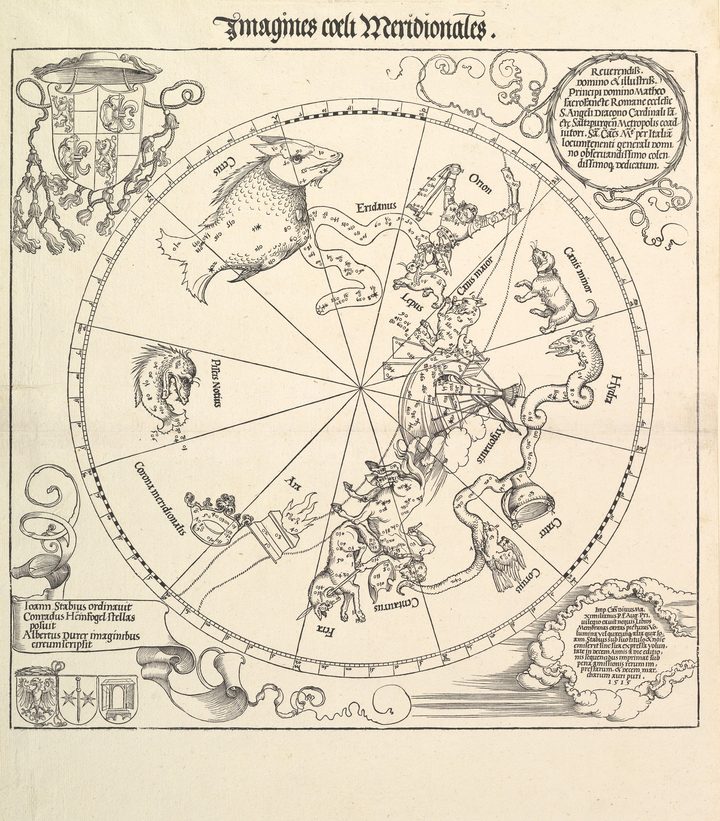
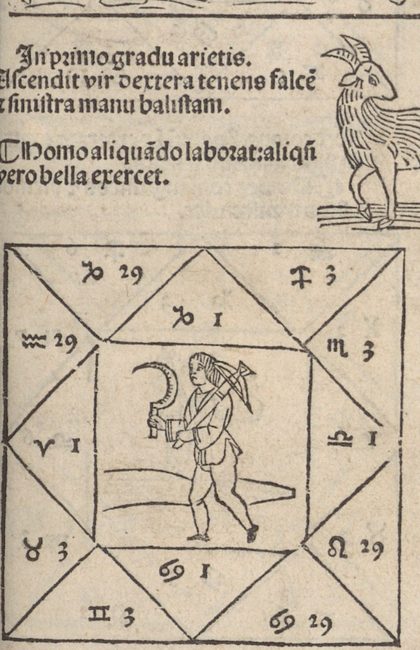
- Other sets of degree images. Charubel's and La Volasfera's images of the nineteenth century, and the much older images of the figure below, are different sets, not versions of the Sabian symbols. Not offered.
- The Mean Node, the osculating Lilith and asteroids. Our nodes are the True Nodes and our Lilith the mean apogee; the alternatives move some placements to a neighbouring degree. Some calculators add Ceres, Pallas, Juno, Vesta and Pholus. Left out.
Myths and disputed claims
What is said about the symbols, who says it, and what the record shows. The label is ours. Six more are recorded in our research: that the system's name is a registered trade mark (false: no register holds it, and the live SABIAN marks belong to a cymbal maker and a water-treatment firm), Jones's Hebrew etymology for the name (his own, unverified), the Harranians as a people of alchemists going back to the third millennium BC (unverified), that the symbols were long kept from ordinary readers by hard arithmetic (false, marketing), Jones's belief that the Sumerians came from Atlantis (legend), and famous birth charts said to confirm particular images (unverified, and picked after the fact).
-
The symbol texts on a site "preserve the absolute integrity" of Elsie Wheeler's visions: what sites print as the Sabian symbols is her own wording.
falseWho says it: Our own old page, the retired page writer's file, and most calculator sites, which print Rudhyar's 1973 lines.
What the record shows: Her words survive only as Jones's pencilled notes, some hard to read. Jones reworded them in 1931 and 1953, Rudhyar in 1936 and 1973, Hill in her books. Our lines are our own after the 1925 images, and say so.
-
The images were received clairvoyantly: Wheeler saw each one with inner vision, and neither she nor Jones knew which degree was on the card.
unverifiedWho says it: Jones's account, and every retelling since.
What the record shows: The method as Jones described it. What Wheeler experienced cannot be checked; we describe the session and make no claim about where the images came from.
-
An unseen Brother of an ancient brotherhood stood by the car and helped with the session.
told as loreWho says it: Jones's own account, retold by Roche, Hill and others.
What the record shows: Jones's belief and his story, told here as his. It is not the source of the images.
-
The session ran for about eight hours, one symbol every 80 to 90 seconds.
unverifiedWho says it: Lynda Hill's arithmetic, copied by our retired page writer.
What the record shows: The accounts give the first sitting as about two hours and the second as ninety minutes, the rest after lunch; nobody recorded the total. We say one day, four sittings of ninety cards.
-
In 830 the caliph al-Ma'mun ordered the pagans of Harran to convert, and they took the name Sabians from the Quran to be spared.
told as loreWho says it: Ibn al-Nadim's Fihrist, written about a century later, and many retellings.
What the record shows: Historians treat the story as a foundation narrative, in all probability untrue. We say only that Jones named his group after the Harranians.
-
Roman edicts destroyed the pagan temples in 389 and 529, and Harran's last temple fell to the Tartars in 1032.
falseWho says it: The retired page writer's file and Lynda Hill's site.
What the record shows: The Theodosian decrees are of 391 and 392, and 529 is the closing of the Athenian school. The Harranian temple was seized in 1031 and gone by about 1081.
-
The degree before and the degree after are part of the wheel's built-in structure, computed by our engine as an evolutionary triad.
falseWho says it: Our own old page, without naming its source.
What the record shows: It is Lynda Hill's practice, and the names Karmic Condition and Quest Degree are hers. We show the two degrees with her name.
-
Reading the arc between two planets as a Sabian degree is part of our method and a standard technique.
falseWho says it: Our own old page.
What the record shows: It is Robert P. Blaschke's technique, from his book of 2000. We do not compute it.
-
Jones's 1953 book is in the public domain in the United States.
unverifiedWho says it: Our own inference from the Copyright Office's records.
What the record shows: No renewal appears where one would have to be, which supports it, and abroad the text may be protected to 2050. We quote none of it either way.
-
Dane Rudhyar's 1973 lines are the Sabian symbols and free to print.
falseWho says it: Calculator sites and lists that print his wording, and our own old table.
What the record shows: They are his rewording, with his keynotes and commentary, renewed in 2002 and in US copyright to the end of 2068. We print none of them.
-
The wording of each symbol is settled: Jones's 1953 lines are what Wheeler said.
disputedWho says it: Implied wherever the 1953 lines are called the original.
What the record shows: The pencilled cards are sometimes hard to read, Wheeler changed some phrases during the session and Jones changed some lines for 1953: one card reads white geese where the book has wild geese.
-
A position at an exact whole degree belongs to that degree's image, not the next.
disputedWho says it: The Sabian Assembly's sunrise page.
What the record shows: Hill's own rule and every calculator we tested put it in the next degree, as our engine does. A computed position practically never lands on a whole degree.
-
Our old 360-line table gave every degree its own image.
falseWho says it: Our engine and pages before 10 October 2026.
What the record shows: Seven degrees carried another degree's image, twelve carried images that are not Sabian symbols, and two were duplicates. Fixed on 10 October 2026.
-
The symbols are purely descriptive and work as a projective test of the psyche.
unverifiedWho says it: Astrograph, Hill, and our own old page.
What the record shows: A fair account of how the tradition uses them, and our stance too; but no study supports the psychological claim. We read the images as symbols and claim nothing more.
Stories and lore
These are told as the tradition tells them.
The day in the park. Jones fetched Wheeler, who could not leave her wheelchair, from her home and drove to Balboa Park, parking where a screen of trees hid the car from a busy road. He shuffled the cards, laid each one face down and wrote in pencil as she spoke: ninety cards in about two hours, ninety more in an hour and a half, then a drive and lunch, and the last two sittings in the afternoon.
The Brother. Jones believed that an unseen member of an ancient brotherhood stood by the car with his arms folded. When he sensed a mistake in one image and asked why the Brother had not put it right, Wheeler passed on the answer that it was up to Jones.
The Sabians of Harran. Jones named his group after the star-centred pagans of Harran in upper Mesopotamia, whose astral religion outlasted several empires. From them came Thabit ibn Qurra, who led the pagans of Baghdad and commented on Euclid and Ptolemy, and al-Battani, whose tables of fifty years' observations Copernicus cited. How they came by the name is a medieval anecdote; their temple was seized in 1031 and gone some fifty years later. Jones also believed Wheeler was in touch with the astrologers of Chaldea.
The moralised version. Jones grew to dislike his 1931 write-up for moralising the images in the terms of the culture he had grown up in, asked his students to drop it, and went back to the pencilled cards for the 1953 book.
The metaphysician and the clinician. Jones brought Rudhyar to astrology through his mimeographed lessons, let him publish an abridgement in 1936, and welcomed the 1973 book as a variant of the same work. Asked to compare them, Jones called Rudhyar the metaphysician and himself the clinician.
Anybody who wishes. Jones held, as the Assembly records it, that the symbols are a fact, part of common reality, which anyone who wishes may examine and use.
Evidence and criticism
No study. We know of no empirical test of degree symbols. The standard review of about a thousand studies of astrology (Dean and others, 2022) finds effects near zero for signs, chart matching and the other tests it covers, and does not mention the Sabian symbols. The tradition itself calls them descriptive, not predictive.
What can be checked is the mapping. The degree rule is a definition, and our implementation agrees with two independent ephemeris computations and three calculators. The one real hazard is a position within a few seconds of arc of a whole degree, where two ephemerides can disagree by one image.
The text problem. The symbols have no single text. Wheeler's words survive only as Jones's pencilled notes, some hard to read; Jones reworded them twice, Rudhyar twice and Hill once, and sites print whichever version they have as "the Sabian symbols". Our own old table mixed three of those layers and carried the wrong image on about one degree in ten.
The tradition's own criticism. Jones's rejection of his 1931 commentary as moralised is the earliest criticism of the symbols from inside, and the reason the 1953 lines are the ones his organisation uses. Rudhyar's cycle is his own reading laid over the set: Jones welcomed it as a variant, and the Assembly's oracle serves image and keyword with no commentary at all, on purpose.
Our own record. Until 10 October 2026 our chart printed 187 of Rudhyar's lines as the symbols, put the wrong image on seven degrees and non-Sabian images on twelve, and our page presented Hill's degrees and Blaschke's arcs as our own method. All of that is gone, and each degree page that was affected says what was wrong.
Copyright. Rudhyar's 1973 book was renewed and is protected in the United States to the end of 2068. Jones's 1953 book shows no renewal where one would have to be, which supports its being in the US public domain, but it is protected to 2050 in Canada and Australia; the 1925 card wording, first published in 1998, may be protected to at least 2047, with no clear owner. Hill's books and site are in copyright. So we quote none of them and write every line ourselves. "Sabian Symbols" is a descriptive name that no trade mark covers.
Terms
- Sabian symbol
- The image of one degree of the zodiac, one of 360 recorded in San Diego in 1925. We say "the Sabian symbol of Gemini 24", never "a Sabian" alone.
- Degree (Gemini 24)
- A degree is named by its sign and number, "Gemini 24" or "the 24th degree of Gemini". A position is written with minutes beside it, "Gemini 23°54′", and falls in the degree it is in, counted from one.
- Absolute degree
- The degree's number in the whole zodiac, Aries 1 = 1 to Pisces 30 = 360; the sign's index times 30, plus the degree in the sign.
- Image
- Our word for the symbol line, the picture itself. Ours are EsoTerrier's own wording after the 1925 pictures.
- Keyword
- Our two to four words naming the image's theme. Jones's 1953 "keyword" is his own term for his own word, which we do not use.
- Keynote
- Our one sentence on what the image may stand for. Rudhyar's "keynote" is his term for his own sentence, which we do not use.
- Degree before and degree after
- The degrees on either side of a placement, read beside it after Lynda Hill, who calls them its Karmic Condition and its Quest Degree.
- Degree opposite
- The degree 180° away, offered on our pages as a reading aid. It is arithmetic, not a teaching of Jones's.
- Elsie Wheeler
- The clairvoyant (1887 to 1938) who described the images in 1925. "Medium" and "psychic" are the sources' words for her.
- The Sabian Assembly
- Marc Edmund Jones's study group, formed in 1923 and named "Sabian" in 1928. Not the Sabians of Harran.
- The Sabians of Harran
- A star-centred pagan community of late antique and early Islamic Harran, in upper Mesopotamia, after whom Jones said he named his group.