How it works
A Jyotisha chart starts from the same moment and place as the Western birth chart, and from the same astronomy: the positions come from NASA JPL's DE440s ephemeris through the Skyfield library. What changes is where the zodiac begins, how the houses are counted, which bodies are read, and the periods drawn from the Moon.
The zodiac and the ayanamsa. The tropical zodiac counts its signs from the March equinox, which slides westward against the stars by about 50.29 arc seconds a year, a degree in about 72 years. The sidereal zodiac counts from a point fixed among the stars instead, and the distance between the two starting points is the ayanamsa. India's national standard is the value the Calendar Reform Committee recommended in its report of 1955: "23° 15' 0" on 21st March, 1956", growing with precession. It is called Chitrapaksha after the star Chitra, Spica, which it places near the beginning of Tula, and Lahiri after the committee's secretary, N. C. Lahiri. We compute it as the true value, the mean value with the nutation added, as the Indian Astronomical Ephemeris does; it is about 24°13′ in 2026, and each sidereal longitude is the tropical one less the ayanamsa. Indian tools can differ from ours by seconds of arc in the ayanamsa, by minutes of arc in the lagna and by days in the dasha dates, because each follows its own conventions.
The lagna and the bhavas. The lagna is the rising degree, the Ascendant, in the sidereal zodiac. The houses, the bhavas, are whole signs: the lagna's rashi is the first bhava, the next rashi the second, and so round the twelve. That differs from the tropical chart's quadrant houses for most placements: in our 56 test births, 296 of 504 graha placements, 59 percent, fell in a different house.
The nine grahas. Graha means "seizer". The seven visible ones, Surya (the Sun), Chandra (the Moon), Mangala (Mars), Budha (Mercury), Guru (Jupiter), Shukra (Venus) and Shani (Saturn), are joined by Rahu and Ketu, the Moon's north and south nodes, the points where its path crosses the Sun's. We use the mean node by default, as the official Rashtriya Panchang does, and offer the true node, up to about 2° away, as an option. Uranus, Neptune and Pluto can be shown as modern additions, as Indian tools show them behind a switch.
The nakshatras and padas. The circle is also divided into 27 nakshatras, lunar mansions of 13°20′, from Ashwini at 0° Mesha to Revati, and each into four padas of 3°20′. Each nakshatra has a lord in the Vimshottari order, which runs Ketu, Shukra, Surya, Chandra, Mangala, Rahu, Guru, Shani, Budha three times round the circle. The older lists had 28, with Abhijit; the equal division leaves it out.
The navamsa. The navamsa, D9, divides the circle into 108 parts of 3°20′, one for each pada, and gives them the rashis in order from Mesha: the first part of Mesha is Mesha, of Vrishabha Makara, of Mithuna Tula, of Karka Karka, as the Brihat Jataka gives them. It is the divisional chart every Indian tool draws beside the rashi chart, and ours draws D1 and D9 side by side.
The Vimshottari dasha. The dasha is a sequence of periods ruled by the grahas in the same order, 120 years in all: Ketu 7, Shukra 20, Surya 6, Chandra 10, Mangala 7, Rahu 18, Guru 16, Shani 19 and Budha 17. It starts from the Moon: the first period belongs to the lord of the Moon's nakshatra, and only the part still to run is counted. Each period divides into nine sub-periods, antardashas, in the same order. We use years of 365.25 days and say so on the chart; 360-day and other years are also in use. The tradition reads a period as a stretch of years coloured by its lord's themes. We give the dates as the chart's arithmetic and the themes as the tradition's.
The chart forms. The chart is a square, not a wheel. The South Indian form keeps the rashis in fixed boxes, Meena at the top left and Mesha beside it, running clockwise, and marks the lagna's box with a diagonal; the North Indian form keeps the bhavas in fixed places, the first at the top, and moves the rashi numbers. We draw the South Indian form by default and the North Indian on a toggle. Neither is the more authentic.
What you read. Our chart writes the lagna, the Moon's rashi, the janma nakshatra (the Moon's nakshatra at birth) with its deity and symbol, and a line for each dasha lord, in EsoTerrier's own words, written from the meanings the tradition shares. The nakshatra's symbol is labelled as the modern tradition's, with the figure the medieval lists give beside it. The chart computes no doshas and suggests no remedies or gemstones. Without a birth time it is cast at noon and shows no lagna, bhavas, navamsa or dasha dates, and the Moon's nakshatra is hedged when it lies near an edge.
Origins and history
Jyotisha has two layers of very different age. One is a calendar science of the Sun, the Moon and the nakshatras, written down in the first millennium BCE to time the rites. The other is the horoscope, with its twelve signs and rising degree, which reached India through Greek texts in the early centuries CE and was reworked there with the nakshatras, the dashas and the divisional charts.
| When | Who | What happened |
|---|---|---|
| 2nd to 1st millennium BCE | The Vedic texts | The nakshatras as star groups: the Atharvaveda lists 28 with Abhijit, the Taittiriya Samhita and the Shatapatha Brahmana 27. The Taittiriya Samhita gives each a deity; the Kathaka Samhita's list differs for five, and has the deities used today. |
| Second half of the 1st millennium BCE | Lagadha | The Vedanga Jyotisha, a five-year calendar of the Sun and Moon for the rites. Its winter solstice at the start of Dhanishta fits about 1400 to 1200 BCE, but scholars date the text itself later, from about 700 BCE to the last centuries BCE. |
| About 400 BCE to the 1st century BCE | Babylonian and Greek astronomers | The twelve equal signs in Babylon, about 401 BCE; then in Ptolemaic Egypt the horoscope with its rising degree and its places; Hipparchus finds precession in the 2nd century BCE. |
| After 22 CE, perhaps as late as the 7th century | Yavaneshvara and Sphujidhvaja | The Yavanajataka, "the horoscopy of the Greeks": twelve signs, the Ascendant, the places, the planets' natures. Pingree dated it to 149/150 and 269/270 CE; Mak showed in 2013 that those dates rest on emendations. |
| About 505 to 587 CE | Varahamihira of Ujjain | The Pancasiddhantika, the Brihat Samhita and the Brihat Jataka, the classic of birth charts. He praised the Greeks, the Yavanas, as learned in the sciences and used Greek words in Sanskrit form. |
| About 600 to 750 CE (first part) | Attributed to the sage Parashara | The Brihat Parashara Hora Shastra: grahas, bhavas, the sixteen vargas and the dashas, Vimshottari among them. Pingree dates its first part by its ayanamsa, computed from 522 CE, and its use about 800; a commentator of 966 had not obtained it. |
| 1643 to 1898 | Copyists | Dated manuscripts of the book or of parts of it, from a copy of 1643 to some twenty more by 1898. |
| 1896/97 and 1905 | Giridhara Lala Sarman and Govinda Sarman, Bombay | An extract printed in a journal, then the first edition: the first part as an extract (saramsa), the second with Sridhara's commentary, from six named manuscripts; its preface is dated 1899. |
| 1894 | Sri Yukteswar Giri | The Holy Science: a theory of the ages tied to precession, and an ayanamsa of 20°54′36″ for 1894. |
| 1936 | B. V. Raman | Restarts The Astrological Magazine and edits it for 62 years; his books carry Jyotisha into English, and an ayanamsa bears his name. |
| 1950 | Cyril Fagan and Donald Bradley | Zodiacs Old and New and the Western sidereal school, with its own ayanamsa; Western techniques, not Jyotisha. |
| 1952 to 1955 | The Calendar Reform Committee: Meghnad Saha, chairman; N. C. Lahiri, secretary | Appointed in November 1952 to examine India's calendars, about thirty of them; its report of 1955 opens with Jawaharlal Nehru's message and recommends the Saka civil calendar, in use from 22 March 1957, and the ayanamsa of 23°15′00″ on 21 March 1956. |
| From 1908 to 1972 | K. S. Krishnamurti | The Krishnamurti Paddhati: nakshatra sub-lords with quadrant house cusps, and an ayanamsa a few minutes of arc smaller than Lahiri's. |
| 1985 | The Indian Astronomical Ephemeris | The Lahiri value restated as 23°15′00.658″ at the same epoch; the tables show it to be a true value, with the nutation, as the 1955 value was. |
| 1980s to 1990 | North American writers | "Vedic astrology" coined as an English name and spread by books such as Astrology of the Seers (1990); it reaches India in the 1990s. |
| 2001 to 2004 | University Grants Commission; Supreme Court of India | Degree courses in "Jyotir Vigyan" approved for twenty universities; the court dismisses a petition against them in 2004 without judging the subject's standing. |
| 2009 | Narlikar, Kunte, Dabholkar and Ghatpande | A controlled test of 27 astrologers in Current Science: results at chance. |
| 2026 | EsoTerrier | The Jyotisha chart built: whole-sign bhavas, nine grahas, mean nodes, the navamsa, the Vimshottari dasha and the true Lahiri ayanamsa. |
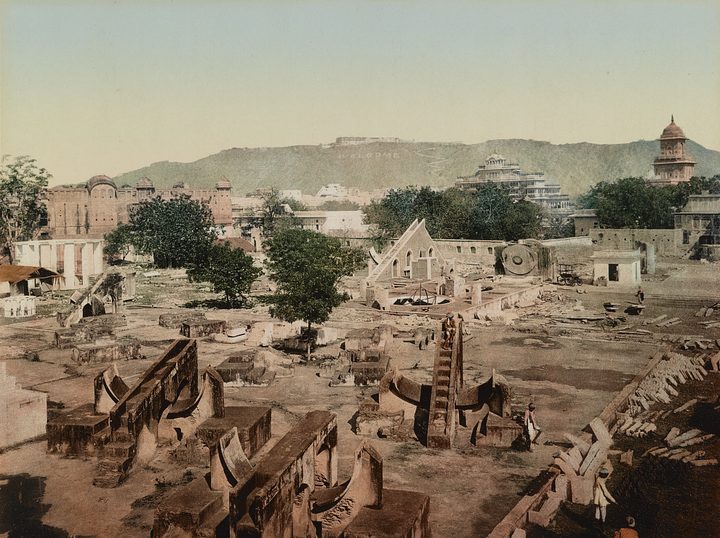
Astronomy and astrology long shared their instruments and their almanacs. The observatory in the next figure, built at Jaipur in the early 18th century under Jai Singh II, has some twenty fixed instruments in masonry for observing positions by eye; UNESCO, which listed it in 2010, describes it as serving the court's science, its keeping of time and its astrology alike.
The nakshatras, grahas and rashis
Each of the 48 has a page of its own: the 27 nakshatras with their deities and emblems marked by source, the nine grahas with their dignities as the Brihat Jataka gives them, and the twelve rashis with their shapes and natures. The lagna, the bhavas, the vargas and the dasha periods are described on this page and in the chart's readings, not on pages of their own.
Where a page gives a deity or a symbol, it says which list the item comes from: the Taittiriya Samhita's Vedic list, the Kathaka Samhita's, which agrees with the deities used today, the figures of the medieval lists, or the symbols of modern books.
The 27 nakshatras
- Nakshatra 1: Ashwini
- Nakshatra 2: Bharani
- Nakshatra 3: Krittika
- Nakshatra 4: Rohini
- Nakshatra 5: Mrigashira
- Nakshatra 6: Ardra
- Nakshatra 7: Punarvasu
- Nakshatra 8: Pushya
- Nakshatra 9: Ashlesha
- Nakshatra 10: Magha
- Nakshatra 11: Purva Phalguni
- Nakshatra 12: Uttara Phalguni
- Nakshatra 13: Hasta
- Nakshatra 14: Chitra
- Nakshatra 15: Swati
- Nakshatra 16: Vishakha
- Nakshatra 17: Anuradha
- Nakshatra 18: Jyeshtha
- Nakshatra 19: Mula
- Nakshatra 20: Purva Ashadha
- Nakshatra 21: Uttara Ashadha
- Nakshatra 22: Shravana
- Nakshatra 23: Dhanishta
- Nakshatra 24: Shatabhisha
- Nakshatra 25: Purva Bhadrapada
- Nakshatra 26: Uttara Bhadrapada
- Nakshatra 27: Revati
The nine grahas
The twelve rashis
Variants and what we leave out
- Ayanamsas. Lahiri is the Indian standard. Krishnamurti's (22.363889° on 1 January 1900) is about 4 to 5 minutes of arc less and is used by the KP school; Raman's, from a zero year of 389 CE, is about 1.5° less; Fagan and Bradley's is about 0°53′ more and belongs to Western siderealists; True Chitrapaksha holds Spica at exactly 180°, Pushya-paksha holds delta Cancri at 106°, and there are many more. We compute Lahiri only, as a true value, and name it on the chart; Krishnamurti and Raman are planned as options.
- Houses. The rashi chart is whole-sign. A bhava chalit chart with quadrant cusps is a standard second chart in Indian software, and the KP school uses Placidus cusps. We draw whole signs only, for now.
- Rahu and Ketu. Mean or true: the official almanac tabulates the mean node; some software offers both or defaults to the true one. Ours is mean by default, true as an option, both labelled.
- Chart forms. North Indian (houses fixed, common in the north), South Indian (rashis fixed, clockwise, common in the south and among Western students), East Indian or Bengali (rashis fixed, Mesha at the top centre, anticlockwise) and the Odia form. We draw South Indian with a North Indian toggle and leave East Indian out.
- Dasha systems. Vimshottari is the common one; Ashtottari of 108 years, Yogini, Kalachakra, Chara and dozens more exist, and years of 365.25, 365.2425 and 360 days are all in use. We use Vimshottari with 365.25-day years and say so.
- Vargas. The Brihat Parashara Hora Shastra lists sixteen divisional charts, from D1 and D2 to D60, each read for a different matter. We draw D1 and D9, the two every Indian tool shows together.
- Aspects. Jyotisha's aspects are counted by rashi: every graha aspects the seventh rashi from itself, Mangala also the fourth and eighth, Guru the fifth and ninth, Shani the third and tenth. Western degree aspects have no place in the chart. We draw no aspect lines; a list of drishti is planned.
- Modern planets. Uranus, Neptune and Pluto are shown by some Indian tools behind a switch and used by some practitioners. Ours returns them as optional.
- Western sidereal astrology. Fagan and Bradley's school, and Kenneth Bowser's today, use a sidereal zodiac with Western houses and aspects and none of Jyotisha's apparatus. It is a different thing, and would be a separate option.
- Left out on purpose. Doshas (and the fear sold with them), verdicts on yogas, remedies and gemstones, caste-coded attributes in matching tables, and images of deities as decoration. The almanac of the birth day, transits by rashi and nakshatra (gochara), ashtakavarga and shadbala are later work.
Myths and disputed claims
Each claim below is in our research register with its sources and our position. Others are answered in the text: that every Jyotisha tool agrees, that the 108 padas mirror the distances of the Sun and Moon (C6), that Jyotisha owes nothing to the Greeks (C11) or is only Greek astrology copied (C12), that Vimshottari is the only dasha (C15), that mean or true Rahu is the one correct node (C17), that the janma nakshatra reveals the subconscious (C20), that the padas map by mathematics onto the four aims of life (C23), that whole signs are the only houses (C29), and that Rahu and Ketu have exaltation rashis (C101).
-
"Vedic astrology" is the traditional name of the system.
falseWho says it: Common in English books and websites since the 1990s.
What the record shows: The traditional names are Jyotisha, and hora or jataka for birth charts; English writers said Hindu or Indian astrology until "Vedic astrology" was coined in North America in the 1980s. It reached India in the 1990s.
-
The Vedas contain horoscopy, so the birth chart comes from the Vedas.
falseWho says it: Many popular books and sites.
What the record shows: The Vedic texts know the nakshatras and a calendar for the rites. The twelve signs, the rising degree and the houses enter Sanskrit in the early centuries CE through Greek texts.
-
The Vedanga Jyotisha dates to 1400 to 1200 BCE.
disputedWho says it: Sites and some scholars, from the solstice the text records.
What the record shows: The solstice it records fits that age, but the text's form is later: scholars place it between about 700 BCE and the last centuries BCE. We say the second half of the first millennium BCE, with an older observation preserved in it.
-
The Yavanajataka was written in 149/150 CE and versified in 269/270, and it marks the start of horoscopy in India.
disputedWho says it: Pingree's 1978 edition, repeated widely.
What the record shows: Bill Mak showed in 2013 from newly found manuscripts that those dates rest on emendations; the text is later than 22 CE and could be as late as the early 7th century. It is the oldest Sanskrit horoscopy we can name, not a proven beginning.
-
The Brihat Parashara Hora Shastra is the work of the sage Parashara, from Vedic times.
told as loreWho says it: The text's own frame, and many astrologers.
What the record shows: The attribution is the book's literary frame. Pingree dates its first part to about 600 to 750 CE; we write "attributed to Parashara".
-
The printed Brihat Parashara Hora Shastra is an ancient text that has come down intact.
disputedWho says it: Common among astrologers.
What the record shows: Dated manuscripts run from 1643, a 10th-century commentator could not obtain the book, the first edition of 1905 printed only an extract of its first part, and the 97-chapter version most astrologers use is a translation of 1984 after a Hindi edition whose editor admitted changes.
-
The sidereal zodiac shows the sky as it really is, with the planets where they physically stand.
falseWho says it: Our own old page, a generated source file we retired, and many sidereal sites.
What the record shows: Both zodiacs measure the same positions from different starting points. The rashis are equal divisions counted from a point the ayanamsa sets, not the constellations.
-
Tropical astrology rests on an illusion about the sky.
falseWho says it: A generated source file we retired, and some sidereal sites.
What the record shows: The tropical zodiac is defined from the equinox and does not claim to follow the constellations. Each chart is a convention; we present Jyotisha in its own terms, not against the Western chart.
-
The Lahiri ayanamsa is accepted everywhere.
falseWho says it: Many sites.
What the record shows: It is India's national standard and by far the most used. The KP school, B. V. Raman's followers, Western siderealists and others use different values, up to about 2.5° apart.
-
Lahiri fixes the zodiac exactly on the star Spica at 0° Tula.
disputedWho says it: Many sites.
What the record shows: It is defined by a value at an epoch and places Spica near 0° Tula, not on it; the ayanamsa that holds Spica at exactly 180° is a different one, True Chitrapaksha.
-
The two zodiacs coincided in 285 CE.
disputedWho says it: Sidereal sites.
What the record shows: The year depends on the ayanamsa: 285 CE by Lahiri's measure, 389 CE by Raman's. Nothing happened in that year that fixed either zodiac.
-
The nakshatras are 27 constellations of 13°20′ each.
falseWho says it: Many sites.
What the record shows: They began as star groups of unequal size, 28 in the Atharvaveda; the equal division into 27 is a later convention.
-
The nakshatra deities and symbols are one fixed set handed down from the Vedas.
disputedWho says it: Modern books and sites.
What the record shows: The Vedic lists differ: the Taittiriya Samhita gives other deities than today's for five nakshatras, where the Kathaka Samhita has today's. About half the symbols match the medieval figures; the rest are modern.
-
The dasha foretells events to the day.
unverifiedWho says it: Commercial reports and some astrologers.
What the record shows: The dates move with the ayanamsa, the year length and the Moon's degree, and tools differ by days. We give the dates with their conventions and the themes as the tradition's.
-
All Jyotisha tools agree, because Lahiri is one fixed standard.
falseWho says it: A common assumption among users.
What the record shows: For our synthetic test person one widely used tool's ayanamsa was 12 arc seconds above the official value and its lagna 15 arc minutes ahead of ours; dasha dates spread over four days between tools. Each follows its own conventions.
-
The tropical chart shows the ego and the sidereal chart the soul.
unverifiedWho says it: Western writers on the two zodiacs.
What the record shows: A modern Western contrast, taught by neither tradition. We present each chart in its own terms.
-
Jyotisha is a science, as the university courses of 2001 and the Supreme Court's ruling of 2004 show.
falseWho says it: Supporters of the 2001 courses.
What the record shows: The court dismissed the petition because the University Grants Commission had broken no rule and courts do not judge syllabuses; it did not find astrology scientific. The one controlled Indian test found results at chance.
-
Doshas in the chart cause misfortune, and the chart foretells illness, wealth and marriage.
unverifiedWho says it: The classical texts as read literally, and the commercial kundli.
What the record shows: These are claims of the tradition and of its commercial reports. We compute no doshas.
-
Western sidereal astrology is the same as Jyotisha.
falseWho says it: Some Western sites.
What the record shows: Cyril Fagan and Donald Bradley's school (from 1950) uses a sidereal zodiac with Western techniques and none of the nakshatras, dashas or vargas. It is a different tradition.
Stories and lore
- The eye of the Veda. A phonetics text, the Paniniya Shiksha, makes the six auxiliary sciences the limbs of the Veda: phonetics its nose, grammar its mouth, etymology its ears, metre its feet, ritual its hands, and Jyotisha its eye, because it sees the right time for the rites. The word is cakshuh, the eye, a figure for its part in the rites and not a title.
- The churning of the ocean. When the gods and the demons churned the ocean for the nectar of immortality, the demon Svarbhanu slipped in among the gods and drank. The Sun and Moon gave him away and Vishnu cut off his head, but the nectar had made him deathless; the head, Rahu, and the body, Ketu, chase the Sun and Moon across the sky and swallow them at eclipses. The astronomy underneath is real: eclipses happen when the Sun and Moon are near the nodes.
- The Moon's wives. The Mahabharata and the Harivamsa make the 27 nakshatras the daughters of Daksha, all married to Chandra, the Moon. He loved Rohini best; their father cursed him to waste away, and the gods softened the curse to the monthly waning. The Moon's round of his wives is the month.
- The learned Greeks. Varahamihira wrote that the Yavanas, though outside the ritual order, were learned in the sciences and honoured as sages; the Yavanajataka's last verses tell that Yavaneshvara, "lord of the Greeks", turned a Greek book into Sanskrit and Sphujidhvaja put it into verse. The two may be one person or two.
- Parashara's book. The Brihat Parashara Hora Shastra presents itself as a dialogue in which the sage Parashara, father of Vyasa, teaches his pupil Maitreya. Its first part is dated by Pingree to about 600 to 750 CE, after Varahamihira, and the commentator Bhattotpala wrote in the 10th century that he had not been able to obtain it.
- The book in print. The editor of the first edition, printed at Bombay in 1905, had only an extract of the first part and asked his readers in the preface for a complete copy. Sitaram Jha's Hindi edition followed, with changes its editor admitted, and then R. Santhanam's English translation in 97 chapters (1984), the version most astrologers now cite.
- The committee. In November 1952 the astrophysicist Meghnad Saha was set to examine India's calendars, about thirty of them. The committee's secretary, Nirmal Chandra Lahiri, gave his name to the ayanamsa it fixed, and the 1955 report opens with Nehru's message of 18 February 1953, hoping that "our Scientists will give a lead in this matter".
- The name that went east. "Vedic astrology" was coined in North America in the 1980s and carried to India in the 1990s, where it began to replace "Hindu astrology" in English.
Evidence and criticism
- The Indian test. In 2008 Jayant Narlikar and three colleagues collected the birth charts of 100 children judged intellectually bright and 100 with intellectual disabilities, in Pune, and invited astrologers to tell them apart. Of 51 who took part, each sent 40 charts at random, 27 returned judgments; 28 correct were needed to beat chance, and the best scored 24. An institution that judged all 200 scored 102. The results were at chance throughout. It is the only controlled test of Jyotisha we found. The Western tests found the same for the Western chart, and the scientific consensus is that astrology is a pseudoscience.
- The universities. The University Grants Commission's decision of 2001 to fund degrees in "Jyotir Vigyan" at twenty universities drew a petition from scientists led by P. M. Bhargava. The Supreme Court dismissed it in 2004 because the Commission had broken no rule and courts do not set syllabuses, which settles nothing about the subject's standing.
- The scholarship. The historians' debate is about transmission and dates, not about validity. Pingree traced a Greek source behind the Yavanajataka; Mak redated it on manuscript evidence; Ohashi, Parpola and Plofker argue for Indian elements in the calendar astronomy; and the Brihat Parashara Hora Shastra's history is a problem of textual criticism that the tradition rarely raises.
- The tradition's own debates are about the ayanamsa above all, the Calendar Reform Committee's value against Raman's, Krishnamurti's, True Chitrapaksha and more than forty others, then about the node, the dasha year, quadrant against whole-sign houses, and the modern planets. Users check their nakshatras against several tools, which is why our values must match the Indian ephemeris.
- What our validation shows. With the true ayanamsa our sidereal Sun and Moon equal the official Rashtriya Panchang to its rounding of 1 arc second, over 351 days of the year 1948 Saka, and our mean Rahu equals its "Rahu (Mean)" within 0.6 arc second. Other tools differ from ours and from each other by seconds of arc in the ayanamsa, minutes in the lagna and days in the dasha dates. Agreement with the ephemeris shows that the chart applies the convention it names.
- Tone. Literal translations of the classical texts, as some commercial reports print them, can call a person weak, penniless or deceitful from a single placement. Our texts are written not to.
Terms
- Jyotisha
- Jyotiṣa, the astral science of India: calendar astronomy, astrology and the reading of omens. Often called Vedic astrology in English, a name of the 1980s; earlier English books said Hindu or Indian astrology.
- Rashi
- One of the twelve signs of the zodiac, an equal 30° in the sidereal zodiac, from Mesha (Aries) to Meena (Pisces). Not the constellation of the same name.
- Lagna
- The rising degree, the Ascendant, and the rashi it falls in; the first bhava of the chart.
- Bhava
- A house of the chart. In the rashi chart each bhava is a whole rashi, counted from the lagna's.
- Graha
- Literally a "seizer": one of the nine bodies the chart reads, the Sun, Moon and five visible planets with Rahu and Ketu, the Moon's nodes.
- Nakshatra
- A lunar mansion: one of 27 equal parts of the circle, 13°20′ each, named after a group of stars near it. The older lists have 28, with Abhijit.
- Pada
- A quarter of a nakshatra, 3°20′; there are 108, each the size of one navamsa.
- Varga
- A divisional chart: the rashi chart (D1), the navamsa (D9) and others; the Brihat Parashara Hora Shastra lists sixteen.
- Ayanamsa
- The distance between the tropical and the sidereal starting points, growing by about 50.29 arc seconds a year. India's standard is Lahiri's (Chitrapaksha).
- Dasha, mahadasha, antardasha
- A period ruled by a graha. In the Vimshottari dasha the nine mahadashas fill 120 years, and each divides into nine antardashas.
- Drishti
- A graha's aspect, counted by rashi: every graha aspects the seventh rashi from itself, and Mangala, Guru and Shani others besides.
- Vakri
- Retrograde: a graha that appears to move backwards. Rahu and Ketu always do.
- Kundali
- The birth chart, also janma kundali or janam patri.
- Janma nakshatra
- The nakshatra of the Moon at birth. It starts the Vimshottari dasha, gives the first syllable of a name in many families, and is used to choose times.
- Muhurta
- An auspicious time chosen in advance for an undertaking, and the branch of Jyotisha that chooses it.
- Panchanga
- The almanac of the five limbs of each day (weekday, lunar day, nakshatra, yoga and karana); India's official one is the Rashtriya Panchang.