How it works
The draconic chart is not cast from anything new. It starts from the ordinary natal chart, the tropical chart of the birth moment, and changes one thing: where the zodiac begins. In the natal chart 0° Aries is the spring equinox; in the draconic chart it is the Moon's North Node, the point where the Moon's path crossed the Sun's path going north at the time of birth. Practitioners call the result a draconic zodiac, after the old name of the nodes, the dragon's head and tail.
The rotation. Every point's draconic longitude is its natal longitude minus the Node's, counted round the circle. For the sample person in Figure 1, the True Node stood at Pisces 5°18′ (335.31°) and the Sun at Capricorn 29°55′ (299.92°): 299.92 minus 335.31 is −35.39, which round the circle is 324.61°, so the draconic Sun is Aquarius 24°36′. The same subtraction moves every planet, angle and house cusp by the same amount, and the North Node itself lands on 0° Aries, the South Node on 0° Libra. Our engine sets the two nodes to those values directly: done by subtraction alone, the arithmetic of the computer left the South Node at 179.999° on about one birth in fourteen and labelled it "Virgo 30".
What stays the same. Because everything turns together, a planet in the natal tenth house is still in the tenth house, and two planets 90° apart are still 90° apart. The houses and the aspects of the draconic chart are the natal ones; only the signs differ. Astrodienst, Olliver, the Australian Academy's tutorial and yesastrology all keep the natal houses this way, and so do we: the twelve cusps turn with the planets. On our 46 test births every point kept its natal house.
What is new. If the aspects inside the draconic chart are the natal aspects, the technique's content has to lie elsewhere, and its writers place it in the comparison of the two charts: where a draconic point falls on, or opposite, a point of the natal chart. Olliver calls these inter-chart aspects and the reading a "synastry of self"; Crane speaks of alignments. Our chart lists every draconic point conjunct or opposite a natal point within 3°, marked exact within 1°, among the Sun to Pluto, Chiron, the Ascendant, the Midheaven and the North Node, never a point with itself, closest first. Olliver rates conjunctions and oppositions far above any other contact between the charts and uses natal orbs, and Crane's examples are exact alignments; 3° and 1° are our practical reading of those sources, and the chart says so. Pairs that involve the Sun, Moon, Ascendant, Midheaven or Node are marked as the ones practitioners take first.
The anchors. The chart leads with three points: the draconic Sun, Moon and Ascendant, each beside its natal sign. Each has a one-line reading in our own words, written in October 2026 from the way draconic astrologers frame these three, and worded as their view. When the draconic and natal signs agree, the chart says the sign is the same.
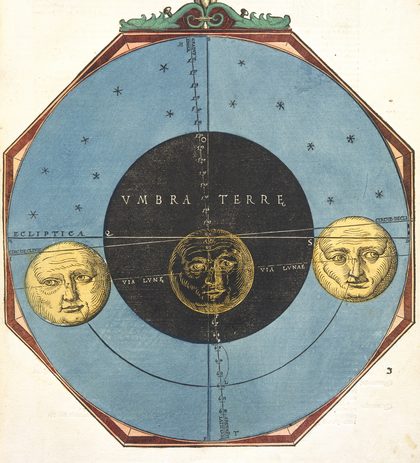
The node. There are two ways to place the Node, and the tradition has no rule between them. The True Node is the ascending node of the Moon's orbit at that moment, which wobbles; the Mean Node is its average, which moves steadily backward. They differ by up to about 2° (1.95° at most between 1950 and 2050). Crane, Olliver, Astro Gold and astro-seek use the True Node; Elwell and Rudhyar used the Mean, augurine's calculator turns by it, and Solar Fire follows the user's own setting, its manual noting that astrologers are split about evenly. Because the whole chart moves by the difference, at least one of fifteen points changed sign in 34.6 percent of 3,000 moments we simulated. So the chart names the node it used, computes the other one for the same moment, and lists the points whose sign would change. The True Node is the default.
What you enter, and what we compute. Your birth date, clock time and place. Positions come from our own ephemeris engine, Skyfield on NASA JPL's DE440s, with Placidus houses (Porphyry beyond the polar circles): twenty points, the Sun to Pluto, Chiron, the four angles, both nodes, the Part of Fortune, the Vertex and Lilith, the mean apogee of the Moon as in the natal chart. On 46 births our natal longitudes agree with an independent Skyfield computation to under half a second of arc for the planets and nodes and to about thirty seconds for the angles, and with astronomy-engine within its own accuracy; all 644 draconic signs agree with both. On a test birth our result is identical to yesastrology's True Node chart, and the Mean Node points of augurine agree with ours to 0.1°. That checks the arithmetic, and only the arithmetic.
Origins and history
The dragon is old; the chart is from the second half of the twentieth century.
| When | Who | What happened |
|---|---|---|
| First millennium BC and after | Babylonian, Indian and Persian astronomers | Eclipses are understood to happen near the two points where the Moon's path crosses the Sun's. In India the points become the shadow planets Rahu and Ketu; in Persian tradition the dragon Gozihr spans the sky, its head at the ascending node and its tail at the other. |
| 9th to 12th centuries | Arabic astronomers and astrologers | The eclipse dragon, al-Jawzahr from its Persian name, is treated as an eighth body; its head (ra's) and tail (dhanab) are the nodes. |
| 12th to 17th centuries | Latin astrologers; William Lilly, 1647 | Caput Draconis and Cauda Draconis come into Europe from the Arabic. Lilly's Christian Astrology gives the Head as fortunate and the Tail as its contrary. |
| 1950 and 1951 | Cyril Fagan, Zodiacs Old and New | A section on "The Draconic 'Zodiac'", opening with a Babylonian myth and arguing that the Babylonians reckoned the planets from the nodes. The earliest use of the term we have found. |
| Undated, said to be the late 1950s | An astrologer named Froger | A "nodal horoscope" with the Node on the Ascendant, recorded in a 1985 dictionary. The article said to have introduced it has not been found. |
| 1963 | Ronald C. Davison, Astrology | Reads an example chart in a lunar zodiac beginning at the North Node. |
| September 1977 | Dennis Elwell, Astrological Association conference, Cambridge | A talk on the draconic zodiac, published that winter in The Astrological Journal as "Multi-dimensional Transits", citing Fagan. Elwell measured from the Mean Node. |
| 1977 | Ronald C. Davison, Synastry | Recommends the "Nodal or Draconic Zodiac" for comparing charts and credits it to two European astrologers who had proposed it some years before. Calling Davison the technique's founder, as some recent posts do, overstates his part. |
| 1981 and 1982 | Pamela Crane | Speaks on draconic astrology at the Astrology World Congress in Zurich and starts the book; founds her college of horoscopy in part to teach it. |
| 1987 | Pamela Crane, Draconic Astrology; Elwell, Cosmic Loom | The first book on the technique, using the True Node; Elwell writes of the nodal or draconic zodiac in his own book the same year. |
| 1989 | Pamela Crane | A "Current Draconic" directed chart, and four-ring charts that set heliocentric, tropical, draconic and sidereal side by side. |
| 1990s | Astrology software | Draconic charts added to the main programs, by Crane's account; Astrodienst offers a draconic chart and a natal-draconic bi-wheel. |
| 2000 and 2013 | Pamela Crane, The Draconic Chart | The fuller book, revised in 2013: natal work, synastry, forecasting, rectification and horary. |
| 2017 and 2021 | Maria Blaquier | An article for The Astrological Journal, reposted by Astrodienst, with a 5° orb for the contacts. |
| 2022 | Victor Olliver | An article for Astrodienst's Timelords and the book Chasing the Dragons: the ground rules, and the choice of node left to the astrologer. |
| 2026 | EsoTerrier | The engine rebuilt on 10 October: the houses kept, the contacts, both nodes, the readings, the nodes pinned; 46 births checked. |
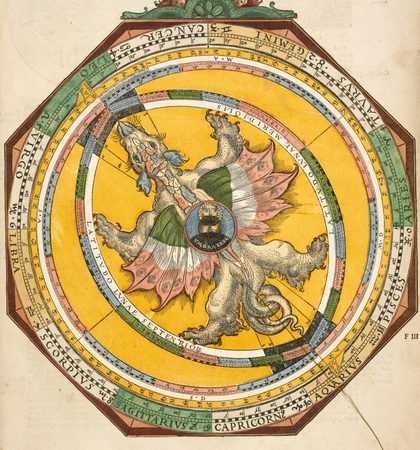
From fortune to past lives. The medieval and early modern astrologers read the nodes as fortune and misfortune, not as a chart of their own. William Lilly, writing in English in 1647, gives the Head of the Dragon as "of the nature of Jupiter and Venus, and of himselfe a Fortune", and the Tail as "cleane contrary to the Head; for he is evill when joined with good Planets, and good when in conjunction with the malignant Planets". He adds from his own practice that the Tail made the evil planets worse. The reading of the nodes as past and future lives, which most draconic writing now takes for granted, is modern: historians of astrology find it nowhere much more than a century back. Rudhyar's 1936 book, often named as its source, treats the nodes as poles of integration and disintegration.
Who started it. Elwell's Cambridge talk is where Crane dates her own work from, and she and Olliver credit him. Fagan had the term in 1950, Davison had read charts from the Node in 1963 and credited the idea to two European astrologers, and a nodal horoscope by an astrologer named Froger is on record without a date. Who Davison's two astrologers were is still open; so is whether Froger's article exists. We say what each source shows and no more.
Reading the two charts
This system has no pages of its own for signs or planets, and that is deliberate. A draconic chart is made of the natal chart's own elements, its signs, planets and houses, which belong to the natal chart; what it adds is a rotation and a list of contacts between the two charts, not a fixed set of placements. Here is how its practitioners read it, in their terms.
The draconic chart as an older layer. Draconic astrologers read the turned chart as a layer beneath the natal personality. Crane and Olliver describe it as the soul's chart, and Crane as a summary of lives lived before this one; the Australian Academy's tutorial reads it the same way. That is the tradition's frame, and on EsoTerrier it is always given as theirs: nothing shows that a chart records a soul or its past lives, and Olliver himself writes that the work does not need a belief in reincarnation.
The anchors first. Practitioners begin with the draconic Sun, Moon and Ascendant and set each beside its natal sign. Our chart gives a line for each, in our own words, after the way draconic astrologers frame them: the draconic Sun as what they take the soul to be organised around, the Moon as an inherited emotional baseline, the Ascendant as a native bearing. For the sample person the draconic Sun falls in Aquarius, beside a natal Sun in Capricorn, and our line reads: "Draconic astrologers read a draconic Sun in Aquarius as a soul organised around independence: in their view it came in to think freely, serve the group and change what no longer works."
Then the contacts. Where a draconic point falls on or opposite a natal one, practitioners read the two points together, and they treat this list as the heart of the technique. The sample person has six: draconic Mercury exactly on the natal North Node, draconic Mars on natal Jupiter, draconic Uranus and Saturn on the natal Sun, and the draconic Moon and Chiron opposite it. A chart with no contact within 3° is common, and the chart says so plainly.
Beside the natal chart, never instead of it. The draconic chart is read with the natal chart, not as a replacement, and always with its node named, since a reading that does not say which node it used cannot be checked.
Variants and what we leave out
Draconic practice varies in its node, its orbs, its houses and what it reads. We describe the variants so you can recognise them, and say what we do.
- Mean Node charts. Elwell and Rudhyar used the Mean Node; augurine and astrolium turn by it; Solar Fire uses whichever node the astrologer has set. We offer it as the alternative and list the points that change sign.
- The South Node at 0° Aries. No authority we found uses it. Left out.
- Rotating the houses. One site, draconicchart.com, turns the houses as well on its outer wheel and its own help pages say this differs from other sites. Every authority keeps the natal houses; so do we.
- Orbs. Blaquier uses 5°, Brignone 2° as Blaquier reports it, Olliver his natal orbs, and Crane's examples are exact. We use 3°, marked exact within 1°, and say so.
- Readings for every draconic planet, and dignities. Olliver compares the dignity of each planet in the two charts; augurine gives sign readings for the draconic Sun and Moon. We read only the three anchors.
- The natal house of the draconic Sun. An observation of Mark Penfield's, which Crane came to accept. Our engine gives the house of every point; a reading of it is not offered.
- Progressions, solar arcs, returns, transits and synastry in the draconic zodiac, and Crane's Current Draconic chart and four-ring charts: real techniques, offered by astro-seek and described by Crane and Olliver. Out of scope for a natal chart.
- Sabian symbols on draconic degrees. Lynda Hill allows them; no draconic authority or calculator we tested uses them. Our engine stopped on 10 October 2026.
- Equal houses. Olliver uses Equal houses for draconic work and calls the house system a personal choice. We keep Placidus, as in our natal chart.
- Vedic Rahu and Ketu. The Indian names of the nodes belong to a different system with its own doctrine. Not a variant of the draconic chart, and not read here.
- The name. Draconic charts are free to name: no trade mark in astrology or publishing covers "draconic", "draconic chart" or "nodal astrology", and programs are named here only to say what they do.
Myths and disputed claims
What is said about the draconic chart, who says it, and what the record shows. The label is ours.
-
The Moon's nodes are the head and tail of the chaos dragon of the Babylonian creation epic, so the draconic chart comes down from Babylon.
falseWho says it: Our own old page, its page writer's file and many draconic blogs; the dragon framing goes back to Fagan.
What the record shows: The epic, the Enuma Elish, has Marduk split the dragon to make sky and earth and set the stars and the Moon; it says nothing of the nodes. Composed in the late second millennium BC, its earliest copy is of the 9th century BC. The eclipse dragon of the nodes is Indian, Persian and Arabic.
-
The draconic chart is ancient: an undercurrent that ran beneath Hellenistic astrology.
falseWho says it: Our retired page writer's file and calculator sites.
What the record shows: Nothing before 1950 uses a chart with the Node at 0° Aries. The technique dates from Fagan's chapter (1950), Elwell's essay (1977) and Crane's book (1987); the dragon names of the nodes are medieval.
-
The Babylonians measured the planets from the Moon's nodes.
unverifiedWho says it: Cyril Fagan (1950), repeated by Elwell (1977).
What the record shows: An inference opened with a myth, not a report of a nodal chart. No cuneiform horoscope measured from the nodes is known to us; Olliver, the technique's own advocate, calls it reasonable but not conclusive.
-
The draconic chart shows the soul, its purpose, its karma and the lives before this one.
unverifiedWho says it: Crane, Olliver, the Australian Academy tutorial and most draconic writing.
What the record shows: The tradition's way of reading the chart, not a finding: nothing shows that a chart records earlier lives, and Olliver writes that belief in reincarnation is not needed for the work. On this page it is always the tradition's view.
-
The nodes have always meant the past life and the future one.
disputedWho says it: Most modern writing on the nodes.
What the record shows: The medieval doctrine is fortune and misfortune: Lilly (1647) makes the Head "of himselfe a Fortune" and the Tail its contrary. Historians of astrology date the past-life reading to roughly the last century.
-
Dane Rudhyar tied the nodes to past lives in 1936.
unverifiedWho says it: A Reddit history thread and a blog, via our retired page writer.
What the record shows: His Astrology of Personality makes the North Node a pole of integration and the South Node of disintegration; we found no passage linking the nodes to past lives.
-
Ronald Davison formalised draconic astrology in the 1970s.
disputedWho says it: A Substack post and search summaries drawn from it.
What the record shows: Davison read a chart from the North Node in 1963 and recommended the "Nodal or Draconic Zodiac" for comparing charts in 1977, but he credits it to two European astrologers, not himself.
-
The first modern nodal chart was Froger's "The Nodal Horoscope", in the Astrological Lodge's journal in the late 1950s.
unverifiedWho says it: A history blog and a Reddit thread, with no issue or page.
What the record shows: A 1985 dictionary attests a nodal horoscope proposed by an astrologer named Froger, with the node on the Ascendant rather than at 0° Aries. The article, its date and its venue are unconfirmed.
-
The draconic chart has houses of its own, an inner layer to be read over the natal houses.
falseWho says it: Our old page and its page writer's file; one website rotates the houses.
What the record shows: The cusps turn with the planets, so every point keeps its natal house. Astrodienst, Olliver, the Australian Academy tutorial and yesastrology all keep the natal houses.
-
The True Node is the real one and the Mean Node an inferior approximation.
disputedWho says it: Our old page and its page writer's file.
What the record shows: Both are conventions. Crane and Olliver use the True Node, Elwell and Rudhyar used the Mean, and Solar Fire's manual says astrologers are split about evenly. A third of charts change at least one sign between them.
-
Draconic-to-natal contacts should be taken within 5°.
disputedWho says it: Maria Blaquier (2017), taken over by our retired page writer.
What the record shows: Blaquier uses 5°, Brignone 2°, Olliver his natal orbs, and Crane's examples are exact. A looser convention, not a wrong one; ours is 3°, exact within 1°, and the chart says so.
-
Reading the Sabian symbol of each draconic degree is standard practice.
unverifiedWho says it: Our old engine; Lynda Hill allows it.
What the record shows: Permitted by Hill, but no draconic authority or calculator we checked does it. Our engine stopped on 10 October 2026.
-
Draconic overlays of the British royal family's charts demonstrate fated ties between them.
unverifiedWho says it: A practitioner's tutorial, copied by our retired page writer.
What the record shows: Illustrations by a practitioner, not evidence: any two charts give some contacts within an orb.
-
Draconic charts strip away the ego's illusions and expose the hidden pattern of a person's fate.
falseWho says it: Our own old page and its retired page writer.
What the record shows: Marketing language with no basis, removed in October 2026; claims about fate and the person's inner life as fact are against our rules.
Stories and lore
These are told as their tellers tell them.
The dragon that eats the Sun and Moon. In Indian myth the demon Rahu is beheaded while drinking the gods' nectar and lives on as a head that swallows the Sun and Moon at eclipses, with Ketu as the tail. In the Persian Bundahishn the dragon Gozihr stretches across the sky between the Moon's two nodes, head to the east and tail to the west, and at the end of time falls to earth and melts the metal of the mountains. Arabic astronomers took the name over as al-Jawzahr, and the Latin West as Caput and Cauda Draconis. This, and not the Babylonian creation epic, is where "draconic" comes from.
Fagan's Babylonians. Cyril Fagan, the Irish astrologer who founded Western sidereal astrology, opened his 1950 section on the draconic zodiac with a Babylonian myth in which Marduk set the Great Dragon's head at the Moon's ascending node, and argued that the Babylonians had measured the planets from the nodes. Elwell repeated the story in 1977; Olliver, writing for Astrodienst in 2022, judged it good reasoning but not conclusive without charts or documents.
Cambridge, autumn 1977. Pamela Crane, then assistant editor of The Astrological Journal, met the draconic chart at the Astrological Association's conference in Cambridge in September 1977, the autumn in which Chiron was discovered. Elwell's talk became his essay "Multi-dimensional Transits", and her interviewer calls it the starting point of all her draconic work.
Crane's tree. Crane pictured her four charts as one tree: the heliocentric chart the roots, the draconic the trunk, laid down over earlier years and, as she put it, earlier lives; the tropical the crown, where this year's growth happens; and the sidereal the tree's dealings with its surroundings.
Elwell's cloister. Elwell read his own Saturn square Uranus in "draco" Sagittarius and Pisces as monastic, and wondered aloud whether he had once practised astrology in a monastery. He also held, against most draconic writers after him, that the draconic layer lies nearer the surface of the mind than the tropical one.
Evidence and criticism
No study. We know of no empirical test of draconic charts. The standard review of a thousand studies of astrology, Dean and his colleagues' Understanding Astrology (2022), reports effects near zero for tests of signs, chart matching and the like and does not discuss the draconic chart.
What can be checked is the arithmetic. The rotation is a definition, and our implementation of it agrees with two independent ephemeris computations on 46 births and with two calculators on a test birth. The only fault we found was the South Node's rounding, fixed on 10 October 2026.
The node decides the signs. The tradition has no rule for the node: Crane and Olliver use the True Node, Elwell and Rudhyar the Mean, Solar Fire leaves it to the astrologer. About a third of charts change at least one sign between the two, so a draconic reading that does not name its node cannot be reproduced.
Past lives and the nodes. That the draconic chart records earlier lives is a belief of its practitioners, and Olliver writes that the work does not depend on believing it. Historians of astrology date the past-life reading of the nodes to roughly the last century; before that the Head was a fortune and the Tail its contrary.
The Babylonian origin is a guess. The technique's own writers weigh Fagan's argument and find it not conclusive.
The tradition disagrees with itself. On Equal or Placidus houses (Olliver: a personal choice); on rotating the houses (one website against everyone else); on orbs, from exact to 5°; and on whether the draconic chart is the inner or the outer ring of the bi-wheel: Astrodienst puts it outside, AstroConnexions inside, and Crane drew both.
Our own earlier page. Until October 2026 our page and its page writer said the nodes were a Babylonian dragon, the technique ancient, the draconic chart a house system of its own, the True Node the only real one and the chart a key to fate. Each is a card above, and none is on this page as fact.
Terms
- Draconic chart
- The natal chart turned so that the Moon's North Node stands at 0° Aries. The name we use; "draconic astrology" is the practice of reading it.
- Draconic zodiac
- The frame of the draconic chart: twelve signs of 30° counted from the North Node, in place of the spring equinox. Fagan's term, 1950.
- North Node
- The point where the Moon's path crosses the ecliptic going north, the ascending node; the South Node is the point opposite. Always "the Moon's North Node": a point of an orbit, not a body.
- True Node
- The ascending node of the Moon's orbit at the moment of birth, which wobbles. Crane, Olliver, Astro Gold and astro-seek use it; our default.
- Mean Node
- The node averaged over time, moving steadily backward. Elwell and Rudhyar used it; up to about 2° from the True Node.
- Natal
- The chart as cast, untouched. Olliver calls it the tropical chart; the two words mean the same here.
- Cross aspect
- A draconic point on (conjunct) or opposite a natal point. Olliver's words are "inter-chart aspect" and "synastry of self"; Crane speaks of alignments.
- Exact
- Our mark for a cross aspect within 1°. The 3° and 1° orbs are our practical reading of Crane's and Olliver's examples.
- Anchors
- Our word for the three points the chart leads with: the draconic Sun, Moon and Ascendant, each beside its natal sign.
- Bi-wheel
- The natal and draconic charts drawn as two rings on one zodiac. Astrodienst puts the draconic chart outside, AstroConnexions inside; Crane drew both.
- Dragon's Head and Dragon's Tail
- Caput Draconis and Cauda Draconis, the medieval names of the North and South Nodes, from the Arabic al-Jawzahr and the Persian Gozihr. "Draconic" means "of the dragon".
- Other names
- "Nodal astrology" (Olliver), "draco" and "draconitic" (Elwell), "Nodal or Draconic Zodiac" and "lunar zodiac" (Davison). Rahu and Ketu are the Indian names of the nodes, not draconic terms.