How it works
A natal chart is a map of the sky for one moment, seen from one place: the moment of a birth and the place it happened. The tradition draws it as a wheel. Around the rim run the twelve signs of the zodiac; inside, the twelve houses divide the sky as it stood above and below the local horizon; the Sun, the Moon and the planets sit at their positions; and lines across the middle join the pairs that stand at certain angles to one another, the aspects.
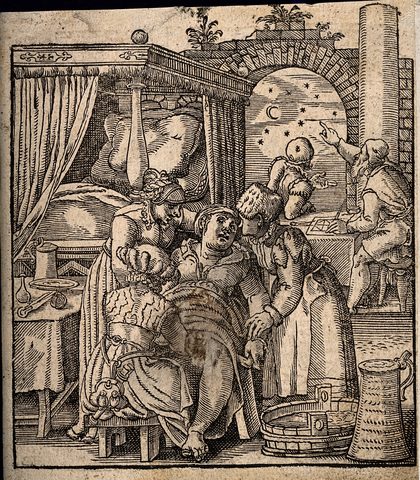
The signs. The zodiac is the band of sky along the ecliptic, the Sun's yearly path, cut into twelve equal signs of 30°. The tropical zodiac counts them from the March equinox: 0° Aries is where the Sun stands as northern spring begins, and each sign keeps its place in the seasons. The signs take their names from constellations near them but are not the constellations, which are star figures of unequal size. The equinox also slides slowly against the stars, about 1° in 72 years, the drift astronomers call precession, so a zodiac counted from the stars now differs from ours by about 24°.
The planets. In the tradition's usage "the planets" are the Sun and Moon, the two luminaries, with Mercury, Venus, Mars, Jupiter and Saturn, the five known since antiquity. Modern astrology added Uranus (found in 1781), Neptune (1846) and Pluto (1930). We also show Chiron, a small body found in 1977, and say that it is a modern addition.
The houses. The houses turn with the Earth. They are counted from the Ascendant, the degree of the zodiac rising in the east at the moment of birth, which moves about a degree every four minutes; this is why the chart needs a birth time and a place. Opposite the Ascendant sets the Descendant; the Midheaven is the degree culminating on the meridian, and the IC lies opposite it. How the sky between these four angles is divided has many answers. We use Placidus by default and offer Whole Sign and Equal houses with one tap; above the polar circles, where Placidus cannot be computed, we use Porphyry and say so on the chart.
The aspects. Two bodies are in aspect when the angle between them along the zodiac is close to one of the classic distances: 0° (conjunction), 60° (sextile), 90° (square), 120° (trine) or 180° (opposition). The chart also lists the 150° quincunx. How close counts is the orb, and orbs differ from school to school. Ours are 10° for a conjunction, square, trine or opposition, 6° for a sextile and 3° for a quincunx when the Sun or Moon is one of the pair, and 8°, 4° and 2° otherwise; Chiron, the North Node, the Ascendant and the Midheaven take half of these, and never from one another. Within a quarter of a degree an aspect is marked exact, and each is labelled applying or separating from the two speeds.
The points. The lunar nodes are where the Moon's path crosses the ecliptic; we show the true North Node, labelled, and the South Node opposite it. Lilith, in our chart, is the mean apogee of the Moon's orbit, an empty point and not a body. The Part of Fortune is a lot counted from the Ascendant: Ascendant plus Moon minus Sun by day, reversed by night, with day and night decided by the Sun's height above the horizon at the birth place. The Vertex is a twentieth-century point where the prime vertical meets the ecliptic in the west. The South Node, Lilith, the Part of Fortune and the Vertex take no aspects.
How we compute it. The birth date, the clock time to the minute, the place's latitude and longitude and the time zone in force there at the time (from the IANA history) give one instant in universal time. The engine reads apparent positions from NASA JPL's DE440s ephemeris through the Skyfield library, with the IAU 2000A nutation, and interpolates Chiron from JPL Horizons. In our validation over 56 births every planet fell within 0.7 arc second of an independent computation, the same class of accuracy as the software most astrologers use, and the houses, points and aspects followed the stated conventions. Those checks show that the positions match astronomy. They say nothing about whether a chart describes anyone; that question is under Evidence and criticism below.
Without a birth time the chart is cast for noon and says so. The Moon can then be as much as 7° from where it really was, so its sign is uncertain when it sits near a boundary, and there is no Ascendant, no Midheaven and no houses to read.
What else the chart names. The chart ruler, which is the traditional ruler of the rising sign, with the modern co-ruler named beside it for Scorpio, Aquarius and Pisces; whether the birth was by day or by night; the Moon's phase as one of the eight phases Dane Rudhyar named in The Lunation Cycle (1967), labelled as his; each body's decan, and whether it is out of bounds, beyond the Sun's farthest declination; and the traditional dignities of the seven classical planets: domicile, exaltation, detriment and fall. The readings beside the chart are EsoTerrier's own words, written in 2026 from the shared symbolism of the tradition, and they describe tendencies, never events.
Origins and history
The chart as we draw it is about 2,100 years old; its pieces are older. Babylonian scribes recorded sky omens for their kings, divided the ecliptic into twelve equal signs about 400 BCE and cast the first birth horoscopes; in Ptolemaic Egypt, in the last two centuries BCE, these met the Egyptian decans and Greek geometry, and the result was a chart counted from the rising degree. The tradition passed through Greek, Arabic and Latin textbooks to the Renaissance, lost its place in the universities, and was remade twice in the twentieth century, first as an astrology of character and then by a revival of the old texts.
| When | Who | What happened |
|---|---|---|
| 2nd millennium BCE | Babylonian scribes | Celestial omens for the king and the state are gathered in the series Enuma Anu Enlil; the star catalogue MUL.APIN follows about 1000 BCE. |
| 29 April 410 BCE | A Babylonian scribe | The oldest surviving birth horoscope: a clay tablet listing the planets' positions for a birth. Such texts run on to the 1st century BCE. |
| 409 to 398 BCE | Babylonian astronomers | The ecliptic is divided into twelve equal signs of 30°, probably within a few years of 401 BCE: the uniform zodiac that both later zodiacs inherit. |
| 2nd century BCE | Hipparchus | Finds that the equinox moves against the stars by comparing Spica with older records: precession, now known to run about 1° in 72 years. |
| Late 2nd to 1st century BCE | Authors writing under the names Hermes, Nechepso and Petosiris | In Ptolemaic Egypt the Babylonian zodiac, the Egyptian decans and Greek geometry become horoscopic astrology: the horoskopos, or hour-marker, and the twelve places counted from it, the aspects and the lots. |
| 1st century CE | Dorotheus of Sidon; Marcus Manilius | Dorotheus's verse textbook, which survives in Arabic, and Manilius's Latin poem Astronomica. |
| About 152 to 188 CE | Vettius Valens | The Anthologies, the largest practitioner's book of the tradition, with more than a hundred example charts; the source of the day and night reversal of the Lot of Fortune. |
| 2nd century CE | Claudius Ptolemy | The Tetrabiblos gives the tradition its best-known rationale, from Aristotelian physics, and counts the zodiac from the equinox; the planets' natures, the aspects and the dignities. |
| 4th century CE | Julius Firmicus Maternus | The Mathesis, eight books in Latin, among the late-antique textbooks. |
| 8th to 11th century | Masha'allah, Abu Ma'shar, al-Biruni and others | The Arabic synthesis of Greek, Persian and Indian astrology; Abu Ma'shar's Great Introduction (848) argues for astrology on Aristotelian principles. |
| 1133 to 1140 | John of Seville, Hermann of Carinthia, Plato of Tivoli | Latin translations of Abu Ma'shar and of the Tetrabiblos bring the tradition back to Europe. |
| About 1277 | Guido Bonatti | The Liber Astronomiae, the largest Latin textbook of the 13th century; Dante puts its author in the Inferno. |
| 1496 | Giovanni Pico della Mirandola | The Disputationes adversus astrologiam divinatricem, the Renaissance's great attack on judicial astrology, published after his death. |
| 1601 to 1619 | Johannes Kepler | Argues for a reformed astrology of aspects in three books and adds new aspects, such as the quintile; casts more than 800 horoscopes. |
| 1602; 1650s | Giovanni Antonio Magini; Placidus de Titis | The first confirmed publication of the house division later named for Placidus, who promoted it. |
| 1647 | William Lilly | Christian Astrology, the English textbook of the tradition, with the houses, orbs and dignities. |
| 18th century | Astrology leaves the universities as Newtonian science removes its rationale. | |
| 1890s to 1917 | Alan Leo | Modern Astrology and a long run of textbooks; turns the reading of a chart from events to character; convicted of fortune-telling in 1917. |
| 24 August 1930 | R. H. Naylor, Sunday Express | A horoscope for the newborn Princess Margaret leads to Britain's first regular newspaper astrology column. |
| 1936 | Dane Rudhyar | The Astrology of Personality: astrology as insight rather than prediction, drawing on Jung's psychology. |
| 1952 | C. G. Jung | Publishes a statistical experiment on married couples' charts and judges it inconclusive. |
| 1960s; 1971 | Walter Koch | The Koch house system; its tables appear in English in 1971. |
| 1976 | Liz Greene | Saturn: A New Look at an Old Devil; with Howard Sasportas she later founds the Centre for Psychological Astrology. |
| 1 November 1977 | Charles Kowal | Announces the discovery of Chiron; astrologers take it up in the 1980s. |
| 1985 | Olivia Barclay; Shawn Carlson | A facsimile of Lilly's Christian Astrology starts the traditional revival in Britain; in Nature, a double-blind test of astrology. |
| 1993 | Robert Schmidt, Robert Hand, Robert Zoller | Project Hindsight begins translating the Greek and Latin sources; whole-sign houses and the lots return to practice. |
| 2017 | Chris Brennan | Hellenistic Astrology, the survey that took the revival to a wide readership. |
| 2021 | Ryan Park and colleagues at JPL | The DE440 and DE441 ephemerides, the planetary data our engine reads. |
| 2026 | EsoTerrier | The chart rebuilt: positions validated to under one arc second, the Vertex and the Part of Fortune corrected, house systems and the mean points added. |
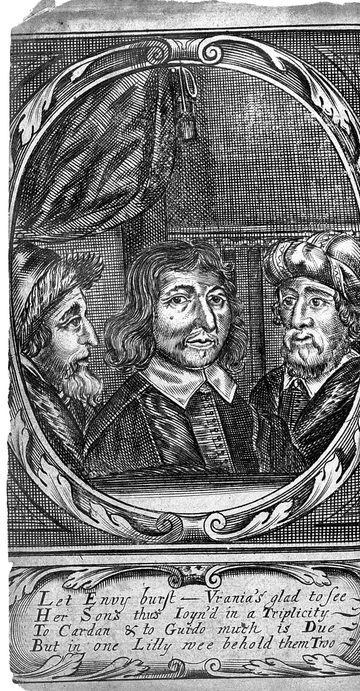
The line from Leo to Rudhyar matters for how the chart is read today. Leo argued in court in 1917 that he described tendencies, not events; Rudhyar built an astrology of personality on that turn and on Jung's ideas; Liz Greene's generation made it the mainstream. Jung himself used horoscopes in his practice but founded no school of astrology. The revival since 1985 reads the old texts again, and whether the psychological or the traditional reading is the true art is still argued.
The signs, bodies, points, houses and aspects
Each has its own page: what it is, how it is computed, how Ptolemy, Valens, Lilly and the modern schools read it, our own keywords labelled as ours, and the claims made about it. They are listed in the engine's order, by kind. The planet-in-sign and planet-in-house readings are in the chart itself.
The twelve signs
The Sun, the Moon, the planets and Chiron
The nodes, Lilith, the Part of Fortune, the Vertex and the two angles
The twelve houses
- House 1: self and approach
- House 2: values and resources
- House 3: communication and learning
- House 4: home and roots
- House 5: creativity and play
- House 6: work and routines
- House 7: partnership
- House 8: intimacy and shared resources
- House 9: belief and travel
- House 10: vocation and public life
- House 11: friends and community
- House 12: solitude and retreat
The five major aspects
Variants and what we leave out
The commonest question about any birth chart is why two tools give different charts. The answer is almost always one of these conventions.
- House systems. Whole Sign is the oldest, the Hellenistic places, in disuse in the West from about the 10th century and revived since the 1980s and 1990s. Equal houses divide from the Ascendant; Porphyry, first described by Valens, and Alcabitius trisect the quadrants; Campanus and Regiomontanus divide space; Placidus and Koch divide time. Placidus is the most used in modern Western astrology, Koch is popular among German speakers, and Whole Sign leads in the Hellenistic revival. We default to Placidus, offer Whole Sign and Equal, fall back to Porphyry above the polar circles, and have left Koch, Regiomontanus, Campanus and Alcabitius out for now. A planet can change house between systems: between Placidus and Whole Sign a median of twelve of sixteen objects moved in our test charts.
- Tropical or sidereal. Western astrology counts the signs from the equinox; Jyotisha, and the Western sidereal school of Cyril Fagan and Donald Bradley, count them from a point among the stars, about 24° back by Lahiri's measure in 2026, the Indian national standard fixed by the Calendar Reform Committee of 1955. Neither is the "real" sign: they measure the same sky from different starting points, and many tools offer both. We draw the Jyotisha chart separately, with its square layout, whole-sign houses, nine grahas and nakshatras. The oldest surviving Sanskrit horoscopy, the Greek-derived Yavanajataka, has been redated by Bill Mak to after 22 CE and possibly as late as the early 7th century.
- The node. True (osculating) or mean: astro.com shows the true node, Astro-Seek and the Indian ephemerides the mean, and the two differ by up to about 2°. We show the true node, labelled "(true)", and use the mean node in the Jyotisha chart.
- Lilith. Three things carry the name: a second moon that Georg Waltemath claimed in 1898, which Sepharial called Lilith in 1918 and which was never confirmed; the asteroid 1181 Lilith, found in 1927; and the Black Moon, the Moon's apogee, an empty point whose French name Lune noire goes back to Dom Neroman's book of 1937. The apogee comes as a mean point and an osculating ("true") one that swings about 30° around it. We show the mean apogee as "Lilith (mean)" and compute neither the asteroid nor the hypothetical moon.
- The Part of Fortune. Ptolemy used the day formula "both by night and day" (Tetrabiblos III.13, in Ashmand's 1822 translation), and Lilly did the same in 1647; Valens and Dorotheus reversed it for night births, as astro.com does by default. We reverse at night, decide day or night by the Sun's altitude, and name the formula used.
- The Vertex. A twentieth-century point: Charles Jayne, testing L. Edward Johndro's "electrical ascendant", found the opposite point more sensitive, and Johndro confirmed it before he died in November 1951. Neither astro.com nor Astro-Seek draws it by default; we show it in the table and with the points toggle.
- Chiron and the asteroids. Some schools use Ceres, Pallas, Juno, Vesta and the other centaurs. We show Chiron and no other small body.
- Orbs. Lilly gave each planet its own orb and counted an aspect as begun within half the sum of the two, "the moyity of both their Orbs" (1647). astro.com's default is a flat 10°, 6° for the sextile; its classical style and the Astrowiki scale the orb by planet; CHANI counts aspects by whole sign. Ours, chosen in 2026 to cut clutter, sits between the flat and the classical styles and is printed with every chart.
- Minor aspects. Kepler's quintile and biquintile, the semi-sextile, the semi-square and the sesquiquadrate. We compute the quincunx and no other minor aspect.
- Rulers. The traditional seven rulers, with Uranus, Neptune and Pluto as modern rulers of Aquarius, Pisces and Scorpio. That came in stages: John Varley gave Uranus Aquarius in 1828, Alan Leo in 1899 still wrote of Neptune as "supposed to govern Pisces", and Pluto was listed for Scorpio by 1936; the traditional revival keeps the old rulers. We name the traditional ruler as chart ruler and the modern co-ruler beside it.
- Techniques we do not compute. Transits, progressions, solar returns, synastry, midpoints, the other lots, zodiacal releasing and annual profections, fixed stars, and the term and face dignities. The Sabian symbols and the draconic chart are separate pages built on the same positions.
Myths and disputed claims
The chart attracts more confident claims than any other system on this site, from both its friends and its critics. Each card gives the claim, who makes it and what the record shows; the full list is in our research.
-
Astrology is 5,000 years old.
disputedWho says it: Popular histories, app copy and some practitioners' books.
What the record shows: Omens are recorded from the 2nd millennium BCE, but the twelve equal signs date from about 400 BCE, the oldest birth horoscope from 410 BCE and the chart with an Ascendant and houses from the 2nd or 1st century BCE: about 2,100 years.
-
Nechepso, Petosiris and Hermes Trismegistus invented horoscopic astrology.
told as loreWho says it: Firmicus Maternus in the 4th century, the Hellenistic texts themselves and many sites.
What the record shows: The texts under these names were written in Ptolemaic Egypt in the 2nd or 1st century BCE. The art did arise there, from Babylonian, Egyptian and Greek pieces; its named founders are literary.
-
Ptolemy purged astrology of superstition and made it a rigorous science.
disputedWho says it: Popular accounts of the Tetrabiblos.
What the record shows: He gave the tradition its best-known rationale, from Aristotelian physics, and left out much of the lot-based practice; but he was one author among several, and the practitioners' tradition went on beside him.
-
Kepler validated the aspects, proving that harmonious angles act on the air and the mind.
falseWho says it: Popular histories of astrology, and our retired page writer.
What the record shows: Kepler argued for a reformed astrology of aspects in 1601, 1610 and 1619 and added new aspects of his own. He proposed; he did not prove, and he mocked much of the practice he was paid for.
-
Carl Jung created psychological astrology.
falseWho says it: Blogs and marketing that lean on his name.
What the record shows: Alan Leo turned the reading of charts towards character before 1917; Dane Rudhyar built on Jung's ideas from 1936; Liz Greene and others made it the mainstream from the 1970s. Jung used horoscopes in his practice but founded no school of astrology.
-
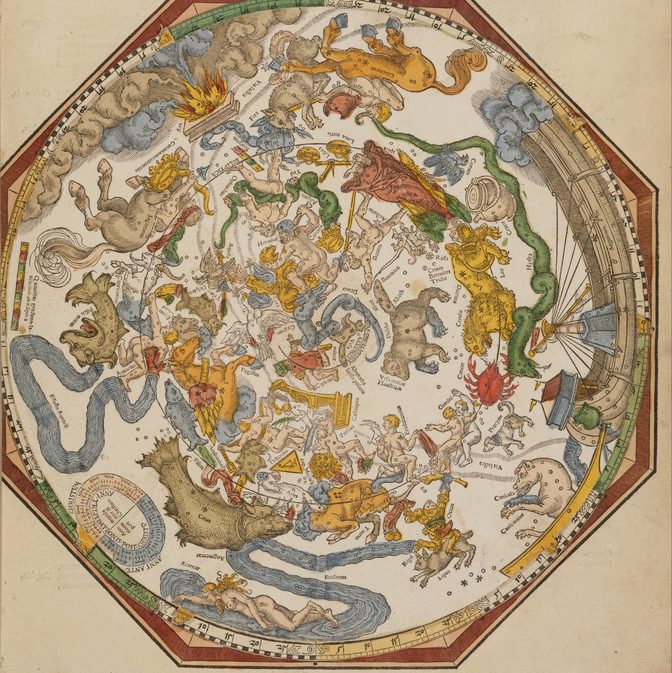
The twelve signs are the twelve constellations, each 30° wide.
falseWho says it: Beginners' pages and some school textbooks.
What the record shows: The signs are equal divisions of the ecliptic; the constellations are star figures of different sizes, and by the boundaries astronomers drew in 1930 the Sun crosses thirteen of them. The names were shared from the start, the shapes never.
-
There is a thirteenth sign, Ophiuchus, and everyone's sign has moved.
falseWho says it: Books of 1970 and 1995, and the viral stories of 2011 and 2016.
What the record shows: The tropical signs are twelve equal divisions counted from the equinox and were never the constellations. Ophiuchus is a constellation the ecliptic crosses, not a sign of either zodiac in use.
-
NASA changed the zodiac.
falseWho says it: Viral articles of September 2016, revived in 2020.
What the record shows: NASA's own post of 20 September 2016 said it had changed no zodiac signs and had only done the math, after a page for children explained precession. NASA does not define the zodiac.
-
Tropical astrology is wrong because its signs no longer match the constellations.
falseWho says it: Sidereal advocates, sceptics' pages, and our own old comparison table.
What the record shows: The tropical zodiac is defined from the March equinox and keeps each sign with its season by definition. The two zodiacs measure the same positions from different starting points; whether either means anything is a separate question.
-
Each Sun sign has fixed calendar dates, such as 21 March to 19 April for Aries.
falseWho says it: Newspaper horoscopes and most popular astrology sites.
What the record shows: The Sun enters each sign at a different moment each year, and the date also depends on the time zone; in 2024 to 2028 Aries began on 20 March at times from 02:17 to 20:24 UTC. The chart decides.
-
Studies show that birth charts describe personality.
falseWho says it: Chart sites and apps.
What the record shows: The controlled tests found astrologers at chance.
-
Carlson's 1985 test proved astrology false; or, Ertel's 2009 reanalysis proved the astrologers right.
disputedWho says it: Sceptics' summaries on one side; Suitbert Ertel and the astrologers who cite him on the other.
What the record shows: Carlson's astrologers matched charts to profiles at chance. Ertel's reanalysis of the same data reports a marginal effect that he himself calls insufficient. One test settles nothing either way.
-
The Mars effect proves that the planets shape people.
disputedWho says it: Michel Gauquelin and later writers.
What the record shows: It was replicated on data Gauquelin had collected, not by the American and French tests; and it concerns the daily position of one planet, not signs, houses or aspects.
-
Placidus is the traditional, or the original, house system.
falseWho says it: Many chart sites and beginners' books, because it is the software default.
What the record shows: The Hellenistic tradition used whole-sign houses. The Placidus division was first published by Magini in 1602; it is the most used today, not the oldest.
-
There is one correct house system, and a planet's house is a fact of the sky.
disputedWho says it: Users of every system; apps that offer no choice.
What the record shows: A planet's house depends on the division chosen: between Placidus and Whole Sign a median of twelve of sixteen objects changed house in our 56 test charts. We default to Placidus and show the system on the chart.
-
One set of orbs, such as 10° for every aspect, is the standard.
disputedWho says it: Software defaults presented as rules.
What the record shows: Orbs differ by school: Lilly gave each planet its own; astro.com's default is a flat 10°, 6° for the sextile; others scale by planet; CHANI counts by sign. Ours are printed with every chart.
-
Uranus, Neptune and Pluto rule Aquarius, Pisces and Scorpio.
disputedWho says it: Modern Western astrology, from John Varley in 1828 to the rulership lists of 1936.
What the record shows: A modern attribution made in stages after the three discoveries; the traditional rulers are Saturn, Jupiter and Mars, and the traditional revival keeps them. We name the traditional ruler first and the modern co-ruler beside it.
-
The Part of Fortune is always Ascendant plus Moon minus Sun.
disputedWho says it: Ptolemy, Lilly (1647), much 20th-century software and many sites.
What the record shows: Valens and Dorotheus reversed the formula for night births, and astro.com does by default. Both are conventions; we reverse at night and name the formula used.
-
Lilith is a dark second moon of the Earth, a body in the chart.
falseWho says it: Sepharial (1918), after a claim of 1898; sites that merge the three Liliths.
What the record shows: Three things carry the name: a second moon claimed in 1898 and never confirmed, the asteroid 1181 Lilith, and the Moon's apogee, an empty point. We show the mean apogee.
-
The Vertex is the point of fate, marking fated meetings.
unverifiedWho says it: Charles Jayne's school and the many sites that follow it.
What the record shows: The Vertex is a point of the twentieth century; Jayne and Johndro read it as matters beyond one's control. The reading has no older tradition, and nothing shows that it describes anyone.
-
Chiron, the wounded healer, is an ancient part of astrology.
falseWho says it: Sites that list Chiron beside the planets without a date.
What the record shows: Chiron was announced on 1 November 1977, and astrologers took it up in the 1980s. The reading comes from the Greek myth of the centaur.
-
The chart is cast for the exact millisecond of birth.
falseWho says it: Our own old page, before 2026-10-11, and many chart sites.
What the record shows: Birth times are recorded to the minute at best, and the engine takes minutes. The Ascendant moves about a degree every four minutes; a millisecond means nothing here.
-
A chart cast for noon, without a birth time, still gives the right Moon sign and houses.
falseWho says it: Sites that quietly cast at noon.
What the record shows: At noon the Moon can be up to about 7° from its true place, enough to change its sign for about one birth in four, and the Ascendant and houses are unknown. Our chart marks a noon chart.
-
The chart foretells illness, accidents, money and the outcome of lawsuits.
unverifiedWho says it: The traditional texts, from the Tetrabiblos to Lilly, and many sites and readings.
What the record shows: The tradition makes such claims; we never do. Our pages and readings describe themes and tendencies, never outcomes.
Stories and lore
- The hour-marker. The Greek horoskopos, "hour-marker", named the degree rising in the east at birth, the point that ties a sky to a place and a time and starts the twelve places; the chart and the word "horoscope" take their names from it. The tradition told that the art was given to the pharaoh Nechepso and his priest Petosiris, and to Hermes Trismegistus; Firmicus Maternus repeats the story in the 4th century, and the names belong to textbooks written in the 2nd and 1st centuries BCE.
- The decans. The thirty-six Egyptian decans were star groups whose risings marked the hours of the night. The Hellenistic chart cut each sign into three decans of 10°, and our chart still names a body's decan.
- Kepler's hen. Kepler compared the bulk of astrology's traditional rules to a dung heap in which a busy hen might still find a grain of corn, or a pearl. He cast more than 800 nativities all the same, one of them for Wallenstein.
- Alan Leo in court. Leo was charged in 1914 with pretending to tell fortunes and the case was dismissed; charged again, he was convicted on 16 July 1917 and fined, though he argued that he described only tendencies. He died six weeks later. The shift he argued for, from events to tendencies, is the one our readings follow.
- The princess and the airship. On 24 August 1930 the Sunday Express printed R. H. Naylor's horoscope for the newborn Princess Margaret. A line about danger to aircraft in October, followed by the R101 airship disaster on 5 October, won Naylor a weekly column, and the sun-sign column spread from there.
- Jung's horoscopes. On 6 September 1947 Jung wrote to the Indian astrologer B. V. Raman that in difficult psychological diagnoses he usually had a horoscope cast for a further point of view, and that it often clarified what he could not otherwise understand.
- The three Bobs. Project Hindsight began in 1993 when Robert Schmidt, Robert Hand and Robert Zoller set out to translate the Greek and Latin sources on a monthly subscription; whole-sign houses and sect came back into use from those translations.
- The facsimile. Olivia Barclay found an original copy of Lilly's Christian Astrology in 1980 and had it reprinted in facsimile in 1985, which is where the traditional revival in Britain is usually said to begin.
- Chiron's key. Chiron's glyph is a key, and also a K for Charles Kowal, who found it. The reading astrologers give it comes from the Greek centaur who taught healing and could not heal his own wound.
Evidence and criticism
The controlled tests. In Nature in December 1985 Shawn Carlson reported a double-blind test, its design agreed in advance with astrologers, in which they matched 116 natal charts to personality profiles; they scored at chance, and their confidence did not predict their success. Suitbert Ertel reanalysed the same data in 2009 and reported a marginal effect, which he himself called too small to show that astrology works but enough, in his view, to make Carlson's verdict untenable; he published it in the Journal of Scientific Exploration, outside the mainstream literature, and we found no new test that repeats it. Geoffrey Dean and Ivan Kelly (2003) reported tests of "time twins", people born minutes apart, who showed no shared traits, and tests in which astrologers did no better than people working without charts. A pooled analysis of 40 studies, with some 700 astrologers and more than 1,000 charts, found nothing once obvious cues were removed.
The Mars effect. Michel Gauquelin reported in 1955 that sports champions were born more often just after Mars rose or culminated. A Belgian committee replicated it in 1967 on data he had mostly collected; an American test (1979 to 1980) and a French one (published 1996, 209 of 1,120 champions against a base rate of about 17.7 percent) found no effect; critics proposed misreported birth times as a cause. Whatever its status, it concerns the daily position of one planet, not signs, houses or aspects.
Our own tests show that the positions match independent astronomy to under one arc second and that the houses, points and aspects follow the stated conventions.
The tradition's own debates are about conventions: the house system, the orbs, which node and which Lilith, the day and night Lot of Fortune, the modern rulers, and whether the psychological or the traditional reading is the true art. Reviews of chart apps ask most for explanation, fewer aspect lines and a choice of house system.
Older criticism. Pico della Mirandola argued in 1496 that the planets act on the Earth only through light and heat. Once Newtonian physics took away its rationale, astrology left the universities in the 18th century.
Terms
- Natal chart, birth chart
- The sky at the moment and place of a birth, drawn as a wheel. We avoid "horoscope" for it, since the word now usually means the newspaper column.
- Tropical zodiac
- Twelve equal signs of 30° counted from the March equinox, so each sign keeps its season. Western astrology uses it; Jyotisha counts from the stars instead.
- Sign
- One twelfth of the ecliptic, named after a nearby constellation but not the same thing as it. Elements fire, earth, air and water; modalities cardinal, fixed and mutable.
- Planets, luminaries
- "The planets" in the tradition's usage are the Sun, the Moon and the planets proper; the Sun and Moon are the luminaries.
- House, cusp
- One of twelve divisions of the local sky, counted from the Ascendant; the cusp is its starting degree. How the sky is divided depends on the house system, which we name.
- Ascendant, rising sign
- The degree of the zodiac rising in the east at birth, in Greek the horoskopos or hour-marker; its sign is the rising sign. Opposite it is the Descendant.
- Midheaven, IC
- The Midheaven (MC) is the degree culminating on the meridian; the IC is opposite it. With the Ascendant and Descendant, the four angles.
- Aspect, orb
- An angle between two bodies close to 0°, 60°, 90°, 120°, 150° or 180°; the orb is how far from exact it may be and still count. Squares and oppositions are called hard, trines and sextiles soft, never bad and good.
- Applying, separating
- Whether two bodies are moving towards an exact aspect or away from it, judged from their speeds. Not given for the angles, which outrun every body.
- Domicile, exaltation, detriment, fall
- A planet's own sign, the sign where it is exalted, and the signs opposite each, where the tradition calls it weakened. The houses and exaltations are Ptolemy's; the word "detriment" is medieval.
- Chart ruler
- The traditional ruler of the rising sign, Lilly's lord of the Ascendant; we name the modern co-ruler beside it for Scorpio, Aquarius and Pisces.
- Retrograde
- A planet that seems, from the Earth, to move backwards through the zodiac for a while. We write the word out rather than use the symbol alone.
- Lunar nodes
- The two points where the Moon's path crosses the ecliptic, North (ascending) and South; the Dragon's Head and Tail of medieval astrology, Rahu and Ketu in Jyotisha.
- Lilith (mean), Black Moon
- In our chart, the mean apogee of the Moon's orbit: an empty point, never a "dark moon".
- Part of Fortune, lot
- A lot is a point counted from the Ascendant by the distance between two bodies; the Part of Fortune, or Lot of Fortune, measures from the Sun to the Moon.
- Vertex
- Where the prime vertical meets the ecliptic in the west: a twentieth-century point.
- Decan
- A third of a sign, 10°; originally one of the thirty-six Egyptian star groups that marked the hours of the night.
- Out of bounds
- A body whose declination is beyond the Sun's farthest, about 23.44°.
- Day and night charts
- A chart is a day chart when the Sun is above the horizon at the birth place; the Hellenistic doctrine of sect builds on it, and our Part of Fortune follows it.
- Rudhyar's Moon phases
- Eight 45° slices of the Sun-Moon angle, from New to Balsamic, as Dane Rudhyar named them in 1967; we call the slices from 0° to 45° and from 180° to 225° "New" and "Full".
- Placidus, Whole Sign, Equal, Porphyry
- Ways of dividing the houses: by time (Placidus), by whole signs from the rising sign, by 30° from the Ascendant, or by trisecting the quadrants (Porphyry, our fallback above the polar circles).