Meaning
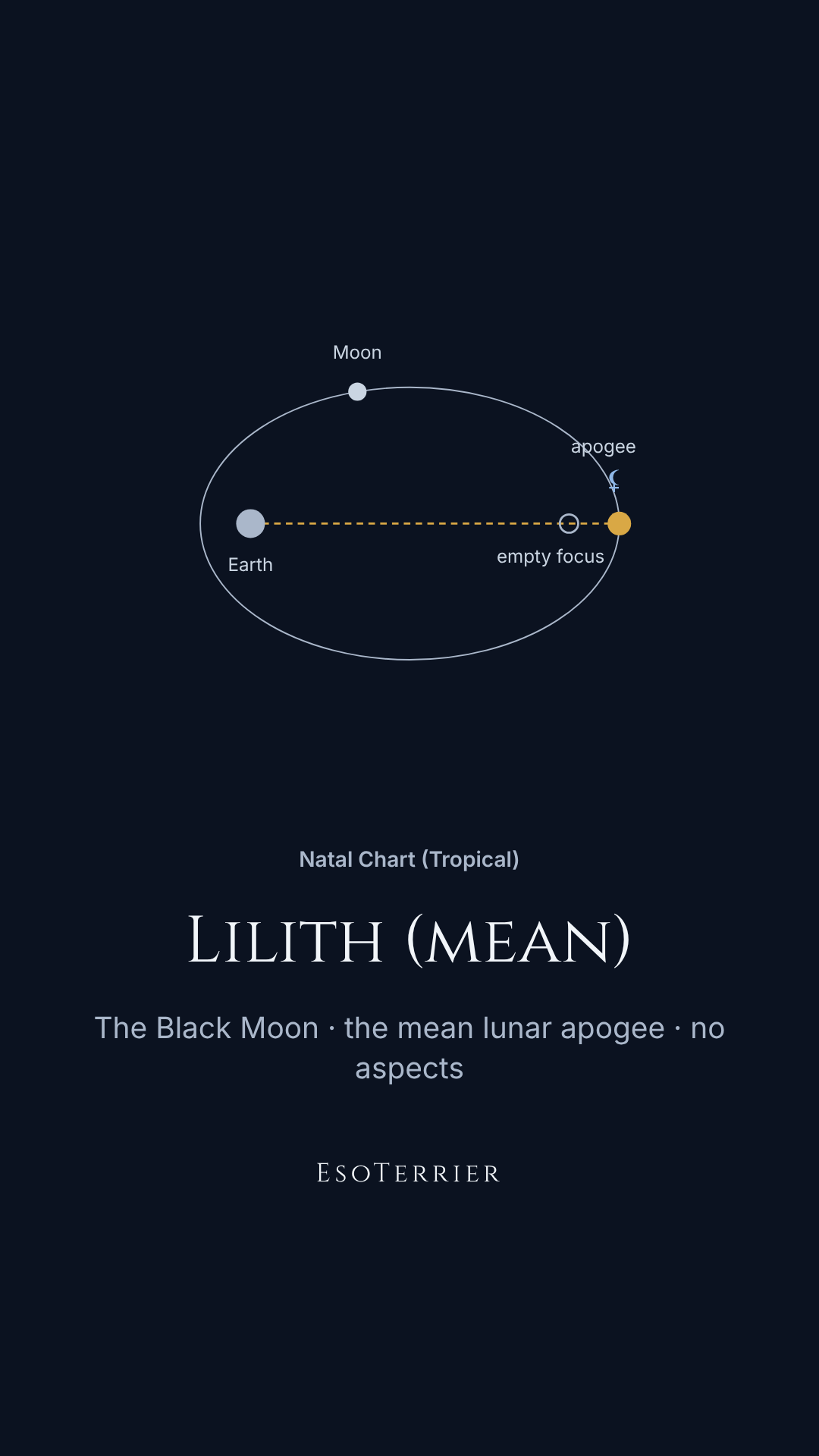
The Moon's orbit is an ellipse with the Earth at one focus. Lilith, as our chart shows it, is the mean apogee: the far end of the Moon's average orbit, the direction of the ellipse's empty second focus. It moves forward through the zodiac, about 40.7° a year, and goes round once in about eight years and ten months. Our value agrees with the standard lunar theory to a third of an arc second.
The name has a tangled history. Georg Waltemath claimed in 1898 to have found a second moon of the Earth; it was never confirmed, and the astrologer Sepharial named it Lilith in 1918. The asteroid 1181 Lilith, found by Benjamin Jekhowsky in 1927, is a third thing again. The idea of the Lune noire, the Black Moon, as the empty focus of the Moon's orbit goes back to the French astrologer Dom Neroman's book of 1937, the earliest dated source we found; when the name Lilith was first given to the apogee is not established.
A modern reading
Modern astrology reads Lilith as what is refused, repressed or kept wild in a person, often borrowing themes from the Lilith of Jewish legend. That is twentieth-century lore with no classical source, and our pages never treat it as a mark of danger in anyone. Our keywords are "instinct, autonomy, wildness".
Mean or "true"
The osculating apogee, often sold as "True Lilith", is computed from the Moon's orbit at one instant and swings about 30° either side of the mean, which the Swiss Ephemeris documentation regards as largely an artifact of that calculation; in our 56 test births the two were up to 27.5° apart. Most tools show the mean point, and so do we, labelled "Lilith (mean)"; the osculating value stays in our data for readers who ask for it. We compute neither the asteroid nor the hypothetical moon, and Lilith takes no aspects in our chart.
Correspondences
Each item with how it stands: “sourced” is in the work cited, “our construction” is EsoTerrier’s own, and “disputed” means the sources disagree.
- Which Lilith
- The mean lunar apogee; the asteroid and the claimed moon are not computed sourced
- The name (Sepharial, 1918)
- Given to a second moon Waltemath claimed in 1898, never confirmed; not the apogee sourced
- Asteroid 1181 Lilith
- A real minor planet, found by Benjamin Jekhowsky in 1927; a different thing sourced
- *Lune noire* (Dom Neroman)
- The empty focus of the Moon's orbit, dated to Neroman's book of 1937; when the apogee was first called Lilith is not established sourced
- Mean or osculating
- Most tools show the mean; the osculating swing is called largely an artifact in the Swiss Ephemeris documentation disputed
- Modern reading
- What is refused, repressed or kept wild; twentieth-century lore with no classical source sourced
- Our keywords
- "instinct, autonomy, wildness" our construction
How the schools read it
- French school (Dom Neroman, 1937)
- The Lune noire, the Black Moon, as the empty second focus of the Moon's orbit.
- Sepharial (1918)
- Lilith as a dark second moon of the Earth, after Waltemath; never confirmed.
- Modern Western
- The refused or untamed part of a person, with themes from the Lilith of legend; modern lore.
- Reference tools
- astro.com and Astro-Seek show the mean apogee by default.
- EsoTerrier
- The mean apogee, labelled, with no aspects; never a mark of danger in anyone.
Claims about it
-
Lilith is a dark second moon of the Earth, a body in the chart.
falseWhat the record shows: Three things carry the name: a second moon claimed in 1898 and never confirmed, the asteroid 1181 Lilith, and the Moon's apogee, an empty point. We show the mean apogee.
-
The "true" node and the "true" Lilith are the accurate ones.
disputedWhat the record shows: "True" means osculating, from the Moon's orbit at one instant. The true and mean nodes are both conventions, up to about 2° apart; the osculating apogee swings about 30° around the mean. We show the true node and the mean Lilith, labelled.