Skip to content

Natal Chart (Tropical) · Point 1 of 7

The North Node, where the Moon's path climbs across the Sun's

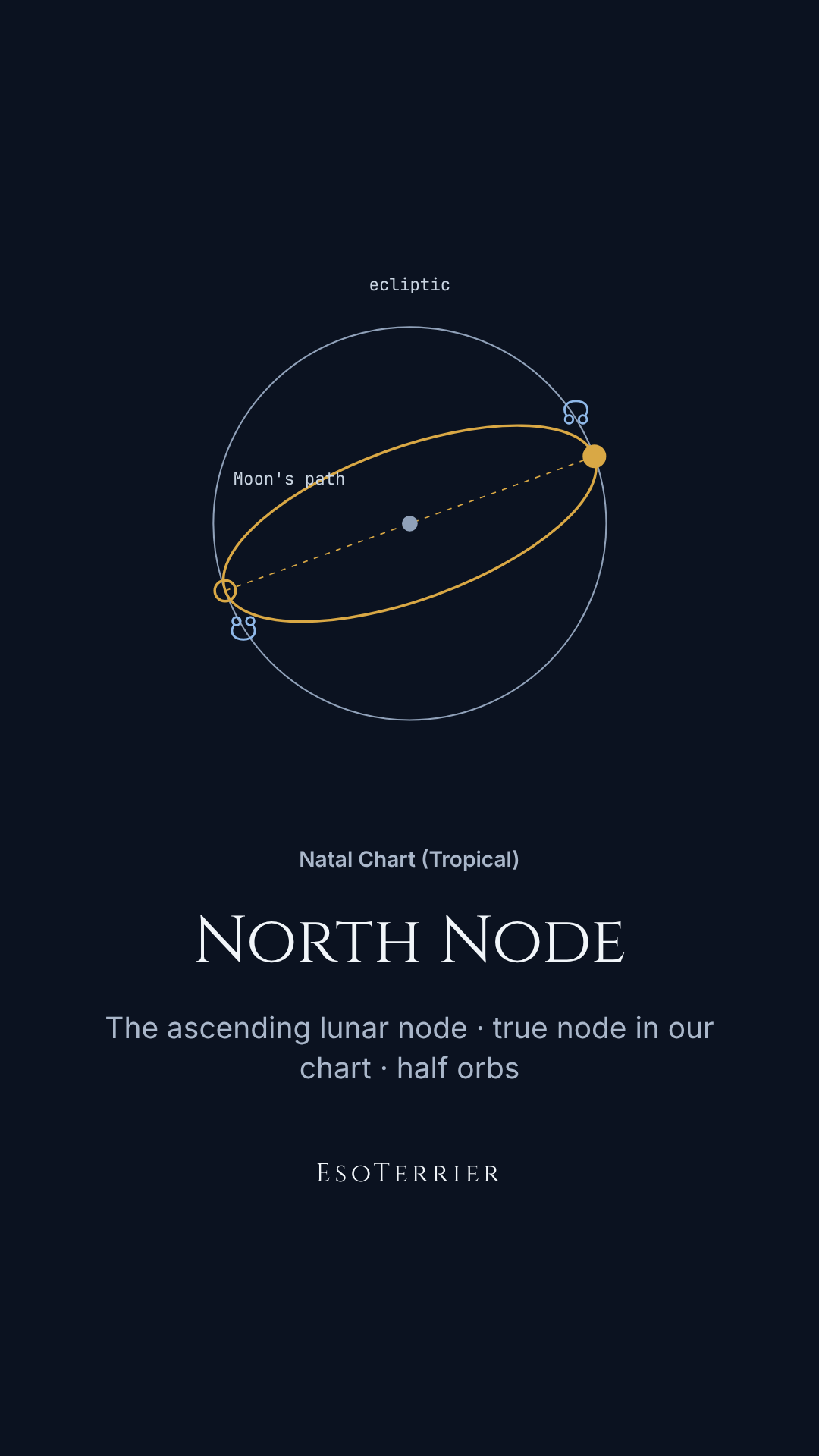
The North Node is not a body but a crossing: the point where the Moon's tilted path crosses the ecliptic heading north. It drifts backwards round the zodiac in 18.6 years; our chart uses the true node, labelled, and gives it half orbs in aspects.

Where does it sit in your chart?

Draw your free chart: natal chart No email needed
The ecliptic drawn as a circle and the Moon's path as a tilted ellipse crossing it at two points; the North Node, where the path climbs northward, is a filled dot, and the South Node opposite is an open ring. ☊︎ ☋︎ ecliptic Moon's path
The Moon's path crosses the ecliptic at two nodes; the North Node, filled, is where it climbs north. The tilt is drawn larger than the real five degrees. Our drawing.

Facts

What it is
A calculated point: where the Moon's orbit crosses the ecliptic heading north (the ascending node)
Glyph
☊︎ (U+260A)
Motion
Backwards round the zodiac in 18.61 years, about 19.3° a year; the true node is briefly direct at times
In our chart
The true node, labelled "(true)", drawn on the wheel by default
True against mean
Up to about 2° apart (1.95° at most from 1950 to 2050)
Our orbs
Aspects from the ten planets at half orb: 5° from the Sun or Moon, 4° from a planet, for a conjunction, square, trine or opposition
Opposite
The South Node, always exactly 180° away; the pair is no longer listed as an aspect
In Jyotisha
Rahu, one of the nine grahas, with an 18-year Vimshottari period; the mean node by default

Meaning

The Moon's orbit is tilted about five degrees to the Sun's path, so it crosses the ecliptic twice a month at two opposite points, the lunar nodes. The North, or ascending, Node is where the Moon passes northward; the South Node is always exactly opposite. Eclipses happen only when a new or full moon falls near one of them. The line of nodes turns backwards through the zodiac once in 18.61 years.

Medieval astrology called the North Node the Dragon's Head, Caput Draconis, and, as Lilly sums up "the constant opinion of all the Ancients" in 1647, held it masculine, of the nature of Jupiter and Venus, and "of himselfe a Fortune". The medieval lists gave it an exaltation at 3° of Gemini, which Ptolemy does not and the Indian tradition does not.

Modern astrology reads the North Node as the direction of growth and the South Node as what is familiar; some schools tell it as a story of former lives, a twentieth-century reading that we label as such and never state as fact. Our keywords are "direction, growth, purpose".

True or mean

The mean node moves smoothly backwards; the true, or osculating, node, computed from the Moon's orbit at the instant, wobbles around it by up to about 2° and is briefly direct at times. Both are conventions, not one right and one wrong: astro.com shows the true node, Astro-Seek and the Indian ephemerides the mean. Our tropical chart shows the true node, labelled "(true)", within 0.006 arc second of the independent check; the Jyotisha chart uses the mean node, as Indian practice does.

In our chart

The North Node is drawn on the wheel by default and takes aspects from the ten planets at half their orbs. We no longer list "North Node opposition South Node": it is exact in every chart by definition, so it says nothing. In Jyotisha the North Node is Rahu, one of the nine grahas, with a Vimshottari period of eighteen years.

Correspondences

Each item with how it stands: “sourced” is in the work cited, “our construction” is EsoTerrier’s own, and “disputed” means the sources disagree.

Definition
The ascending node of the Moon's orbit, computed from the Moon's orbit at the instant (osculating) sourced
Medieval name and nature
The Dragon's Head, Caput Draconis: masculine, of the nature of Jupiter and Venus, "of himselfe a Fortune" (Lilly, 1647, giving the ancients' opinion) sourced
Medieval exaltation
3° of Gemini; not in Ptolemy, and the Hindus give the nodes none (al-Biruni) disputed
True or mean node
Both are conventions; astro.com shows the true node, Astro-Seek and the Indian ephemerides the mean disputed
Modern reading
The direction of growth; the South Node as what is familiar. A twentieth-century reading; past-life versions are not fact sourced
Our keywords
"direction, growth, purpose" our construction

How the schools read it

Medieval and Renaissance
The Dragon's Head, a point of increase, of the nature of the benefics; Lilly calls it Anabibazon.
Modern Western
The direction a life grows towards; some schools add stories of former lives, a twentieth-century reading.
Jyotisha
Rahu, a graha in its own right, with its own period in the Vimshottari dasha; the mean node by default.
EsoTerrier
The true node, labelled; half orbs; keywords "direction, growth, purpose", our own words.

Claims about it

  • The "true" node and the "true" Lilith are the accurate ones.

    disputed

    What the record shows: "True" means osculating, from the Moon's orbit at one instant. The true and mean nodes are both conventions, up to about 2° apart; the osculating apogee swings about 30° around the mean. We show the true node and the mean Lilith, labelled.
Elsewhere on EsoTerrier

Sources

Primary texts (2)
  1. William Lilly, Christian Astrology, modestly treated of in three books. Thomas Brudenell for John Partridge and Humphrey Blunden, London, 1647. Public domain; quoted briefly, from the 1647 edition. archive.org/details/b30338724
  2. Abu'l-Rayhan Muhammad ibn Ahmad al-Biruni; tr. R. Ramsay Wright, The Book of Instruction in the Elements of the Art of Astrology, translated by R. Ramsay Wright. Luzac, London (written in Ghazna, 1029), 1934. In copyright; facts and section numbers only. lccn.loc.gov/35038118
Studies and other sources (3)
  1. Astrodienst AG, Astrodienst (astro.com) chart defaults and FAQ pages: style defaults, aspects and orb tables, calculations (Part of Fortune), extra factors (Lilith), settings (orbs of points), house systems. Astrodienst, Zurich, 2026. Consulted for facts; never copied. astro.com/faq/fq_fh_calc_e.htm
  2. Astro-Seek, Astro-Seek birth chart form (defaults read, nothing submitted). 2026. Defaults read, nothing submitted; never copied. horoscopes.astro-seek.com/birth-chart-horoscope-online
  3. Wikipedia contributors, Wikipedia: Uranus; Neptune; Pluto; Lunar node. Wikimedia Foundation, 2026. CC BY-SA; consulted for facts. en.wikipedia.org/wiki/Lunar_node
Our own research (6)
  1. EsoTerrier, Natal and sidereal wheels: research for the rebuild (README, report-main.md, notes/). Research folder 2026-10-11-natal-sidereal, 2026.
  2. EsoTerrier, Helper report: validation of the natal chart engine (tropical and sidereal). Validation report, 2026-10-11, 2026.
  3. EsoTerrier, EsoTerrier chart engine: services/chart/ephemeris.py, calculation.py, jyotish.py, texts.py. python/esoterrier, services/chart, 2026.
  4. EsoTerrier, Draconic chart and Sabian symbols research, 2026-10-10: the true against mean node simulation (notes/true-vs-mean-node-simulation.json). Research folder 2026-10-10-draconic-sabian, 2026.
  5. EsoTerrier, EsoTerrier app: resources/js/support/natal.ts and components/Chart/NatalChartTropical.vue. The chart component in our app, 2026.
  6. EsoTerrier, Knowledge layer shared topics: _shared/zodiac and _shared/planets (accuracy pass, 2026-10-13). Knowledge layer, shared topics, 2026.

Your Natal Chart reading, $3.99. Includes this system's raw data. Written for you by AI. Read a sample. Charts and the written text are free in every account.

By EsoTerrier. Written with AI assistance from our research and checked against its sources; last revised 20 October 2026. How we write these pages.

First published ; last revised . Corrections: support@esoterrier.com.