Meaning
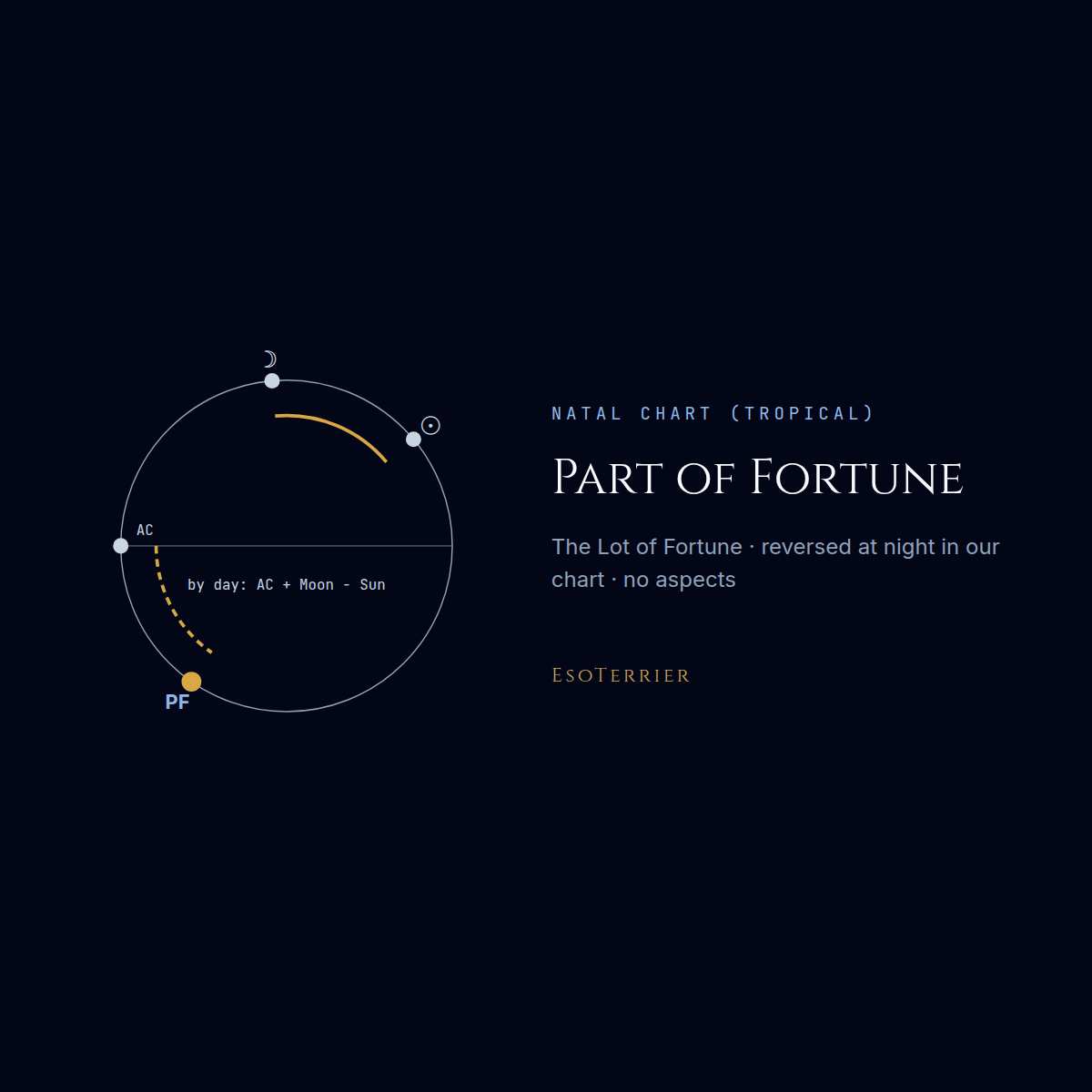
A lot is a point made by measuring the distance between two bodies and counting it off from the Ascendant. The Part of Fortune, the Hellenistic Lot of Fortune, is the oldest and best known: by day it is the Ascendant plus the Moon minus the Sun, so the lot stands to the Ascendant as the Moon stands to the Sun. Ptolemy calls it a kind of lunar ascendant, "a lunar horoscope or ascendant" in Ashmand's 1822 translation.
The Hellenistic texts read it as a second ascendant, for the body and for a person's circumstances. Later writers, Lilly among them, read it chiefly for worldly goods; that reading we leave out here.
By day and by night
Ptolemy used the one formula "both by night and day", and Lilly did the same in 1647, as did much twentieth-century software. Valens and Dorotheus reversed it for night births, Ascendant plus Sun minus Moon, and astro.com does so by default. Both are conventions. Our engine reverses at night and decides whether a birth is by day or by night from the Sun's altitude at the birth place, which also holds above the polar circles, where the older test by the Sun's house gave the wrong answer.
In our chart
The Part of Fortune is listed in the points table and shown on the wheel with the points toggle, drawn as the letters PF. It moves with the Ascendant, about a degree every four minutes, but our data give it no speed of its own, so an applying or separating label would be wrong; in the research two in three such labels were. It therefore takes no aspects. Its other names are the Lot of Fortune and Pars Fortunae, the first of the so-called Arabic parts; we compute no other lot.
Correspondences
Each item with how it stands: “sourced” is in the work cited, “our construction” is EsoTerrier’s own, and “disputed” means the sources disagree.
- Ptolemy's formula
- The day formula "both by night and day"; "a lunar horoscope or ascendant" (Ashmand, 1822, Book III ch. XIII) sourced
- Lilly's formula
- One formula by day or by night (1647, Book II ch. XXIII) sourced
- Valens's formula
- Reversed at night sourced
- One correct formula
- Both are conventions, used side by side for two thousand years disputed
- Hellenistic reading
- A second ascendant, for the body and for circumstances sourced
- Later readings
- Read chiefly for worldly goods by Lilly and others; left out here sourced
How the schools read it
- Ptolemy (2nd century CE)
- The same formula by day and night; a lunar ascendant.
- Valens and Dorotheus
- Reversed for night births.
- Lilly (1647)
- One formula, either by night or by day.
- astro.com default
- Reversed at night; it notes that Ptolemy and much older software did not.
- EsoTerrier
- Reversed at night, day or night by the Sun's altitude, the formula named; no aspects.
Claims about it
-
The Part of Fortune is always Ascendant plus Moon minus Sun.
disputedWhat the record shows: Valens and Dorotheus reversed the formula for night births, and astro.com does by default. Both are conventions; we reverse at night and name the formula used.