Meaning
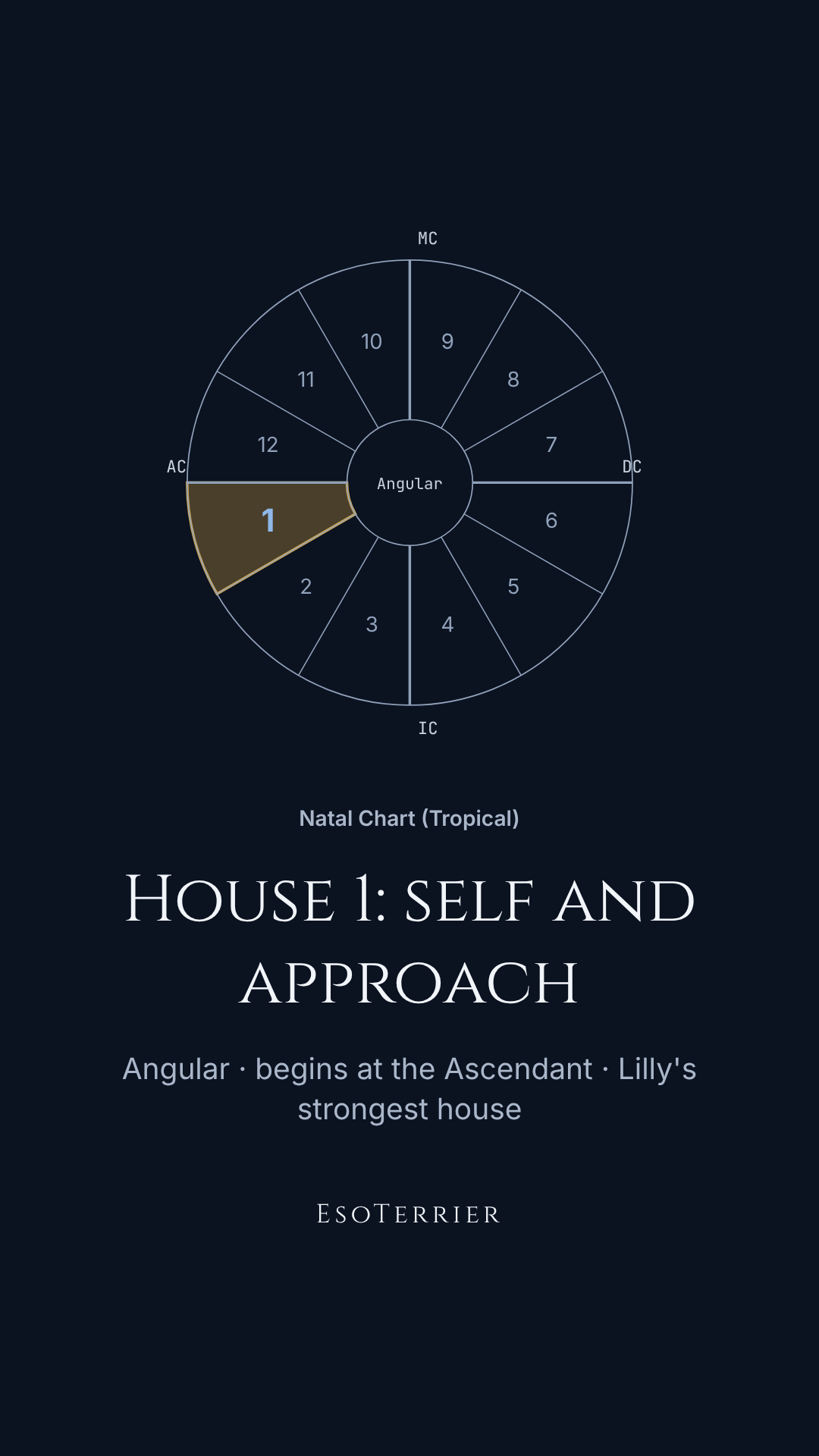
Every house is counted from the first, and the first is counted from the horizon: it begins at the Ascendant, the point of the zodiac rising in the east at the birth moment. In whole-sign houses it is the whole rising sign, with the Ascendant's degree somewhere inside it.
Lilly in 1647 gives the first house the life of the person born, their stature, colour and form, and the head and face; it is the first of his four angles and the first in his ranking of strength. The tradition since has read it as the body, the manner and the way a person starts things and meets the world. Our keywords are "self, appearance, approach".
In a chart
The sign on the first house is the rising sign, and its ruler is the chart ruler, read first after the big three. A planet in the first house, close to the Ascendant, is read as colouring the whole manner of the person. A planet in the rising sign but a few degrees above the Ascendant is in the first house by whole signs and in the twelfth by Placidus, which is why our chart names its house system.
The first house lies below the horizon, at the start of the quadrant that runs down from the Ascendant to the IC. Modern teaching pairs it with Aries and Mars, a scheme Alan Leo taught in the early twentieth century; Lilly's own pairings were different, Aries and Saturn for this house.
Across the traditions
In the Hellenistic texts the twelve places were counted by whole signs from the rising sign, and Valens's first place is simply the hour-marker's sign. Jyotisha keeps that rule: its first bhava is the whole sign of the lagna. Quadrant systems, Placidus among them, came later; whichever is used, the first house always starts at or contains the Ascendant.
Correspondences
Each item with how it stands: “sourced” is in the work cited, “our construction” is EsoTerrier’s own, and “disputed” means the sources disagree.
- Topics (Lilly, 1647)
- The life, stature, colour and form of the person; the head and face sourced
- Class (Lilly)
- Angular, first in strength sourced
- Natural sign and ruler
- Aries, with Mars: a modern teaching device after Alan Leo; Lilly's pairings differ sourced
- Topics (modern)
- Self, appearance, approach sourced
- One right house system
- No: a planet's house can change with the system; ours is named on the chart disputed
- Our keywords
- "self, appearance, approach" our construction
How the schools read it
- Hellenistic (Valens)
- The first place, counted by whole signs from the rising sign.
- Lilly (1647)
- Angular; the life, stature, colour and form of the person; the head and face.
- Modern psychological (Alan Leo, Rudhyar and after)
- Self, appearance, approach.
- Jyotisha
- The first bhava, always counted by whole signs from the lagna.
- EsoTerrier
- Placidus by default, Whole Sign and Equal a tap away, Porphyry above the polar circles; a reading for each planet in the house, in our own words.
Claims about it
-
There is one correct house system, and a planet's house is a fact of the sky.
disputedWhat the record shows: A planet's house depends on the division chosen: between Placidus and Whole Sign a median of twelve of sixteen objects changed house in our 56 test charts. We default to Placidus and show the system on the chart.
-
Placidus is the traditional, or the original, house system.
falseWhat the record shows: The Hellenistic tradition used whole-sign houses. The Placidus division was first published by Magini in 1602; it is the most used today, not the oldest.