Meaning
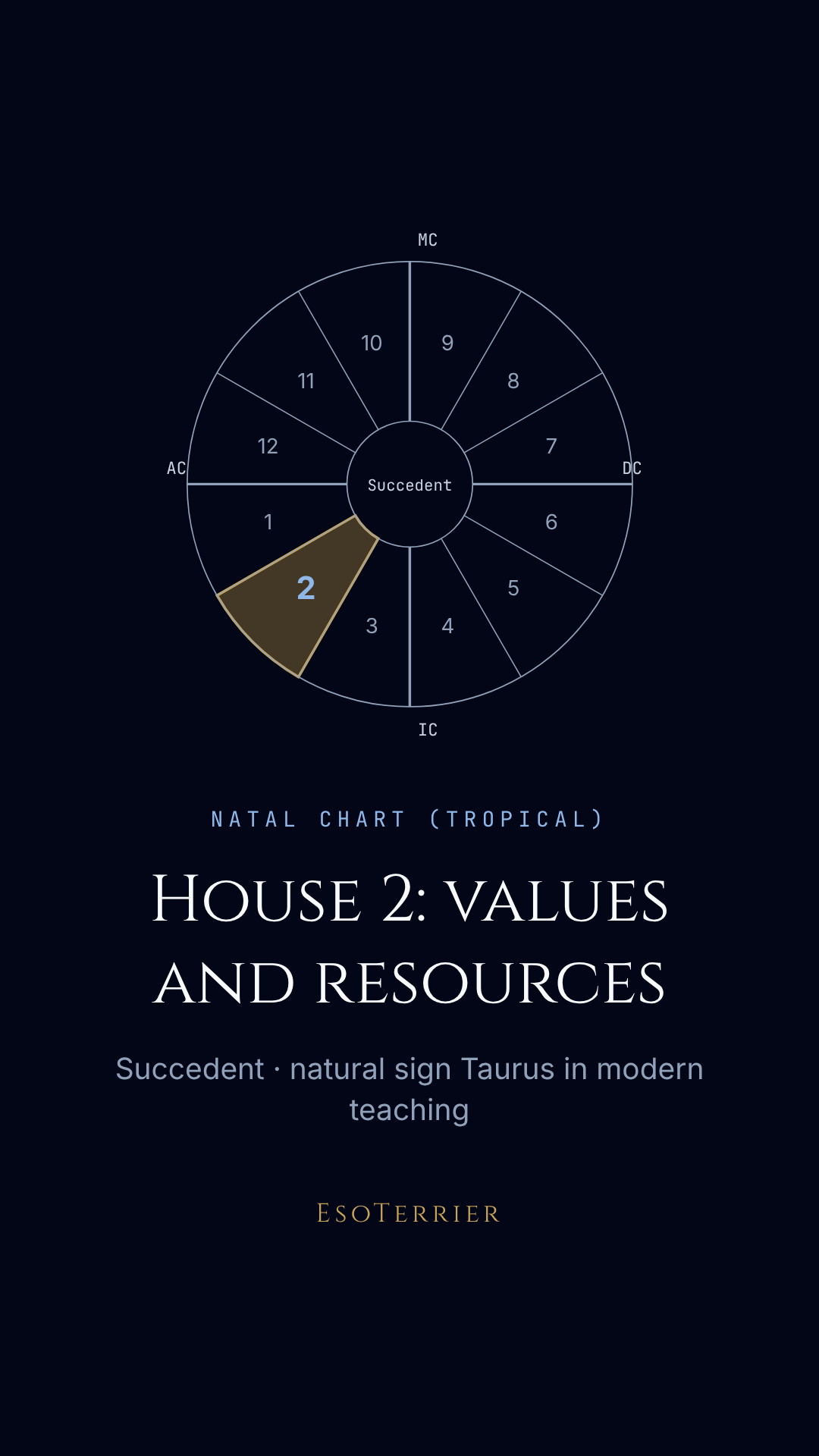
The second house follows the first, rising next after the Ascendant, and belongs to the class Lilly calls succedent, the houses that follow the angles. In his ranking of strength it comes ninth of twelve.
Lilly's list for the second house is almost entirely about property: a person's estate and movable goods, with further items on lending, gain and loss that we leave out here. The tradition read it for possessions, and so does much of the astrology of the last century. We record those topics as history and never write a forecast of money or possessions from them.
Modern astrology widens the house from goods to resources of every kind: talents, time and the things a person relies on, and to values and the sense of one's own worth. Our keywords are "values, resources, self-worth", and the chart's readings for a planet here speak of what a person values and how they hold it.
In a chart
A planet in the second house is read for what it brings to that sense of value: Venus, the natural ruler in modern teaching, as a taste for the beautiful and the lasting, Saturn as care and caution. These are the tradition's colours, not outcomes. The second house sits below the horizon in the first quadrant, between the Ascendant and the IC.
Its pairing with Taurus and Venus is a modern teaching device that Alan Leo taught early in the twentieth century; Lilly's tables pair the houses differently.
Across the traditions
In whole-sign houses the second house is the sign after the rising sign, whatever degrees it holds; Valens's second place is counted that way, and we have checked no special name for it in his text. Jyotisha counts its second bhava in the same whole-sign way from the lagna. Opposite it lies the eighth house, and the two are often read together as what is one's own and what is shared.
Correspondences
Each item with how it stands: “sourced” is in the work cited, “our construction” is EsoTerrier’s own, and “disputed” means the sources disagree.
- Topics (Lilly, 1647)
- A person's estate and movable goods (his items on lending, gain and loss left out) sourced
- Class (Lilly)
- Succedent, ninth in strength sourced
- Natural sign and ruler
- Taurus, with Venus: a modern teaching device after Alan Leo; Lilly's pairings differ sourced
- Topics (modern)
- Values, resources, self-worth sourced
- One right house system
- No: a planet's house can change with the system; ours is named on the chart disputed
- Our keywords
- "values, resources, self-worth" our construction
How the schools read it
- Hellenistic (Valens)
- The second place, counted by whole signs from the rising sign.
- Lilly (1647)
- Succedent; a person's estate and movable goods (his items on lending, gain and loss left out).
- Modern psychological (Alan Leo, Rudhyar and after)
- Values, resources, self-worth.
- Jyotisha
- The second bhava, always counted by whole signs from the lagna.
- EsoTerrier
- Placidus by default, Whole Sign and Equal a tap away, Porphyry above the polar circles; a reading for each planet in the house, in our own words.
Claims about it
-
The chart foretells illness, accidents, money and the outcome of lawsuits.
unverifiedWhat the record shows: The tradition makes such claims; we never do. Our pages and readings describe themes and tendencies, never outcomes.
-
There is one correct house system, and a planet's house is a fact of the sky.
disputedWhat the record shows: A planet's house depends on the division chosen: between Placidus and Whole Sign a median of twelve of sixteen objects changed house in our 56 test charts. We default to Placidus and show the system on the chart.