Meaning
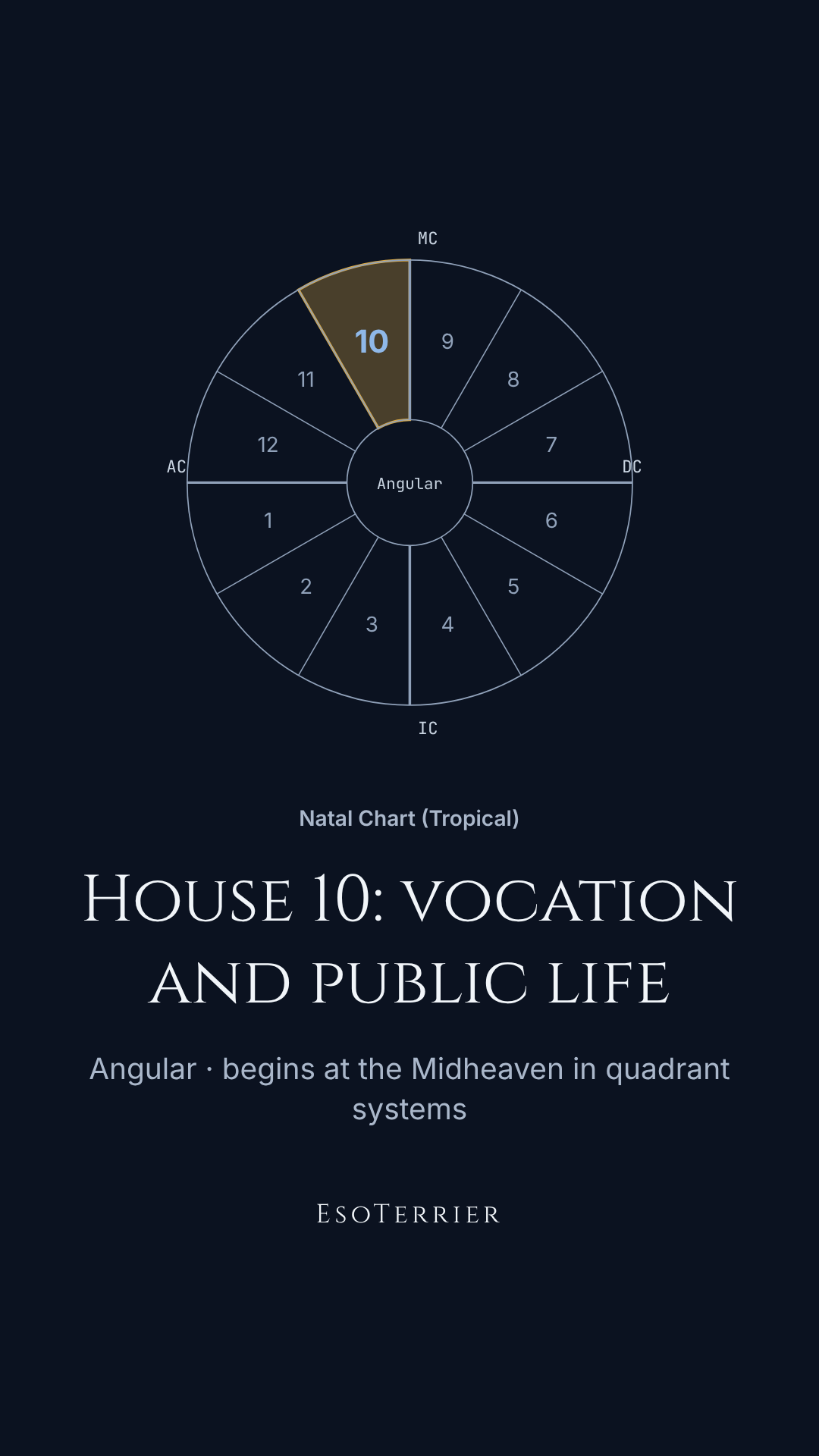
The tenth house is the highest of the angles. In quadrant systems such as Placidus its cusp is the Midheaven, the degree culminating on the meridian, and Lilly ranks it second in strength only to the first.
Lilly in 1647 gives it kings and those in authority, honour and preferment, office and profession, and the mother. Modern astrology reads it as vocation, reputation, public life and the mark a person hopes to leave, and many modern authors move the mother to the fourth house. Our keywords are "vocation, reputation, public life".
In a chart
A planet in the tenth house, near the Midheaven, is read as visible: part of how a person is seen and what they aim to be known for. Saturn, the natural ruler in modern teaching, is read here as ambition built slowly, the Sun as a wish to stand out. These are aims, and our readings never say that a placement brings a promotion, a career or fame.
The tenth and fourth houses make the chart's vertical axis, the public and the private, read together.
Where the Midheaven falls
In whole-sign houses the tenth house is the tenth sign from the rising sign, and the Midheaven degree often falls in the ninth or eleventh instead, further off at high latitudes; in equal houses the tenth cusp is 270° from the Ascendant. That is why a planet in the tenth by one system can be in the ninth by another, and why our chart lets you switch. In the sample chart on our system page the Midheaven is in Taurus, and Jupiter sits in the tenth house in Placidus.
Our reading
Our chart's own line describes the tenth house as vocation, public life, reputation and the mark one hopes to make in the world, and the Midheaven gets a further line for its sign.
Correspondences
Each item with how it stands: “sourced” is in the work cited, “our construction” is EsoTerrier’s own, and “disputed” means the sources disagree.
- Topics (Lilly, 1647)
- Kings and authority, honour and preferment, office and profession, the mother sourced
- Class (Lilly)
- Angular, second in strength sourced
- Natural sign and ruler
- Capricorn, with Saturn: a modern teaching device after Alan Leo; Lilly's pairings differ sourced
- Topics (modern)
- Vocation, reputation, public life sourced
- One right house system
- No: a planet's house can change with the system; ours is named on the chart disputed
- Our keywords
- "vocation, reputation, public life" our construction
How the schools read it
- Hellenistic (Valens)
- The tenth place, counted by whole signs from the rising sign.
- Lilly (1647)
- Angular; kings and authority, honour and preferment, office and profession, the mother.
- Modern psychological (Alan Leo, Rudhyar and after)
- Vocation, reputation, public life.
- Jyotisha
- The tenth bhava, always counted by whole signs from the lagna.
- EsoTerrier
- Placidus by default, Whole Sign and Equal a tap away, Porphyry above the polar circles; a reading for each planet in the house, in our own words.
Claims about it
-
There is one correct house system, and a planet's house is a fact of the sky.
disputedWhat the record shows: A planet's house depends on the division chosen: between Placidus and Whole Sign a median of twelve of sixteen objects changed house in our 56 test charts. We default to Placidus and show the system on the chart.
-
Placidus is the traditional, or the original, house system.
falseWhat the record shows: The Hellenistic tradition used whole-sign houses. The Placidus division was first published by Magini in 1602; it is the most used today, not the oldest.