Meaning
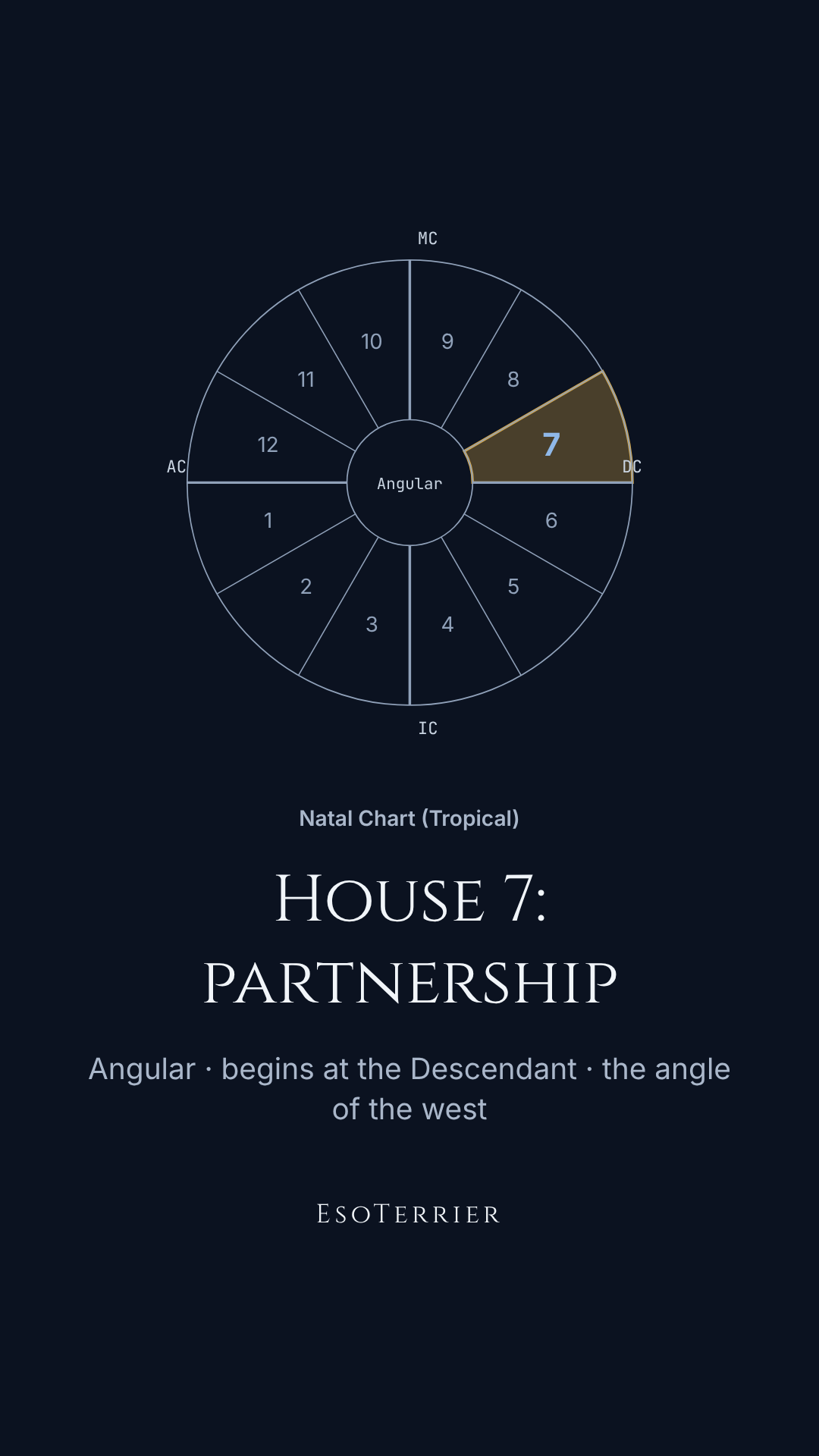
The seventh house begins at the Descendant, the point of the zodiac setting in the west at the birth moment, opposite the Ascendant across the horizon. Lilly calls it the angle of the west and ranks it third in strength, after the first and the tenth; Valens calls the place simply the Descendant.
Lilly gives it marriage and questions of love, the other party in any matter, and open opponents and quarrels; his further items on lawsuits, thefts and outlaws we leave out here. Modern astrology reads it as close partnerships, one-to-one relationships and what a person seeks and meets in others. Our keywords are "partnership, others, cooperation".
In a chart
The seventh house is where the chart puts other people as equals, so a planet here is read as something a person meets through others: Venus, the natural ruler in modern teaching, as harmony sought in partnership, Mars as directness met in it. These are the tradition's themes.
The axis from the first house to the seventh runs from self to other, and astrologers read the two ends together; the Ascendant and Descendant are always exactly opposite in every house system.
Across the traditions
In quadrant systems the Descendant is the seventh cusp; in whole-sign houses the seventh house is the sign opposite the rising sign and the Descendant's degree falls inside it. The pairing with Libra and Venus is a modern teaching device. Jyotisha's seventh bhava is counted by whole signs from the lagna, and there every graha casts its aspect on the seventh sign from itself.
Our reading
Our chart's own line for the house speaks of close partnerships, one-to-one relationships and what we seek in others; the readings for a planet here, in our own words, describe a way of meeting people, never a match or a parting.
Correspondences
Each item with how it stands: “sourced” is in the work cited, “our construction” is EsoTerrier’s own, and “disputed” means the sources disagree.
- Topics (Lilly, 1647)
- Marriage and love questions, the other party, open opponents and quarrels (his items on lawsuits and thefts left out) sourced
- Class (Lilly)
- Angular, third in strength sourced
- Place name (Valens)
- the Descendant sourced
- Natural sign and ruler
- Libra, with Venus: a modern teaching device after Alan Leo; Lilly's pairings differ sourced
- Topics (modern)
- Partnership, others, cooperation sourced
- One right house system
- No: a planet's house can change with the system; ours is named on the chart disputed
- Our keywords
- "partnership, others, cooperation" our construction
How the schools read it
- Hellenistic (Valens)
- The seventh place, counted by whole signs from the rising sign; called the Descendant.
- Lilly (1647)
- Angular; marriage and love questions, the other party, open opponents and quarrels (his items on lawsuits and thefts left out).
- Modern psychological (Alan Leo, Rudhyar and after)
- Partnership, others, cooperation.
- Jyotisha
- The seventh bhava, always counted by whole signs from the lagna.
- EsoTerrier
- Placidus by default, Whole Sign and Equal a tap away, Porphyry above the polar circles; a reading for each planet in the house, in our own words.
Claims about it
-
The chart foretells illness, accidents, money and the outcome of lawsuits.
unverifiedWhat the record shows: The tradition makes such claims; we never do. Our pages and readings describe themes and tendencies, never outcomes.
-
There is one correct house system, and a planet's house is a fact of the sky.
disputedWhat the record shows: A planet's house depends on the division chosen: between Placidus and Whole Sign a median of twelve of sixteen objects changed house in our 56 test charts. We default to Placidus and show the system on the chart.
-
Placidus is the traditional, or the original, house system.
falseWhat the record shows: The Hellenistic tradition used whole-sign houses. The Placidus division was first published by Magini in 1602; it is the most used today, not the oldest.