Skip to content

Natal Chart (Tropical) · Body 5 of 11

Mars, the red planet and Ptolemy's lesser malefic

Mars is the red planet, round the zodiac in 1.88 years and about two months in a sign. Ptolemy gives it Aries and Scorpio, exalts it in Capricorn and calls it malefic from its excess of dryness; modern astrology reads it as drive, desire and courage.

Where does it sit in your chart?

Draw your free chart: natal chart No email needed
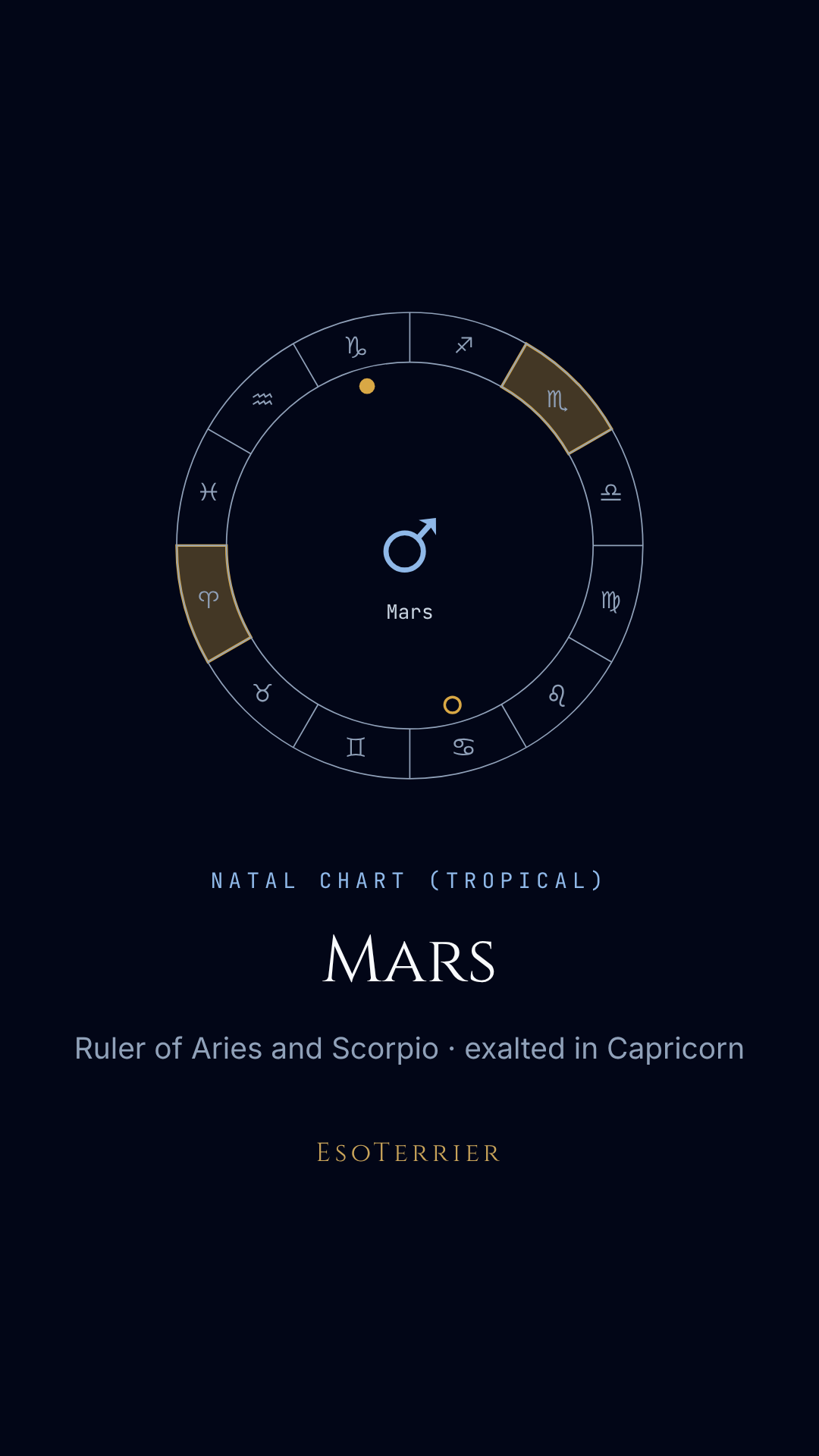
The glyph of Mars at the centre of a ring of the twelve signs, with its houses Aries and Scorpio filled, its exaltation Capricorn marked with a dot and its fall Cancer with a ring. ♈︎ ♉︎ ♊︎ ♋︎ ♌︎ ♍︎ ♎︎ ♏︎ ♐︎ ♑︎ ♒︎ ♓︎ ♂︎ Mars
Mars's dignities after Ptolemy: filled, its houses; dot, its exaltation; ring, its fall. Our drawing.

Facts

Glyph
♂︎ (U+2642)
Orbit
687 days (1.88 years)
Time in a sign
About two months, longer when retrograde
Rules (Ptolemy)
Aries and Scorpio
Exaltation and fall
Exalted in Capricorn; fall in Cancer
Detriment (medieval)
Libra and Taurus
Nature (Ptolemy)
Malefic, masculine and nocturnal
Our orbs
8°, 4° sextile, 2° quincunx; the luminaries' orbs with the Sun or Moon
In Jyotisha
Mangala

Meaning

Mars takes 687 days to circle the Sun and spends about two months in a sign, longer when it turns retrograde. Its sign is shared by everyone born within those weeks.

Ptolemy calls it malefic from its excess of dryness, masculine, and nocturnal, the night giving it a moisture to temper it. He gives it Aries and Scorpio as houses, its exaltation in Capricorn and its fall in Cancer; the medieval writers add its detriments in Libra and Taurus. Valens reads it for force, war and iron.

Modern astrology reads Mars as drive, desire, assertion and the courage to act, and treats the old "malefic" as energy that needs a direction rather than a sentence on anyone. Pluto was named its co-ruler of Scorpio in the twentieth century. Our keywords are "drive, courage, desire".

In a chart

When Aries rises, Mars is the chart ruler; when Scorpio rises, Mars is the traditional ruler and our chart names Pluto beside it. The old texts read Mars for injuries and quarrels; we record that as history and never read a chart for them.

The Mars effect

Mars is the planet of the best-known statistical claim about astrology. Michel Gauquelin reported in 1955 that sports champions were born more often just after Mars rose or culminated; a Belgian committee found the effect again in Gauquelin's own data, but American and French tests did not. Whatever its status, it concerns the daily position of Mars, not its sign.

The medieval lists and the Brihat Jataka both put Mars's exaltation at 28° of Capricorn. The Golden Dawn gave Mars the Tower, and in Jyotisha it is Mangala.

In our readings

Our chart's own line for Mars reads: "Mars represents energy, assertion, desire and the courage to act." Beside it the chart gives a reading for Mars in each sign and house, as drive and its direction. As chart ruler it gets a line of its own: "With Mars as chart ruler, for Aries rising and traditionally for Scorpio rising, drive, courage and the urge to act tend to set the pace of life." These are EsoTerrier's words, written in 2026.

Correspondences

Each item with how it stands: “sourced” is in the work cited, “our construction” is EsoTerrier’s own, and “disputed” means the sources disagree.

Domicile (Ptolemy)
Aries and Scorpio sourced
Exaltation (Ptolemy)
Capricorn, with its fall in Cancer sourced
Exaltation degree
28 Capricorn in the medieval lists; 28 Capricorn in the Brihat Jataka disputed
Detriment (medieval)
Libra and Taurus sourced
Nature (Ptolemy)
malefic, masculine and nocturnal sourced
Significations (Valens)
force, war, iron; our summary sourced
Golden Dawn trump (*Book T*)
The Tower sourced
Our keywords
"drive, courage, desire" our construction

How the schools read it

Ptolemy (2nd century CE)
Malefic, masculine and nocturnal; the houses of Aries and Scorpio, exalted in Capricorn.
Valens (2nd century CE)
Read for force, war, iron.
Modern Western (Alan Leo and after)
Read for character rather than events; the old benefic and malefic labels softened.
Jyotisha
Mangala; the same signs of rulership and exaltation, the exaltation degree 28 Capricorn.
EsoTerrier
Keywords "drive, courage, desire", our own words, and a reading for Mars in each sign and house.

Claims about it

  • Each planet is strongest at one exact degree of exaltation.

    disputed

    What the record shows: Ptolemy gives signs only. The degrees are a later layer and differ between sources: the medieval lists put the Sun at 19 Aries, the Brihat Jataka at 10 Aries.

  • The chart foretells illness, accidents, money and the outcome of lawsuits.

    unverified

    What the record shows: The tradition makes such claims; we never do. Our pages and readings describe themes and tendencies, never outcomes.
Elsewhere on EsoTerrier

Sources

Primary texts (8)
  1. Claudius Ptolemy; tr. Frank Egleston Robbins, Ptolemy, Tetrabiblos, translated by F. E. Robbins (Loeb Classical Library, 1940), online at LacusCurtius. Harvard University Press; penelope.uchicago.edu, 1940. Public domain in the United States only; used for facts and chapter numbers. penelope.uchicago.edu/Thayer/E/Roman/Texts/Ptolemy/Tetrabiblos/home.html
  2. Claudius Ptolemy; tr. J. M. Ashmand, Ptolemy's Tetrabiblos, or Quadripartite: being four books of the influence of the stars, translated by J. M. Ashmand (from the paraphrase of Proclus). Davis and Dickson, London, 1822. Public domain; quoted briefly. archive.org/details/b29293066
  3. Vettius Valens; tr. Mark T. Riley, Vettius Valens, Anthologies, translated by Mark T. Riley (preliminary translation, released 2010). Skyscript (hosting the author's PDF), 2010. The translator's copyright; facts and chapter references only. skyscript.co.uk/valens_riley.html
  4. Michel Gauquelin, L'influence des astres: etude critique et experimentale. Editions du Dauphin, Paris, 1955. Known through the works that test it.
  5. Alan Leo (William Frederick Allan), Astrology for All, to which is added a complete system of predictive astrology for advanced students. Modern Astrology Office, London, 1899. Public domain; quoted briefly. archive.org/details/bub_gb_8CwSAAAAYAAJ
  6. Hermetic Order of the Golden Dawn (S. L. MacGregor Mathers), Book T: The Tarot (the Golden Dawn tarot paper). privately circulated; archive.org item mathers-and-felkin-golden-dawn-book-t-the-tarot-1888, late 1880s or early 1890s. Public domain. archive.org/details/mathers-and-felkin-golden-dawn-book-t-the-tarot-1888
  7. Varahamihira; tr. N. Chidambaram Iyer, The Brihat Jataka of Varaha Mihira, translated by N. Chidambaram Iyer. Foster Press, Madras, 1885. Public domain. archive.org/details/b2488442x
  8. Abu'l-Rayhan Muhammad ibn Ahmad al-Biruni; tr. R. Ramsay Wright, The Book of Instruction in the Elements of the Art of Astrology, translated by R. Ramsay Wright. Luzac, London (written in Ghazna, 1029), 1934. In copyright; facts and section numbers only. lccn.loc.gov/35038118
Studies and other sources (5)
  1. Wikipedia contributors, Wikipedia: Mars effect. 2026. CC BY-SA; consulted for facts. en.wikipedia.org/wiki/Mars_effect
  2. Claude Benski and others, The 'Mars Effect': A French Test of Over 1,000 Sports Champions. Prometheus Books, Amherst, New York, 1996. Known through the works that cite it.
  3. NASA Goddard Space Flight Center, National Space Science Data Center (D. R. Williams), Planetary Fact Sheet (metric). NASA NSSDC, 2024. nssdc.gsfc.nasa.gov/planetary/factsheet
  4. Wikipedia contributors, Wikipedia: Domicile (astrology); Exaltation (astrology); Essential dignity; Astrological sign. Wikimedia Foundation, 2026. CC BY-SA; consulted for facts. en.wikipedia.org/wiki/Exaltation_(astrology)
  5. Jan Willem Nienhuys, The Mars Effect in Retrospect. Skeptical Inquirer 21(6); online at skepsis.nl, 1997. skepsis.nl/mars-effect
Our own research (4)
  1. EsoTerrier, Natal and sidereal wheels: research for the rebuild (README, report-main.md, notes/). Research folder 2026-10-11-natal-sidereal, 2026.
  2. EsoTerrier, EsoTerrier chart engine: services/chart/ephemeris.py, calculation.py, jyotish.py, texts.py. python/esoterrier, services/chart, 2026.
  3. EsoTerrier, EsoTerrier app: resources/js/support/natal.ts and components/Chart/NatalChartTropical.vue. The chart component in our app, 2026.
  4. EsoTerrier, Knowledge layer shared topics: _shared/zodiac and _shared/planets (accuracy pass, 2026-10-13). Knowledge layer, shared topics, 2026.

Your Natal Chart reading, $3.99. Includes this system's raw data. Written for you by AI. Read a sample. Charts and the written text are free in every account.

By EsoTerrier. Written with AI assistance from our research and checked against its sources; last revised 20 October 2026. How we write these pages.

First published ; last revised . Corrections: support@esoterrier.com.