Meaning
Scorpio is the fixed water of deep autumn. Ptolemy gives it to Mars, and later writers split Mars's two houses by sect: Lilly in 1647 calls Aries his day house and Scorpio his night house. The Moon, exalted in Taurus, has its fall opposite, in Scorpio. Valens counts it among the moist signs with Cancer and Pisces.
Modern astrology added Pluto as a co-ruler after its discovery in 1930; rulership lists had it for Scorpio by 1936, while some still argued for Aries in the 1940s. The traditional revival keeps Mars alone. We name Mars first and Pluto beside it.
Astrologers read Scorpio as intensity, loyalty, privacy and the capacity to go through an ending and come out changed; it feels everything and shows little. The shadow they name is suspicion and the wish to control. Our keywords: "intense, loyal, transformative".
In a chart
A body in Scorpio answers to Mars, and in modern readings also to Pluto. Venus is in its detriment here, opposite its own Taurus; the Moon is in its fall. With Scorpio rising, the chart ruler is Mars, and our chart names Pluto as the modern co-ruler beside it.
The Sun is in Scorpio from about 22 or 23 October to about 21 November; in 2026 it enters on 23 October at 09:38 UTC.
The sign and the sky
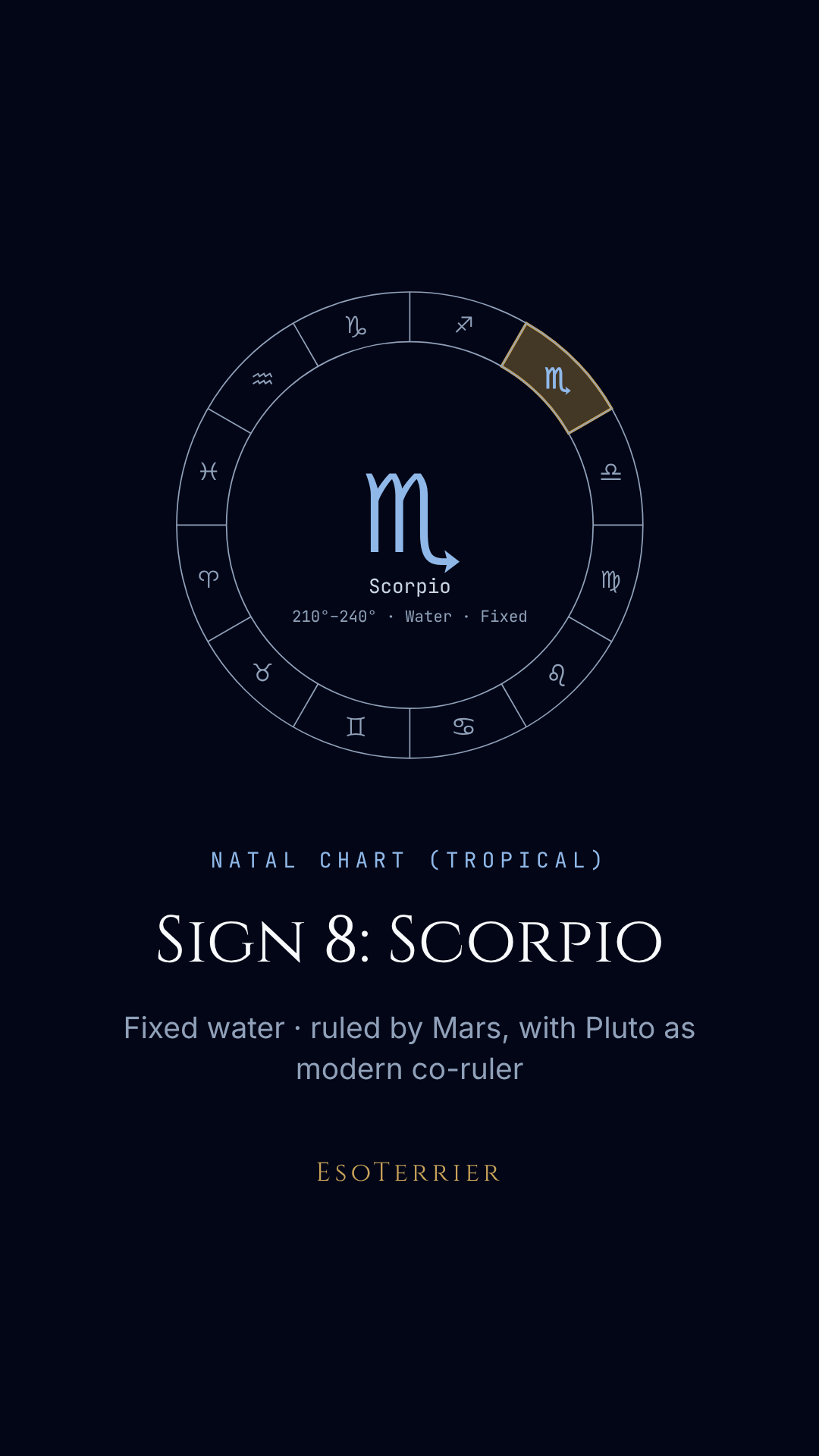
The sign runs from 210° to 240° past the March equinox. The constellation of the Scorpion is small on the ecliptic, and the Sun crosses a corner of Ophiuchus after it; that is the root of the "thirteenth sign" story, which confuses the star figures with the signs. NASA did not change the zodiac. The Jyotisha chart's Vrishchika is counted from the stars, about 24° behind.
Rising
When Scorpio is the rising sign, our chart's own reading opens: "A Scorpio Ascendant meets the world with intensity, reserve and a perceptive gaze that misses little." Those are EsoTerrier's words, written in 2026 as a reading aid. The chart then names Mars as ruler and Pluto beside it as the modern co-ruler.
Correspondences
Each item with how it stands: “sourced” is in the work cited, “our construction” is EsoTerrier’s own, and “disputed” means the sources disagree.
- Element (Valens)
- Water: the moist triangle with Cancer and Pisces sourced
- Modality (Ptolemy)
- Fixed; our fixed sourced
- Polarity (Ptolemy)
- feminine, nocturnal (negative) sourced
- Ruler (Ptolemy)
- Mars sourced
- Modern co-ruler
- Pluto, a twentieth-century attribution; the traditional revival does not use it disputed
- Day or night house (Lilly, 1647)
- Mars's night house (Aries his day house) sourced
- Triplicity lords (Ptolemy, in Ashmand)
- Mars, with Venus by day and the Moon by night sourced
- Detriment (medieval)
- Venus, in the sign opposite its own house sourced
- Golden Dawn trump (*Book T*)
- Death sourced
- Natural house (modern teaching)
- House 8, in the sign, house and planet scheme Alan Leo taught sourced
- Our keywords
- "intense, loyal, transformative" our construction
How the schools read it
- Ptolemy (2nd century CE)
- A fixed sign, the house of Mars.
- Valens (2nd century CE)
- In the moist triangle with Cancer and Pisces.
- Lilly (1647)
- Mars's night house (Aries his day house).
- The Golden Dawn (*Book T*)
- Attributed to Death.
- Modern Western (Alan Leo and after)
- Read for character rather than events, with Mars as ruler and Pluto as co-ruler.
- Jyotisha
- Vrishchika, the sidereal sign of the same name, counted from the stars about 24° back.
- EsoTerrier
- Keywords "intense, loyal, transformative", our own words, and a reading for each planet in Scorpio.
Claims about it
-
Each Sun sign has fixed calendar dates, such as 21 March to 19 April for Aries.
falseWhat the record shows: The Sun enters each sign at a different moment each year, and the date also depends on the time zone; in 2024 to 2028 Aries began on 20 March at times from 02:17 to 20:24 UTC. The chart decides.
-
The twelve signs are the twelve constellations, each 30° wide.
falseWhat the record shows: The signs are equal divisions of the ecliptic; the constellations are star figures of different sizes, and by the boundaries astronomers drew in 1930 the Sun crosses thirteen of them. The names were shared from the start, the shapes never.
-
Tropical astrology is wrong because its signs no longer match the constellations.
falseWhat the record shows: The tropical zodiac is defined from the March equinox and keeps each sign with its season by definition. The two zodiacs measure the same positions from different starting points; whether either means anything is a separate question.
-
Uranus, Neptune and Pluto rule Aquarius, Pisces and Scorpio.
disputedWhat the record shows: A modern attribution made in stages after the three discoveries; the traditional rulers are Saturn, Jupiter and Mars, and the traditional revival keeps them. We name the traditional ruler first and the modern co-ruler beside it.
-
There is a thirteenth sign, Ophiuchus, and everyone's sign has moved.
falseWhat the record shows: The tropical signs are twelve equal divisions counted from the equinox and were never the constellations. Ophiuchus is a constellation the ecliptic crosses, not a sign of either zodiac in use.
-
NASA changed the zodiac.
falseWhat the record shows: NASA's own post of 20 September 2016 said it had changed no zodiac signs and had only done the math, after a page for children explained precession. NASA does not define the zodiac.
Elsewhere on EsoTerrier
- Mars its traditional ruler
- Pluto its modern co-ruler
- House 8: intimacy and shared resources the house modern teaching pairs with it
- Sign 2: Taurus the opposite sign
- Vrishchika (Jyotisha chart) the sidereal sign of the same name
- Death (tarot) its Golden Dawn trump
- Scorpio 1 (Sabian symbols) the first of its thirty Sabian degrees