Skip to content

Natal Chart (Tropical) · Body 10 of 11

Pluto, found in 1930 and a dwarf planet since 2006

Pluto is the body Clyde Tombaugh found in 1930, which astronomers reclassified as a dwarf planet in 2006, a change that left astrological practice as it was. Its eccentric orbit keeps it twelve to thirty years in a sign; modern astrology made it co-ruler of Scorpio.

Where does it sit in your chart?

Draw your free chart: natal chart No email needed
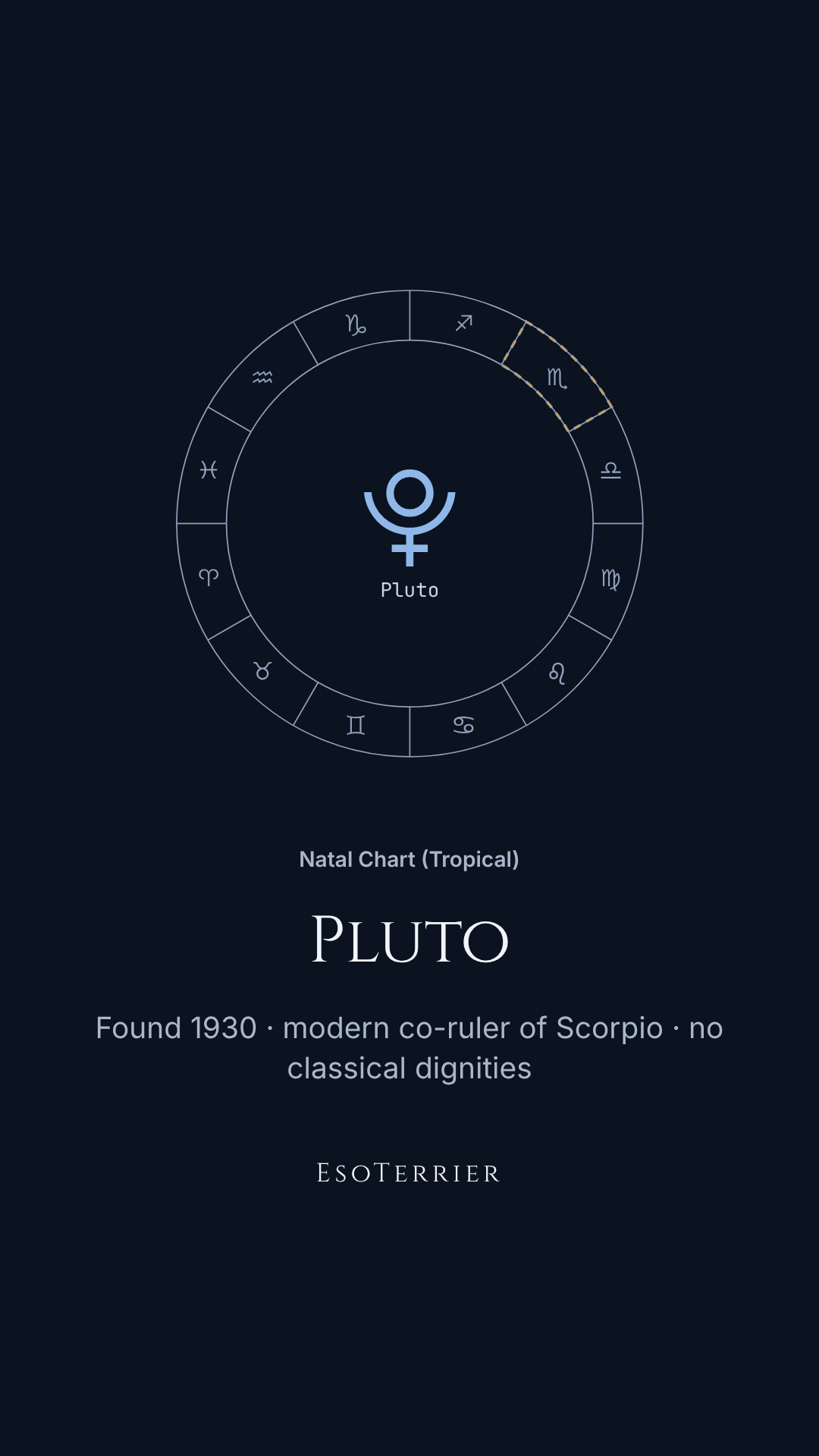
The glyph of Pluto at the centre of a ring of the twelve signs, with Scorpio outlined with a dashed line for its modern co-rulership; it has no classical dignities. ♈︎ ♉︎ ♊︎ ♋︎ ♌︎ ♍︎ ♎︎ ♏︎ ♐︎ ♑︎ ♒︎ ♓︎ ⯓︎ Pluto
Pluto and the sign modern astrology gave it, Scorpio, dashed because the rulership is modern. Our drawing.

Facts

Glyph
The bident with an orb, U+2BD3, as in the figure; not the PL monogram ♇ (U+2647)
Orbit
247.9 years, on an eccentric orbit
Time in a sign
Twelve to thirty years
Found
18 February 1930, Clyde Tombaugh, Lowell Observatory (announced 13 March 1930)
Classical dignities
None: unknown to the classical texts
Modern co-rulership
Scorpio, beside its traditional ruler Mars
Our orbs
8°, 4° sextile, 2° quincunx; the luminaries' orbs with the Sun or Moon
Status
A dwarf planet since the IAU decision of 2006

Meaning

Clyde Tombaugh found Pluto at the Lowell Observatory on 18 February 1930, and the discovery was announced on 13 March. In 2006 the International Astronomical Union reclassified it as a dwarf planet; astrologers kept it, as they keep Chiron.

Its orbit takes 247.9 years and is so eccentric that it spends between about twelve and thirty years in a sign, so its sign marks a generation and its house and aspects carry the personal reading.

Modern astrology reads Pluto as depth, power, endings and renewal. Our keywords are "power, depth, transformation".

A ruler within a decade

Astrologers had listed Pluto as ruler of Scorpio by 1936, though some argued for Aries into the 1940s. The traditional revival keeps Mars. We name Mars as Scorpio's ruler and Pluto as its modern co-ruler, second.

Glyph and correspondences

Two glyphs are in use: the PL monogram, ♇, for Percival Lowell, and the bident with an orb, the trident's two-pronged cousin drawn in the figure on this page. We draw the bident, by the owner's choice of 2026. Paul Foster Case in 1933 set Pluto beside Judgement, with his own question mark; the Golden Dawn's Book T gives that trump the element of fire.

In our readings

Our chart's own line for Pluto reads: "Pluto represents depth, power, letting go and the capacity for profound renewal." The chart gives Pluto a reading in each sign and house like any planet. Its sign is shared by everyone born over twelve to thirty years, so the house and the aspects carry the personal reading. As chart ruler it gets a line of its own: "With Pluto as the modern ruler of Scorpio rising, depth, intensity and cycles of renewal tend to run through the whole life." These are EsoTerrier's words, written in 2026.

Correspondences

Each item with how it stands: “sourced” is in the work cited, “our construction” is EsoTerrier’s own, and “disputed” means the sources disagree.

Discovery
18 February 1930, Clyde Tombaugh, Lowell Observatory (announced 13 March 1930) sourced
Ruler of Scorpio
Listed as ruler of Scorpio by 1936, with Aries still argued in the 1940s disputed
Trump (Paul Foster Case, 1933)
Judgement (Case writes 'Pluto(?)'); not in Book T sourced
A generation's sign
Twelve to thirty years in a sign, so its sign is shared across a generation sourced
Our keywords
"power, depth, transformation" our construction

How the schools read it

Modern Western
Co-ruler of Scorpio; read for its house and aspects, its sign as a generation's.
Traditional revival (Project Hindsight and after)
Not used as a ruler; sometimes not shown.
Jyotisha
Shown only behind a "modern planets" switch in some Indian tools.
EsoTerrier
Shown on the wheel; named second as co-ruler of Scorpio; keywords "power, depth, transformation".

Claims about it

  • Uranus, Neptune and Pluto rule Aquarius, Pisces and Scorpio.

    disputed

    What the record shows: A modern attribution made in stages after the three discoveries; the traditional rulers are Saturn, Jupiter and Mars, and the traditional revival keeps them. We name the traditional ruler first and the modern co-ruler beside it.
Elsewhere on EsoTerrier

Sources

Primary texts (4)
  1. Claudius Ptolemy; tr. J. M. Ashmand, Ptolemy's Tetrabiblos, or Quadripartite: being four books of the influence of the stars, translated by J. M. Ashmand (from the paraphrase of Proclus). Davis and Dickson, London, 1822. Public domain; quoted briefly. archive.org/details/b29293066
  2. Alan Leo (William Frederick Allan), Astrology for All, to which is added a complete system of predictive astrology for advanced students. Modern Astrology Office, London, 1899. Public domain; quoted briefly. archive.org/details/bub_gb_8CwSAAAAYAAJ
  3. Hermetic Order of the Golden Dawn (S. L. MacGregor Mathers), Book T: The Tarot (the Golden Dawn tarot paper). privately circulated; archive.org item mathers-and-felkin-golden-dawn-book-t-the-tarot-1888, late 1880s or early 1890s. Public domain. archive.org/details/mathers-and-felkin-golden-dawn-book-t-the-tarot-1888
  4. Paul Foster Case, A Course on Tarot Divination (The Oracle of Tarot), lesson 1, figure 1-2 'Astrological Attributions of the Major Trumps'. School of Ageless Wisdom (mimeographed course); transcription by TarotWorks, hosted by benebellwen.com, 1933. Facts only. benebellwen.com/wp-content/uploads/2013/02/paul-foster-case-oracle-of-the-tarot-1933-source-credit-tarotworks.pdf
Studies and other sources (5)
  1. Chris Brennan, Hellenistic Astrology: The Study of Fate and Fortune. Amor Fati Publications, Denver, 2017. In copyright; facts only.
  2. NASA Goddard Space Flight Center, National Space Science Data Center (D. R. Williams), Planetary Fact Sheet (metric). NASA NSSDC, 2024. nssdc.gsfc.nasa.gov/planetary/factsheet
  3. NASA Jet Propulsion Laboratory, Solar System Dynamics, JPL Small-Body Database: 2060 Chiron (1977 UB). NASA JPL, 2026. ssd.jpl.nasa.gov/tools/sbdb_lookup.html#/?sstr=2060
  4. Wikipedia contributors, Wikipedia: Uranus; Neptune; Pluto; Lunar node. Wikimedia Foundation, 2026. CC BY-SA; consulted for facts. en.wikipedia.org/wiki/Lunar_node
  5. Wikipedia contributors, Wikipedia: Domicile (astrology); Exaltation (astrology); Essential dignity; Astrological sign. Wikimedia Foundation, 2026. CC BY-SA; consulted for facts. en.wikipedia.org/wiki/Exaltation_(astrology)
Our own research (4)
  1. EsoTerrier, Natal and sidereal wheels: research for the rebuild (README, report-main.md, notes/). Research folder 2026-10-11-natal-sidereal, 2026.
  2. EsoTerrier, EsoTerrier chart engine: services/chart/ephemeris.py, calculation.py, jyotish.py, texts.py. python/esoterrier, services/chart, 2026.
  3. EsoTerrier, EsoTerrier app: resources/js/support/natal.ts and components/Chart/NatalChartTropical.vue. The chart component in our app, 2026.
  4. EsoTerrier, Knowledge layer shared topics: _shared/zodiac and _shared/planets (accuracy pass, 2026-10-13). Knowledge layer, shared topics, 2026.

Your Natal Chart reading, $3.99. Includes this system's raw data. Written for you by AI. Read a sample. Charts and the written text are free in every account.

By EsoTerrier. Written with AI assistance from our research and checked against its sources; last revised 20 October 2026. How we write these pages.

First published ; last revised . Corrections: support@esoterrier.com.