Meaning
William Herschel saw Uranus on 13 March 1781 from his garden in Bath and reported it first as a comet; its planetary nature was recognised in the following months. No classical text could know it, so it has no house, exaltation or fall in Ptolemy's tables, and the traditional revival leaves it out of the rulerships.
It circles the Sun in 83.7 years and spends about seven years in each sign, so everyone born in the same stretch of years shares its sign. Astrologers who use it read the sign as a mark of a generation and the house and aspects as the personal part; we say so whenever its sign comes up.
Modern astrology reads Uranus as sudden change, independence, invention and the urge to break free. Our keywords are "change, freedom, originality".
A ruler by stages
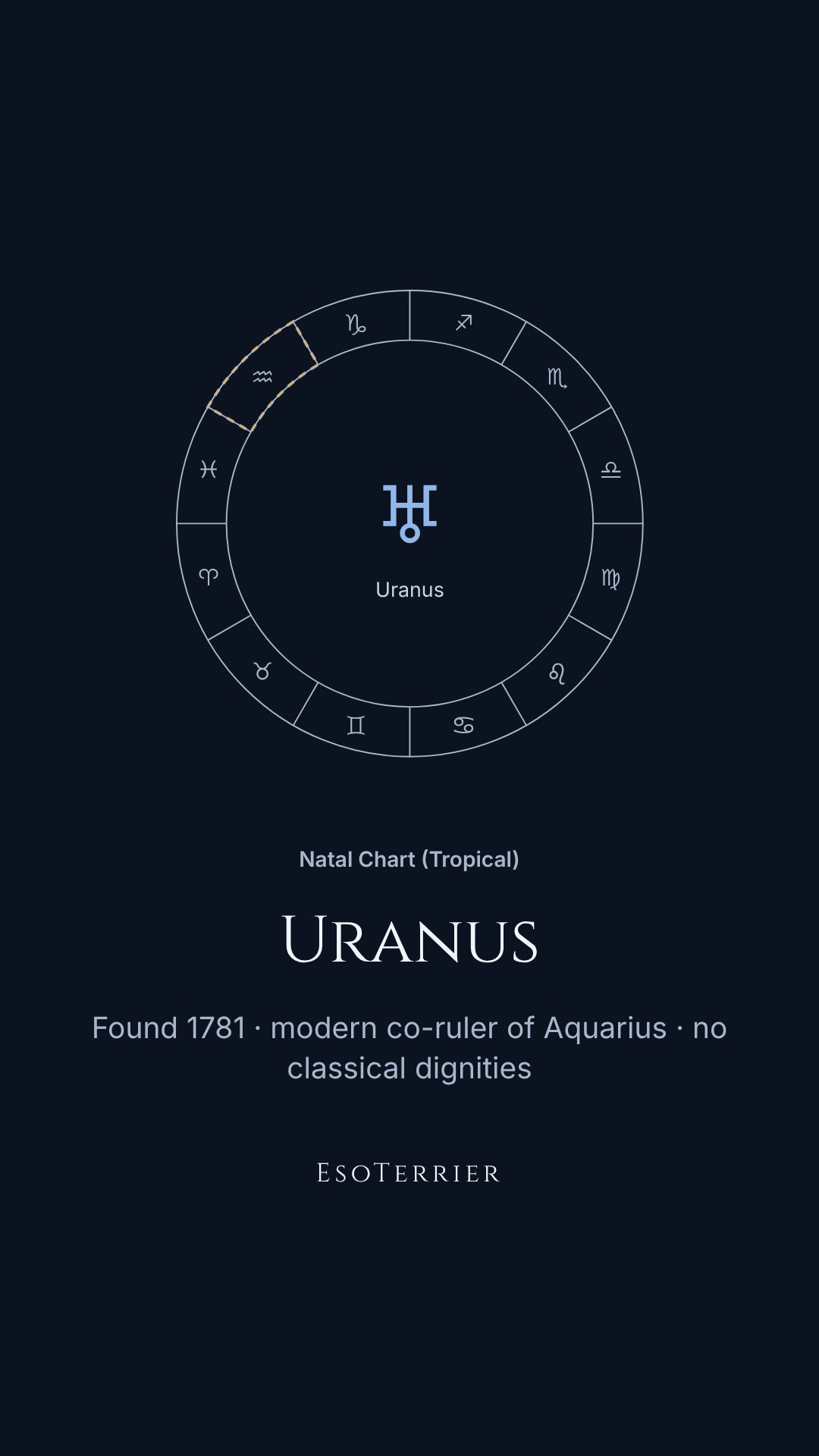
John Varley gave Uranus the sign of Aquarius in 1828. The attribution was argued over through the nineteenth century, Alan Leo wrote in 1909 that astrologers had given it no sign, and it became the modern consensus only later. We name Saturn as Aquarius's ruler and Uranus as its modern co-ruler, beside it and second.
Glyph and correspondences
We draw Uranus with the H-form glyph, ♅, the H standing for Herschel. The Golden Dawn's Book T gives the trumps of the outer planets elements, not planets; it was Paul Foster Case, in a course of 1933, who set Uranus beside the Fool.
In our readings
Our chart's own line for Uranus reads: "Uranus represents sudden change, independence, innovation and the urge to break free." The chart gives Uranus a reading in each sign and house like any planet, but when it comes to the sign we say plainly that it is shared by everyone born in the same seven years or so. As chart ruler it gets a line of its own: "As the modern ruler of Aquarius rising, Uranus brings freedom, originality and the drive to break from convention into the life as a whole." These are EsoTerrier's words, written in 2026.
Correspondences
Each item with how it stands: “sourced” is in the work cited, “our construction” is EsoTerrier’s own, and “disputed” means the sources disagree.
- Discovery
- 13 March 1781, William Herschel, Bath sourced
- Ruler of Aquarius
- Given Aquarius by John Varley in 1828, argued over through the nineteenth century, the modern consensus only in the twentieth disputed
- Trump (Paul Foster Case, 1933)
- The Fool; not in Book T sourced
- A generation's sign
- About seven years in a sign, so its sign is shared across a generation sourced
- Our keywords
- "change, freedom, originality" our construction
How the schools read it
- Modern Western
- Co-ruler of Aquarius; read for its house and aspects, its sign as a generation's.
- Traditional revival (Project Hindsight and after)
- Not used as a ruler; sometimes not shown.
- Jyotisha
- Shown only behind a "modern planets" switch in some Indian tools.
- EsoTerrier
- Shown on the wheel; named second as co-ruler of Aquarius; keywords "change, freedom, originality".
Claims about it
-
Uranus, Neptune and Pluto rule Aquarius, Pisces and Scorpio.
disputedWhat the record shows: A modern attribution made in stages after the three discoveries; the traditional rulers are Saturn, Jupiter and Mars, and the traditional revival keeps them. We name the traditional ruler first and the modern co-ruler beside it.