Meaning
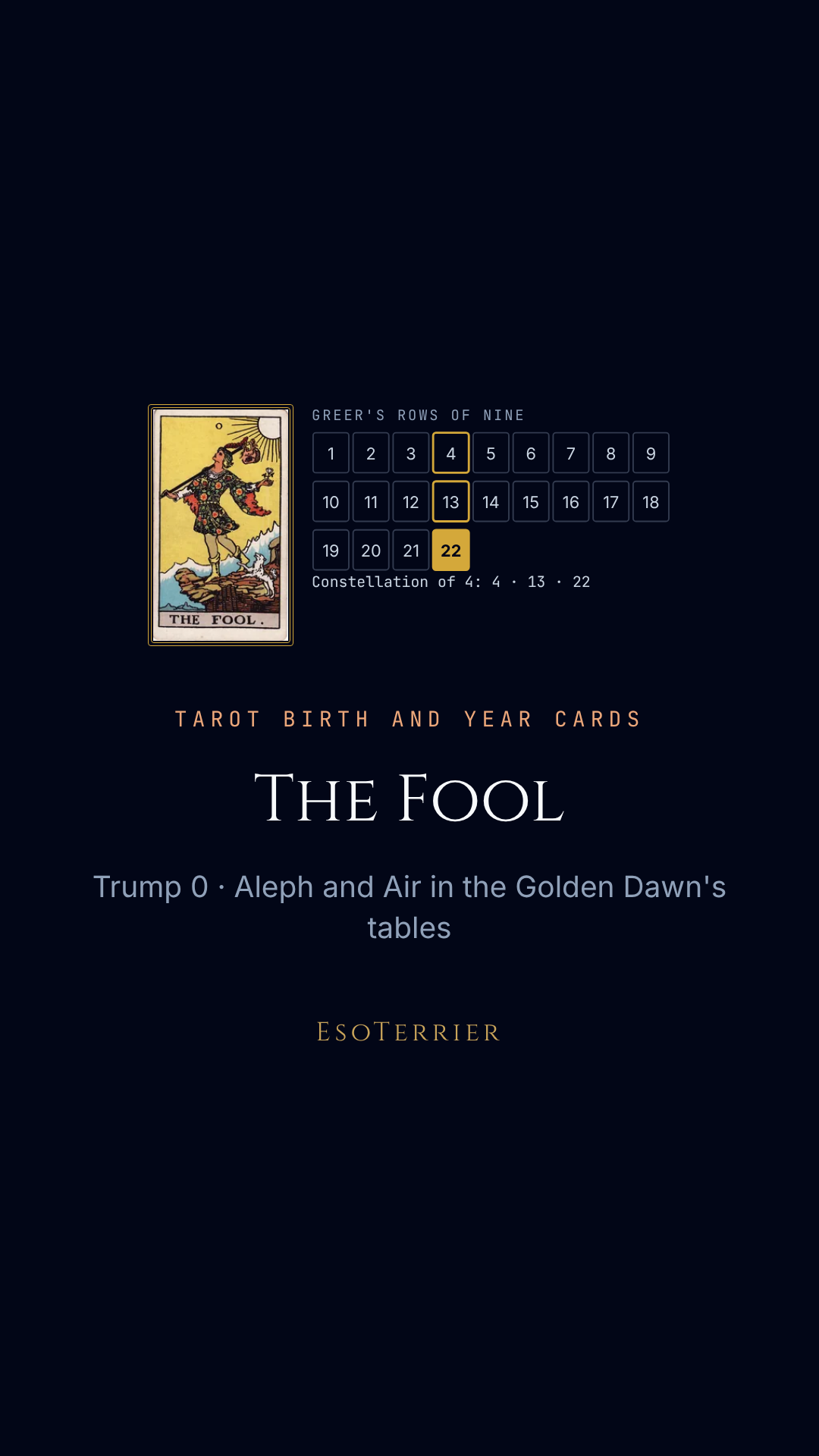
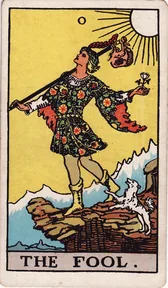
Smith drew the Fool as a young man in a bright tunic on the brink of a cliff, a white rose in one hand and a staff over his shoulder with a small embroidered bag hanging from it, a dog leaping beside him and the sun behind. He looks up and out, not at the drop. Waite calls him the spirit in search of experience, and says the card shows a prince of the other world on his travels through this one.
The Golden Dawn gave the Fool the first Hebrew letter, Aleph, which it glosses as ox, and the element Air, and titled it the Spirit of Æthyr; on its Tree of Life the Fool is path 11, the first of the twenty-two. That table is the order's, made about 1888, and it puts the Fool first. Lévi and the French school had put it next to last, on Shin, and the old game decks left it without a number at all.
We read the card as the open beginning: setting out in trust before the road is known, with the freshness and the carelessness that go together. Waite's own fortune-telling list for the card runs from folly to frenzy; he called such meanings arbitrary.
In the birth cards
The Fool is printed 0, and no sum of positive numbers reaches 0. In Greer's arithmetic a total of 22 stands for the Fool: such a person has the Fool as Personality card and the Emperor, 4, as Soul card, and Death, 13, is the card of their constellation they do not reach. Greer's first edition of 1984 gave the two roles the other way round, and the Tarot School and most web calculators reduce 22 to 4 and name Death and the Emperor instead.
A total of 22 is rare and getting rarer. It happens on 5.3 percent of the days from 1900 to 2030, only for births up to 1991, and for no one born from 1992 until 2256. The Fool is also the Hidden Factor of anyone whose total is 13, or a single 4.
As a year card the Fool always follows a World year, 21, since the yearly total climbs by one until a carry pulls it back. For a 15 June birthday it is the year card in 7 of the 201 years from 1900 to 2100. It is the card of no sign, so it never appears among the natal-chart cards.
History and names
In the fifteenth-century game the Fool was the Excuse, a card played to escape following suit, and it carried no number; the Marseille decks call it Le Mat. Court de Gébelin's plate of 1781 already marks it 0. Smith's deck of 1909 was the first popular pack to print it as 0 at the head of the trumps, following the Golden Dawn, although Waite's own text still lists it after Judgement.
Correspondences
Each item with how it stands: “sourced” is in the work cited, “our construction” is EsoTerrier’s own, and “disputed” means the sources disagree.
- Golden Dawn title (Book T)
- “The Spirit of Æthyr” sourced
- Waite's fortune-telling list (1911), upright
- “Folly, mania, extravagance, intoxication, delirium, frenzy, bewrayment”, quoted as history; Waite called such meanings artificial and arbitrary sourced
- Greer's name for the constellation
- Life Force and the Realization of Power (1987, 2021) sourced
- Our line for the birth-card chain
- 22-4: Steady rule, leaping heart our construction
- Outer planet in later tables
- Uranus, first found in Paul Foster Case's course of 1933; not in Book T, which gives the element only disputed
- Place in the sequence
- First, as 0, in the Golden Dawn and the 1909 deck; next to last in the French school disputed
How the schools read it
- Game decks (15th to 18th century)
- The game's Excuse: unnumbered, played to avoid following suit rather than to win a trick. Le Mat in the Marseille pattern; present but unnamed in the Milanese cards.
- Golden Dawn, Book T
- Aleph, the first letter, a mother letter, and the element Air; path 11, the first of the twenty-two. Book T calls the card the Foolish Man and titles it the Spirit of Æthyr.
- Waite and Smith (1909 to 1911)
- The spirit setting out in search of experience, looking up rather than down; Waite lists the card as zero after XX in his text, but Smith's deck puts it first.
- Mary K. Greer (1984 to 2021)
- Counts it as 22, in the constellation of 4 with the Emperor and Death. For a total of 22 it is the Personality card, with the Emperor as Soul card; her 1984 edition had the two the other way round.
- Lévi and the French school (1856)
- Places the Fool next to last, on the letter Shin, between Judgement and the World, and gives Aleph to the Magician.
- The Tarot School and others
- Never a birth card: no sum reaches a card numbered 0, so a total of 22 is reduced to 4 and gives Death and the Emperor.
- EsoTerrier
- Read here as the open beginning: setting out in trust before the road is known, with the freshness and the carelessness that go together.
Claims about it
-
A birth total of 22 is the Fool, with the Emperor as Soul card.
disputedWhat the record shows: Greer's rule since 2002, which we follow and label. Her 1984 edition made the Emperor the Personality card, and the Tarot School gives Death and the Emperor for the same dates.
-
The Fool is ruled by Uranus.
disputedWhat the record shows: Book T and 777 give the Fool the element Air. Uranus is a twentieth-century addition, first found in Case's 1933 course.
-
The Fool belongs between Judgement and the World.
disputedWhat the record shows: The French school's placing, from Lévi. The Golden Dawn, and the 1909 deck after it, put the Fool first as 0.
-
A Fool year brings sudden changes of work, home or partner.
falseWhat the record shows: No card foretells events. The year card is a theme for the calendar year.