Meaning
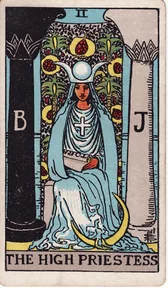
Smith's High Priestess sits between two pillars, a black one marked B and a white one marked J, before a veil patterned with palms and pomegranates. She wears a horned crown with a globe and a solar cross on her breast, and a scroll lettered TORA lies half hidden in the folds of her mantle, which Waite says shows that some things are implied and some spoken. A crescent moon lies at her feet.
For Waite she is the secret and withdrawn side of religion, as the Hierophant is its public side. The Golden Dawn gave her Gimel, the camel, a double letter, and the Moon, and titled her the Priestess of the Silver Star; on its tree she is path 13, the long path from the crown to the centre.
We read the card as inward knowledge kept in silence: what is known before it is said, and what is left unsaid on purpose. Waite's list of fortune-telling meanings for her, secrets and mystery, the future as yet unrevealed, is quoted below as his.
In the birth cards
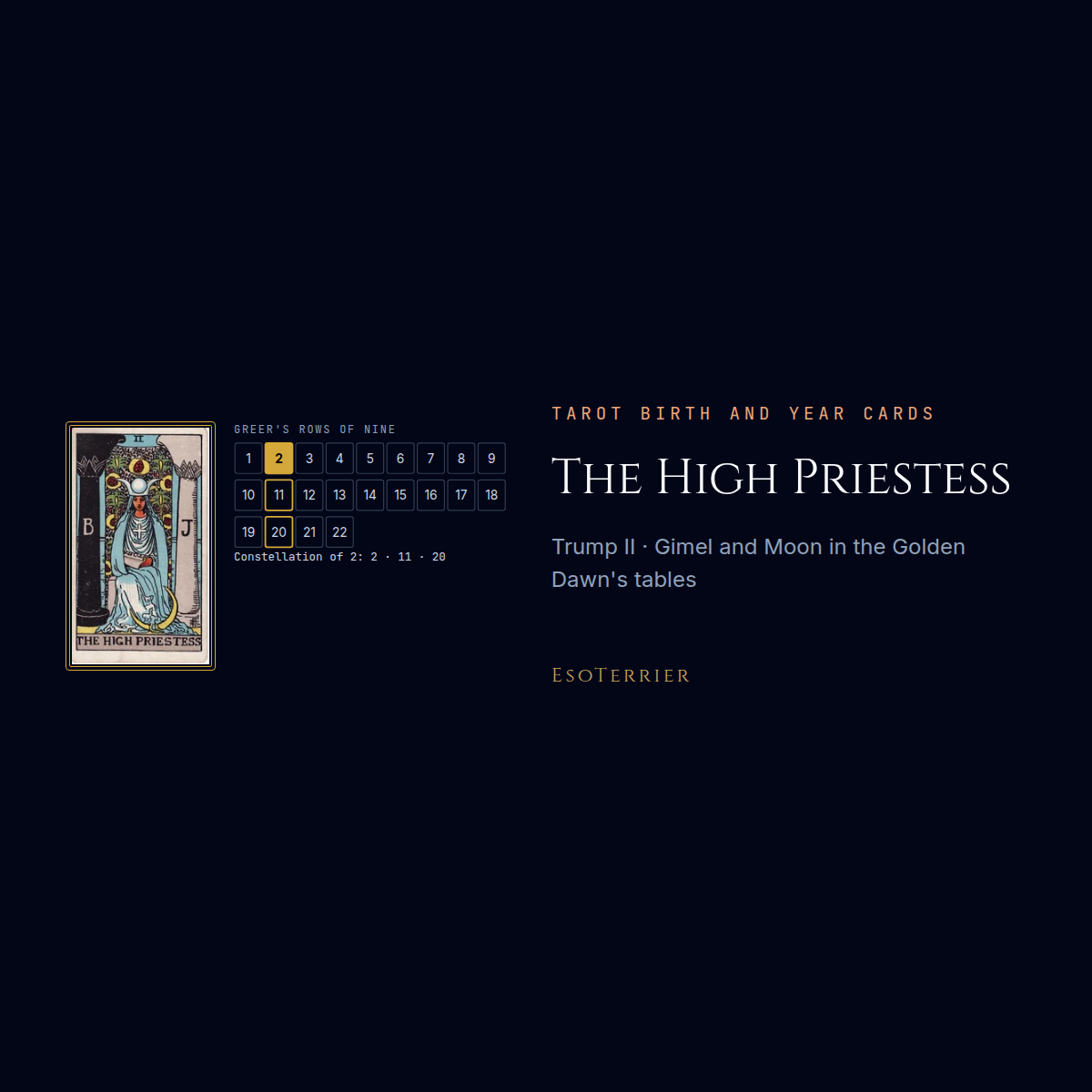
The High Priestess is the root of Greer's second constellation, with Justice, 11, and Judgement, 20. She is the Soul card of everyone whose total is 11 or 20, on 11.1 percent of the days from 1900 to 2030, and both cards at once for the few whose total is exactly 2, on 0.8 percent. A single 2 leaves Justice and Judgement unreached, so those dates have two Hidden Factor cards.
The person in Figure 1 of the Tarot page has her as Soul card, with Justice as Personality card and Judgement as Hidden Factor. That pairing depends on the numbering: with the Marseille order, where trump XI is Strength, the same total would give Strength and the High Priestess.
As a year card she needs the yearly total to fall to 2, which happens rarely: once in the 201 years from 1900 to 2100 for a 15 June birthday. She is the card of no sign.
History and names
In the Marseille pattern the card is La Papesse, the Popess, crowned with a tiara and holding a book. Gertrude Moakley proposed that the figure in the Visconti-Sforza cards is Sister Manfreda, a Milanese nun of a small heretical sect, the Guglielmites, burned in 1300; it is a scholar's reading, not a record. Book T calls the card the High Priestess, and Smith's card keeps that name.
Correspondences
Each item with how it stands: “sourced” is in the work cited, “our construction” is EsoTerrier’s own, and “disputed” means the sources disagree.
- Golden Dawn title (Book T)
- “The Priestess of the Silver Star” sourced
- Waite's fortune-telling list (1911), upright
- “Secrets, mystery, the future as yet unrevealed; the woman who interests the Querent, if male; the Querent herself, if female; silence, tenacity; mystery, wisdom, science”, quoted as history; Waite called such meanings artificial and arbitrary sourced
- Greer's name for the constellation
- Balanced Judgment through Intuitive Awareness (1987, 2021) sourced
- Our line for the birth-card chain
- 2: Inner truth, quietly held; 11-2: Inner truth, fairly weighed; 20-2: Quiet knowing, sudden awakening our construction
- Thoth deck name
- The Priestess, II sourced
- Older name
- La Papesse, the Popess, with tiara and book sourced
How the schools read it
- Game decks (15th to 18th century)
- La Papesse, the female pope, with a tiara and a book; Moakley identified the Milanese figure with Sister Manfreda, burned in 1300.
- Golden Dawn, Book T
- Gimel, the camel, a double letter, and the Moon; path 13, running from Kether to Tiphareth. Book T titles it the Priestess of the Silver Star.
- Waite and Smith (1909 to 1911)
- The hidden, inward side of religion, set against the Hierophant's public teaching; the scroll is half covered to show that some things are implied and some spoken.
- Mary K. Greer (1984 to 2021)
- The root of the constellation of 2, with Justice and Judgement: the Soul card of every total of 11 or 20, and both cards for a single 2.
- Crowley, Thoth deck (1944)
- Called simply the Priestess; the letter and the Moon are unchanged.
- EsoTerrier
- Read here as inward knowledge kept in silence: what is known before it is said, and what is left unsaid on purpose.
Claims about it
-
Gimel and the Moon are the High Priestess's ancient attributes.
disputedWhat the record shows: They are the Golden Dawn's, from about 1888. The card itself began as a Popess in a fifteenth-century game.
-
The High Priestess and Justice always make the pair 11-2.
disputedWhat the record shows: Only with the 1909 numbering, where Justice is XI. Under the Marseille numbering trump XI is Strength, and the pair becomes Strength and the High Priestess.
-
Having the High Priestess as Soul card makes a person intuitive.
unverifiedWhat the record shows: No study links birth cards to any trait. Greer's readings are hers, and we offer the card as a theme to recognise, not a finding.