Meaning
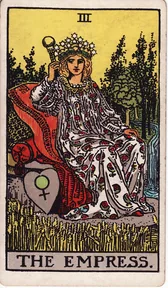
Smith drew the Empress outdoors: a crowned woman seated on cushions, twelve stars in her crown and a sceptre topped with a globe in her hand, a heart-shaped shield bearing the sign of Venus beside her. A field of grain ripens in front of her, and trees and a waterfall rise behind. Waite calls her universal fruitfulness and the outer sense of the Word, the earthly garden and the door by which life is entered.
The Golden Dawn gave the card Daleth, a double letter glossed as door, and the planet Venus, and titled it the Daughter of the Mighty Ones. On the order's tree the Empress is path 14, the crossbar that joins the second and third sephiroth at the top of the tree.
We read the card as growth and care: the power to make things grow, in a household, a body of work or a family, and the patience a harvest asks for. Waite's fortune-telling list for her starts with fruitfulness and initiative and ends with difficulty and doubt; it is quoted below as his, not as a promise.
In the birth cards
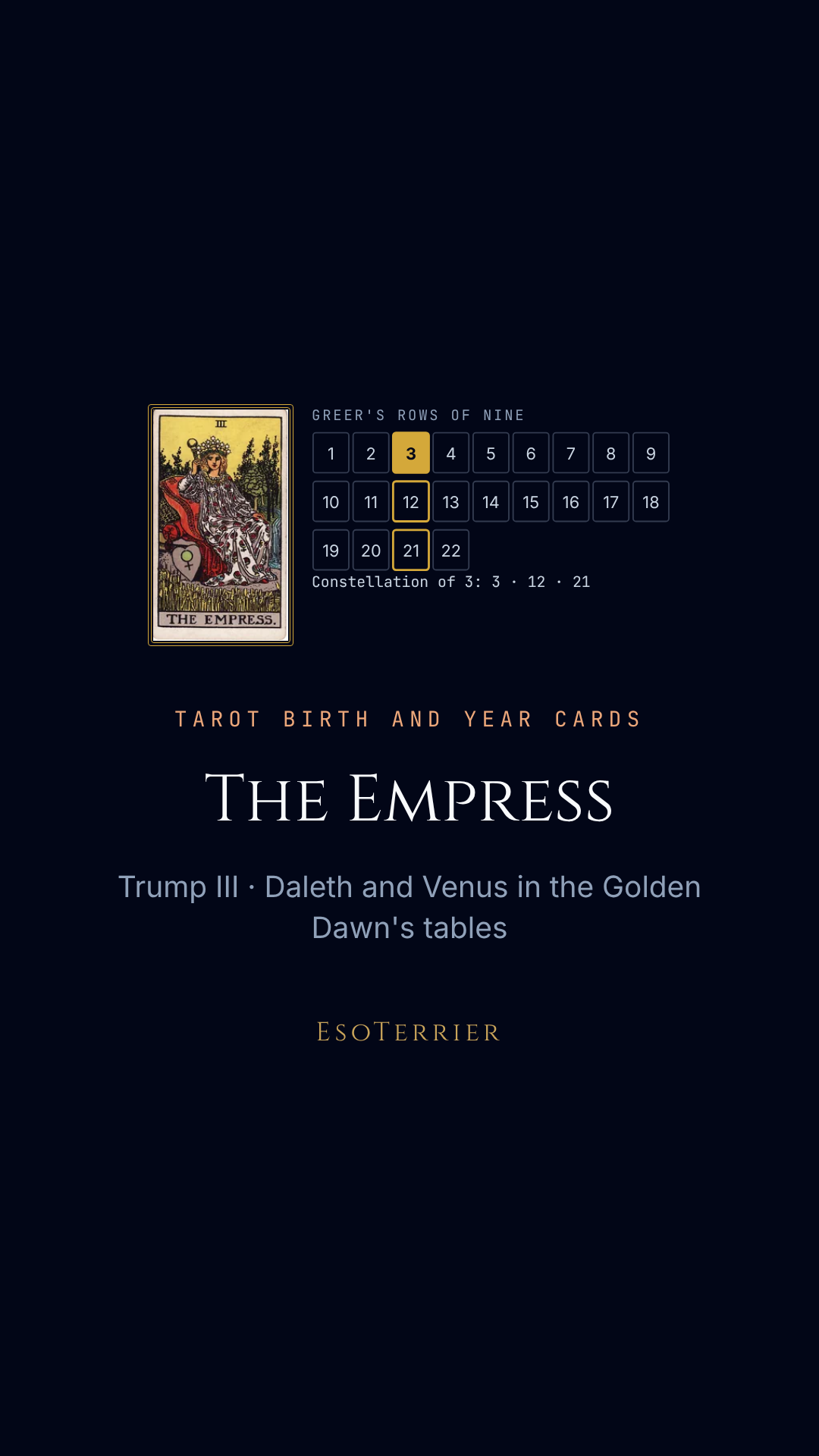
The Empress is the root of Greer's third constellation, with the Hanged Man, 12, and the World, 21. She is the Soul card of everyone whose total is 12 or 21, on 11.1 percent of the days from 1900 to 2030, and both cards at once for a total of exactly 3, on 1.5 percent. A single 3 leaves the Hanged Man and the World both unreached, two Hidden Factor cards.
The chain 21-3 is closing: a total of 21 happens for births up to 1990 and then not again until 2156. People born since then who have the Empress as Soul card all reach her through the Hanged Man, 12.
As a year card she comes three times in the 201 years from 1900 to 2100 for a 15 June birthday. She is the card of no sign; her planet, Venus, is not one of the bodies our chart reads for cards.
History and names
The Empress is L'Impératrice in the Marseille decks, and Court de Gébelin's plate of 1781 shows her crowned, with a sceptre and a shield bearing an eagle. Smith's shield carries the sign of Venus instead, the Golden Dawn's planet for the card.
Correspondences
Each item with how it stands: “sourced” is in the work cited, “our construction” is EsoTerrier’s own, and “disputed” means the sources disagree.
- Golden Dawn title (Book T)
- “The Daughter of the Mighty Ones” sourced
- Waite's fortune-telling list (1911), upright
- “Fruitfulness, action, initiative, length of days; the unknown, clandestine; also difficulty, doubt, ignorance”, quoted as history; Waite called such meanings artificial and arbitrary sourced
- Greer's name for the constellation
- Love and Creative Imagination (1987, 2021) sourced
- Our line for the birth-card chain
- 3: Love that makes things grow; 12-3: Creating through devotion; 21-3: Creation brought to completion our construction
- Planet in Book T
- Venus, shown on her shield in the 1909 design sourced
How the schools read it
- Game decks (15th to 18th century)
- L'Impératrice, crowned, with a sceptre and a shield bearing an eagle, as Court de Gébelin's plate of 1781 shows her.
- Golden Dawn, Book T
- Daleth, the door, a double letter, and Venus; path 14, joining Chokmah and Binah. Book T titles it the Daughter of the Mighty Ones.
- Waite and Smith (1909 to 1911)
- Universal fruitfulness and the outer sense of the Word: the earthly garden, the door by which life is entered.
- Mary K. Greer (1984 to 2021)
- The root of the constellation of 3, with the Hanged Man and the World: the Soul card of every total of 12 or 21, and both cards for a single 3.
- EsoTerrier
- Read here as growth and care: the power to make things grow, in a household, a body of work or a family, and the patience a harvest asks for.
Claims about it
-
The Empress was always the card of Venus.
disputedWhat the record shows: The pairing is the Golden Dawn's, from about 1888, and Smith drew it onto the card in 1909. The fifteenth-century Empress carried the imperial eagle.
-
The Empress foretells pregnancy or wealth.
falseWhat the record shows: No card foretells events. Waite's fortune-telling list is quoted as history.
-
Reading the Empress as a birth card is an ancient practice.
falseWhat the record shows: Birth cards are from the 1970s and 1980s: Arrien taught the sum, and Greer published it in 1984.