Meaning
The Sun is the one body almost everyone knows the sign of, because it moves through the zodiac once a year and so its sign follows the birthday. In the chart it does more than name a sign: whether it stands above or below the horizon at the birth place makes the chart a day chart or a night chart, and that choice changes how the Part of Fortune is counted.
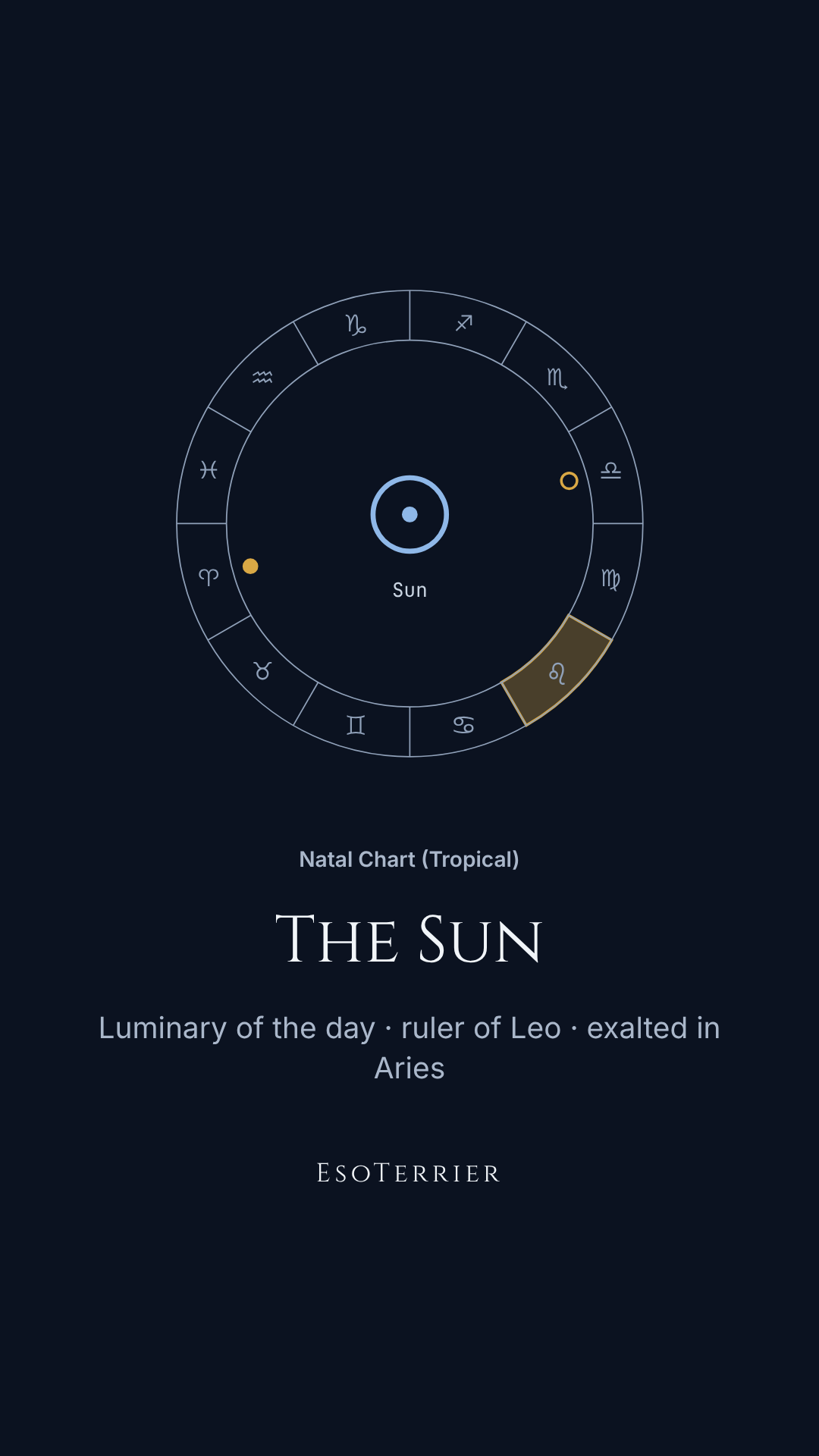
Ptolemy makes it the luminary of the day, masculine and diurnal, and calls it common, neither benefic nor malefic in itself but good or ill with its company. He gives it Leo as its only house and Aries as its exaltation, with its fall in Libra; the medieval writers add its detriment in Aquarius. Valens reads it for rule, intellect, reputation and the father.
Modern astrology, since Alan Leo, reads the Sun as the core self, vitality and the purpose a person grows into, and the sun-sign column of the 1930s made it the first thing most people learn. Our keywords are "identity, vitality, purpose", and our readings follow that line: identity and direction, never a fate.
In a chart
The Sun takes the widest orbs in our aspect policy, with the Moon: 10° for a conjunction, square, trine or opposition, 6° for a sextile. Mercury and Venus are never far from it, so a chart's Mercury and Venus always sit in or near the Sun's sign. The Sun's sign and house are read first, with the Moon and the rising sign: the big three.
Exaltation by degree
Ptolemy names the sign of exaltation and nothing finer. The medieval lists, in Firmicus Maternus and al-Biruni, put the Sun's exaltation at 19° of Aries; the Brihat Jataka, translated by Iyer in 1885, puts it at 10° of Aries. We record the sign as the classical fact and the degrees as a later, disputed layer. In the Jyotisha chart the same body is Surya.
In our readings
Our chart's own line for the Sun reads: "The Sun represents the core self, vitality and the purpose one grows into over a lifetime." Beside it the chart gives a reading for the Sun in each sign and in each house, under each of the three house systems. As chart ruler it gets a line of its own: "When the Sun rules the chart, as it does for Leo rising, life tends to orbit around self-expression, creativity and the wish to live authentically." These are EsoTerrier's words, written in 2026.
Correspondences
Each item with how it stands: “sourced” is in the work cited, “our construction” is EsoTerrier’s own, and “disputed” means the sources disagree.
- Domicile (Ptolemy)
- Leo sourced
- Exaltation (Ptolemy)
- Aries, with its fall in Libra sourced
- Exaltation degree
- 19 Aries in the medieval lists; 10 Aries in the Brihat Jataka disputed
- Detriment (medieval)
- Aquarius sourced
- Nature (Ptolemy)
- common (good or ill with its company), masculine and diurnal sourced
- Significations (Valens)
- rule, intellect, reputation, the father; our summary sourced
- Golden Dawn trump (*Book T*)
- The Sun sourced
- Our keywords
- "identity, vitality, purpose" our construction
How the schools read it
- Ptolemy (2nd century CE)
- Common (good or ill with its company), masculine and diurnal; the house of Leo, exalted in Aries.
- Valens (2nd century CE)
- Read for rule, intellect, reputation, the father.
- Modern Western (Alan Leo and after)
- Read for character rather than events; the old benefic and malefic labels softened.
- Jyotisha
- Surya; the same signs of rulership and exaltation, the exaltation degree 10 Aries.
- EsoTerrier
- Keywords "identity, vitality, purpose", our own words, and a reading for the Sun in each sign and house.
Claims about it
-
Each planet is strongest at one exact degree of exaltation.
disputedWhat the record shows: Ptolemy gives signs only. The degrees are a later layer and differ between sources: the medieval lists put the Sun at 19 Aries, the Brihat Jataka at 10 Aries.