Meaning
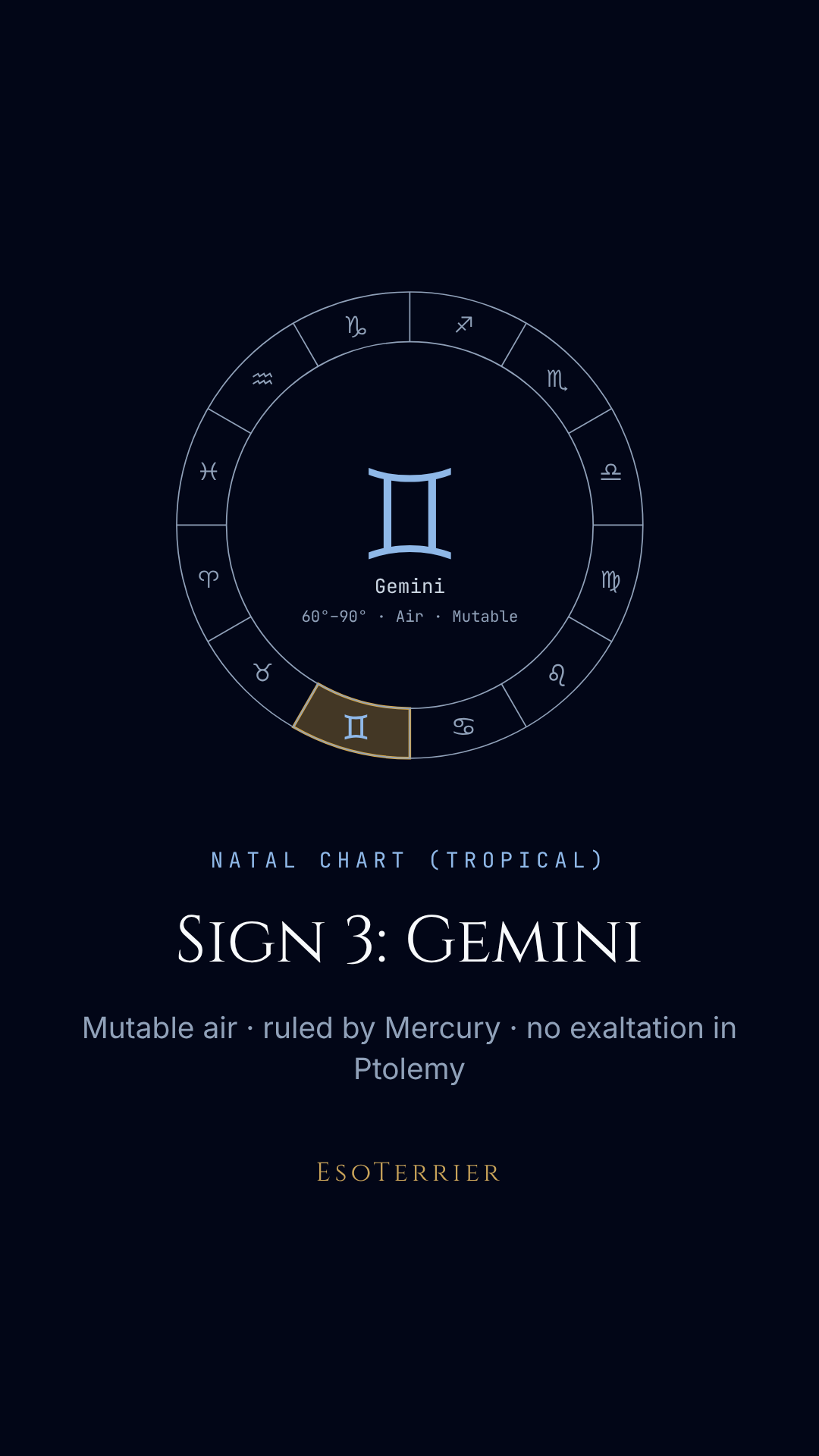
Gemini closes the spring, the season loosening before summer, and Ptolemy puts it in his class of bicorporeal signs, those of two bodies, which suits the Twins. Mercury rules it and brings the tradition's themes of speech, learning, trade and movement; Valens groups it with Libra and Aquarius in the airy triangle. Ptolemy's table gives no planet an exaltation in Gemini.
Astrologers read Gemini as curiosity, versatility and the quick connecting of ideas and people; it would rather know something about everything than everything about one thing. The shadow they name is scattering and inconsistency. Our keywords for it are "curious, versatile, communicative".
In a chart
A body in Gemini works through Mercury, so a Gemini Moon or Venus sends the astrologer to Mercury's own sign and house. Jupiter, the planet of breadth and conviction, is in its detriment here, opposite its own Sagittarius. With Gemini rising, Mercury is the chart ruler, and since Mercury never strays more than about 28° from the Sun, the ruler of such a chart is always found near the Sun.
The medieval lists placed the exaltation of the North Node at 3° of Gemini, a point Ptolemy does not give and the Indian tradition does not use; we record it as a disputed later layer.
The Sun is in Gemini from about 20 or 21 May to about 21 June; in 2026 it entered on 21 May at 00:37 UTC.
The sign and the sky
The sign is the third twelfth of the ecliptic from the equinox, not the constellation of the Twins, whose bright stars Castor and Pollux now stand in tropical Cancer. In the Jyotisha chart the sign of the same name, Mithuna, is counted from the stars and lies about 24° behind.
Rising
When Gemini is the rising sign, our chart's own reading opens: "Gemini rising greets the world with curiosity, wit and a lively, youthful manner." Those are EsoTerrier's words, written in 2026 as a reading aid. The chart then names Mercury as ruler, which always stands in or beside the Sun's sign.
Correspondences
Each item with how it stands: “sourced” is in the work cited, “our construction” is EsoTerrier’s own, and “disputed” means the sources disagree.
- Element (Valens)
- Air: the airy triangle with Libra and Aquarius sourced
- Modality (Ptolemy)
- Bicorporeal; our mutable sourced
- Polarity (Ptolemy)
- masculine, diurnal (positive) sourced
- Ruler (Ptolemy)
- Mercury sourced
- Triplicity lords (Ptolemy, in Ashmand)
- Saturn by day, Mercury by night sourced
- Exaltation of the North Node (medieval)
- 3 degrees of Gemini; not in Ptolemy disputed
- Detriment (medieval)
- Jupiter, in the sign opposite its own house sourced
- Golden Dawn trump (*Book T*)
- The Lovers sourced
- Natural house (modern teaching)
- House 3, in the sign, house and planet scheme Alan Leo taught sourced
- Our keywords
- "curious, versatile, communicative" our construction
How the schools read it
- Ptolemy (2nd century CE)
- A bicorporeal sign, the house of Mercury.
- Valens (2nd century CE)
- In the airy triangle with Libra and Aquarius.
- The Golden Dawn (*Book T*)
- Attributed to The Lovers.
- Modern Western (Alan Leo and after)
- Read for character rather than events, with Mercury as ruler.
- Jyotisha
- Mithuna, the sidereal sign of the same name, counted from the stars about 24° back.
- EsoTerrier
- Keywords "curious, versatile, communicative", our own words, and a reading for each planet in Gemini.
Claims about it
-
Each Sun sign has fixed calendar dates, such as 21 March to 19 April for Aries.
falseWhat the record shows: The Sun enters each sign at a different moment each year, and the date also depends on the time zone; in 2024 to 2028 Aries began on 20 March at times from 02:17 to 20:24 UTC. The chart decides.
-
The twelve signs are the twelve constellations, each 30° wide.
falseWhat the record shows: The signs are equal divisions of the ecliptic; the constellations are star figures of different sizes, and by the boundaries astronomers drew in 1930 the Sun crosses thirteen of them. The names were shared from the start, the shapes never.
-
Tropical astrology is wrong because its signs no longer match the constellations.
falseWhat the record shows: The tropical zodiac is defined from the March equinox and keeps each sign with its season by definition. The two zodiacs measure the same positions from different starting points; whether either means anything is a separate question.
Elsewhere on EsoTerrier
- Mercury its traditional ruler
- House 3: communication and learning the house modern teaching pairs with it
- Sign 9: Sagittarius the opposite sign
- Mithuna (Jyotisha chart) the sidereal sign of the same name
- The Lovers (tarot) its Golden Dawn trump
- Gemini 1 (Sabian symbols) the first of its thirty Sabian degrees