Meaning
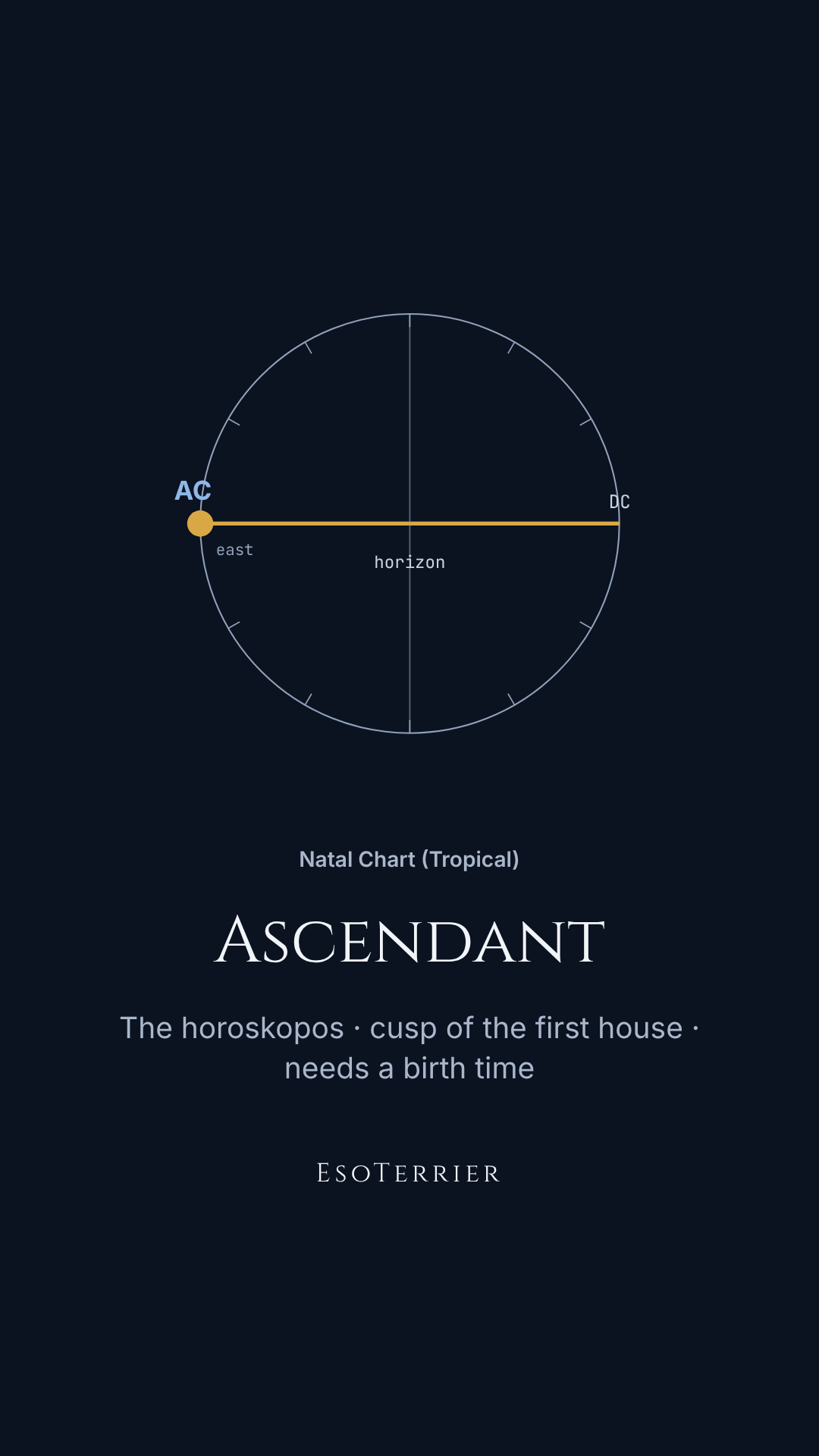
The Ascendant is the point of the ecliptic crossing the eastern horizon at the birth moment. The Greeks called it the horoskopos, the hour-marker, and from it the whole chart and the word "horoscope" take their names: it is what ties a sky to one place and one time. The tradition read the Ascendant as the person born, their life and their manner; Lilly in 1647 gives the first house the life, stature, colour and form of the person.
Astrologers today read it as the manner in which a person meets the world, the first impression and the way they begin things. The chart gives a reading of the rising sign in our own words.
Why it needs a time
The whole zodiac rises once a day, so the Ascendant moves on by about a degree every four minutes, and a whole sign rises in about two hours on average. A birth time an hour out can change the rising sign. Without a time our chart is cast for noon and shows no Ascendant, no houses and no chart ruler.
What hangs on it
The houses: the Ascendant is the cusp of the first house in every quadrant system, and in whole-sign houses the rising sign is the whole first house, with the degree marked inside it. The chart ruler: the ruler of the rising sign is the lord of the chart, a convention Lilly already uses; our chart names the traditional ruler, with the modern co-ruler beside it for Scorpio, Aquarius and Pisces. The Part of Fortune is counted from it. Every Western chart tool draws the Ascendant at nine o'clock, on the left, and so do we.
In our chart
The Ascendant takes aspects from the ten planets at half their orbs and is never labelled applying or separating, since it moves faster than any body. Above the polar circles, where Placidus cannot be computed, the houses fall back to Porphyry, and we keep the Ascendant in the east, as the Swiss Ephemeris also does. In Jyotisha it is the lagna.
Correspondences
Each item with how it stands: “sourced” is in the work cited, “our construction” is EsoTerrier’s own, and “disputed” means the sources disagree.
- Topics (Lilly, 1647)
- The life, stature, colour and form of the person; the head and face (as the first house) sourced
- Lord of the Ascendant
- The ruler of the rising sign rules the chart (Lilly; the modern chart ruler) sourced
- Modern reading
- The manner of meeting the world, the first impression, the way a person begins sourced
- Rising-sign texts
- One reading per rising sign, in our own words our construction
- Our keywords (first house)
- "self, appearance, approach" our construction
How the schools read it
- Hellenistic
- The hour-marker, which starts the twelve places counted by whole signs.
- Lilly (1647)
- The first and strongest angle; its lord is the lord of the chart.
- Modern Western
- The rising sign, read with the Sun and Moon as the big three.
- Jyotisha
- The lagna, from which the whole-sign houses are counted.
- EsoTerrier
- Drawn at nine o'clock; half orbs; a rising-sign reading and the chart ruler named.
Claims about it
-
The chart foretells illness, accidents, money and the outcome of lawsuits.
unverifiedWhat the record shows: The tradition makes such claims; we never do. Our pages and readings describe themes and tendencies, never outcomes.
-
A chart cast for noon, without a birth time, still gives the right Moon sign and houses.
falseWhat the record shows: At noon the Moon can be up to about 7° from its true place, enough to change its sign for about one birth in four, and the Ascendant and houses are unknown. Our chart marks a noon chart.