Meaning
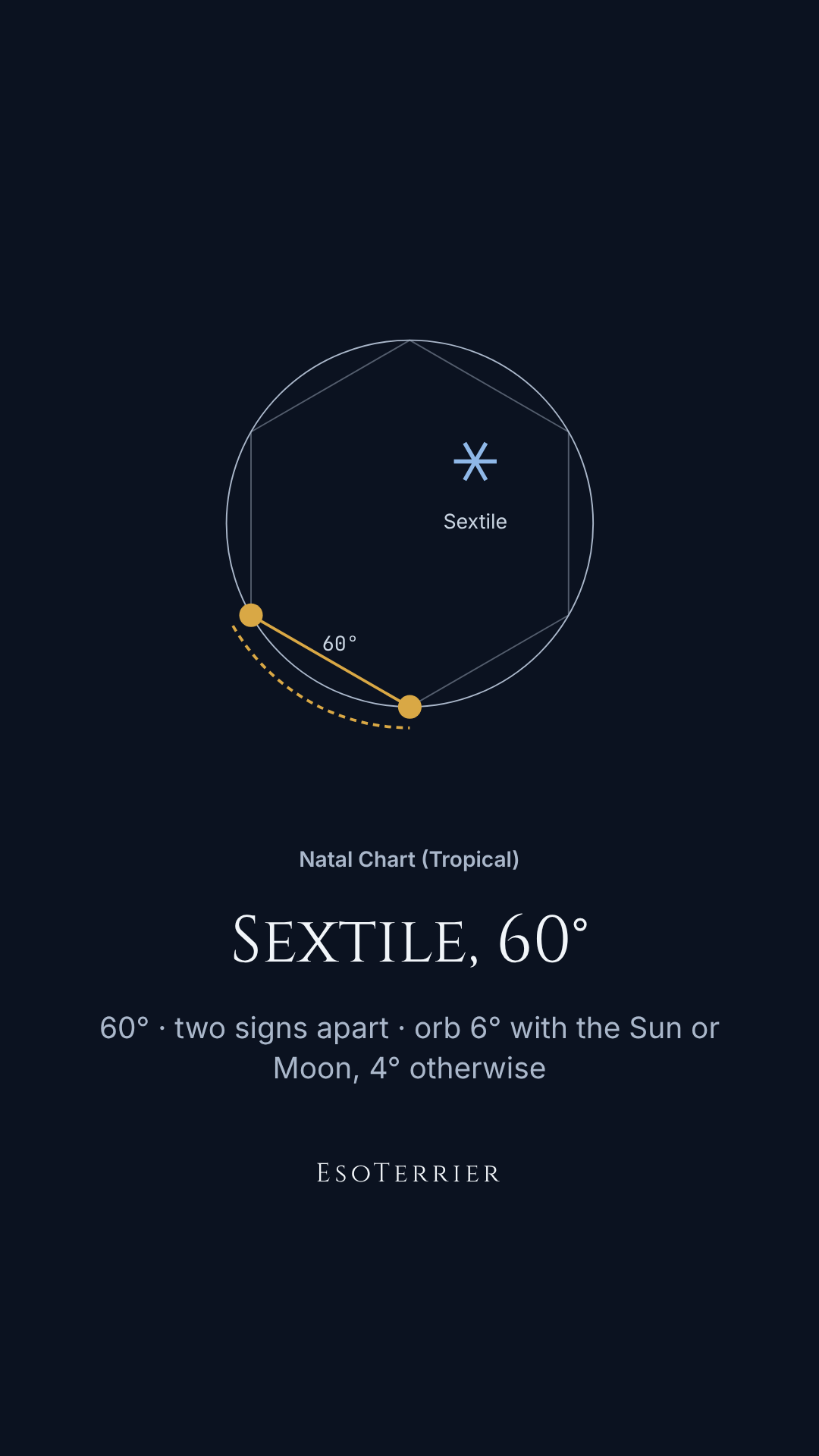
A sextile is a sixth of the circle, the side of a hexagon drawn inside the zodiac. Counted by signs it joins signs two apart, which are always of the same kind in Ptolemy's scheme, both masculine or both feminine: fire with air, earth with water. That shared kind is why he calls it harmonious, with the trine, and the opposition and square discordant.
The tradition reads the sextile as opportunity: an easy, friendly connection between two bodies, weaker than the trine, that comes alive when it is acted on. Modern astrology calls it a soft aspect. Our readings call it easy, never good.
Our orbs
Most modern orb tables give the sextile a smaller orb than the other major aspects, and so do we: 6° with the Sun or Moon and 4° otherwise, and half that, 3° and 2°, to Chiron, the North Node and the angles. Lilly's orbs, by contrast, belong to the planets, not the aspects. Within a quarter of a degree the sextile is marked exact.
Our chart draws a sextile as a short-dashed line, so that its type shows by pattern as well as by colour.
Other schools
astro.com's default allows 6° for the sextile for every pair; its classical style 5°. CHANI counts it by sign, so any two bodies two signs apart are sextile. Kepler, who built the aspects on harmonic ratios in 1619, kept the sextile and added new aspects such as the quintile; the table of musical intervals sometimes printed beside the aspects is a modern construction.
In a chart
Sextiles are common in any chart, since every body has two signs at that distance. Between the Sun and Mercury or Venus no sextile is possible, because those two planets never stray far enough from the Sun. In our chart's aspect list a sextile is named with its orb and whether it is applying or separating, and our readings describe it as an easy link between two bodies, one that the person can use.
Correspondences
Each item with how it stands: “sourced” is in the work cited, “our construction” is EsoTerrier’s own, and “disputed” means the sources disagree.
- Angle (Ptolemy)
- 60° sourced
- Class (Ptolemy, in Ashmand)
- harmonious sourced
- Modern class
- soft or easy sourced
- A musical interval
- A modern table; Kepler built aspects on harmonic ratios in 1619, Ptolemy on halves and thirds of the circle disputed
- Invented by Ptolemy
- No: in use before him; "Ptolemaic" records his later authority disputed
- One standard orb
- No: orbs differ by school disputed
- Our orbs
- 6° with the Sun or Moon, 4° otherwise, half to the points our construction
How the schools read it
- Ptolemy (2nd century CE)
- Harmonious: it joins signs of the same kind.
- astro.com default
- 6° for every pair, points at half.
- astro.com classical style
- Orbs by planet: luminaries 9°, Mercury, Venus and Mars 7°, the outer planets 5°.
- CHANI
- Aspects counted by whole sign, not by degree.
- Kepler (1619)
- Built the aspects on harmonic ratios and added the quintile, biquintile and sesquiquadrate.
- Jyotisha
- No aspects by degree: each graha aspects the seventh sign from it, and Mars, Jupiter and Saturn further signs.
- EsoTerrier
- 6° with a luminary, 4° otherwise; applying or separating; called easy.
Claims about it
-
Ptolemy invented the five major aspects, which is why they are called Ptolemaic.
disputedWhat the record shows: He lists the configurations, but the aspects were in use before him and Valens uses them without crediting him; "Ptolemaic" records his later authority, not an invention.
-
One set of orbs, such as 10° for every aspect, is the standard.
disputedWhat the record shows: Orbs differ by school: Lilly gave each planet its own; astro.com's default is a flat 10°, 6° for the sextile; others scale by planet; CHANI counts by sign. Ours are printed with every chart.
-
Each aspect is a musical interval, and the aspects come from the monochord.
disputedWhat the record shows: Ptolemy derives the aspects from halves and thirds of the circle and calls the trine and sextile harmonious because they join signs of the same kind; Kepler built them on harmonic ratios in 1619. The aspects came first, and the table of intervals is a modern construction.