Skip to content

Natal Chart (Tropical) · Aspect 3 of 5

The square, a quarter of the circle

A square is the aspect of two bodies about 90° apart, a quarter of the circle and three signs apart. Ptolemy counts the quartile discordant because it joins signs of unlike kind; the tradition reads it as friction that forces action, a hard aspect, never a bad one.

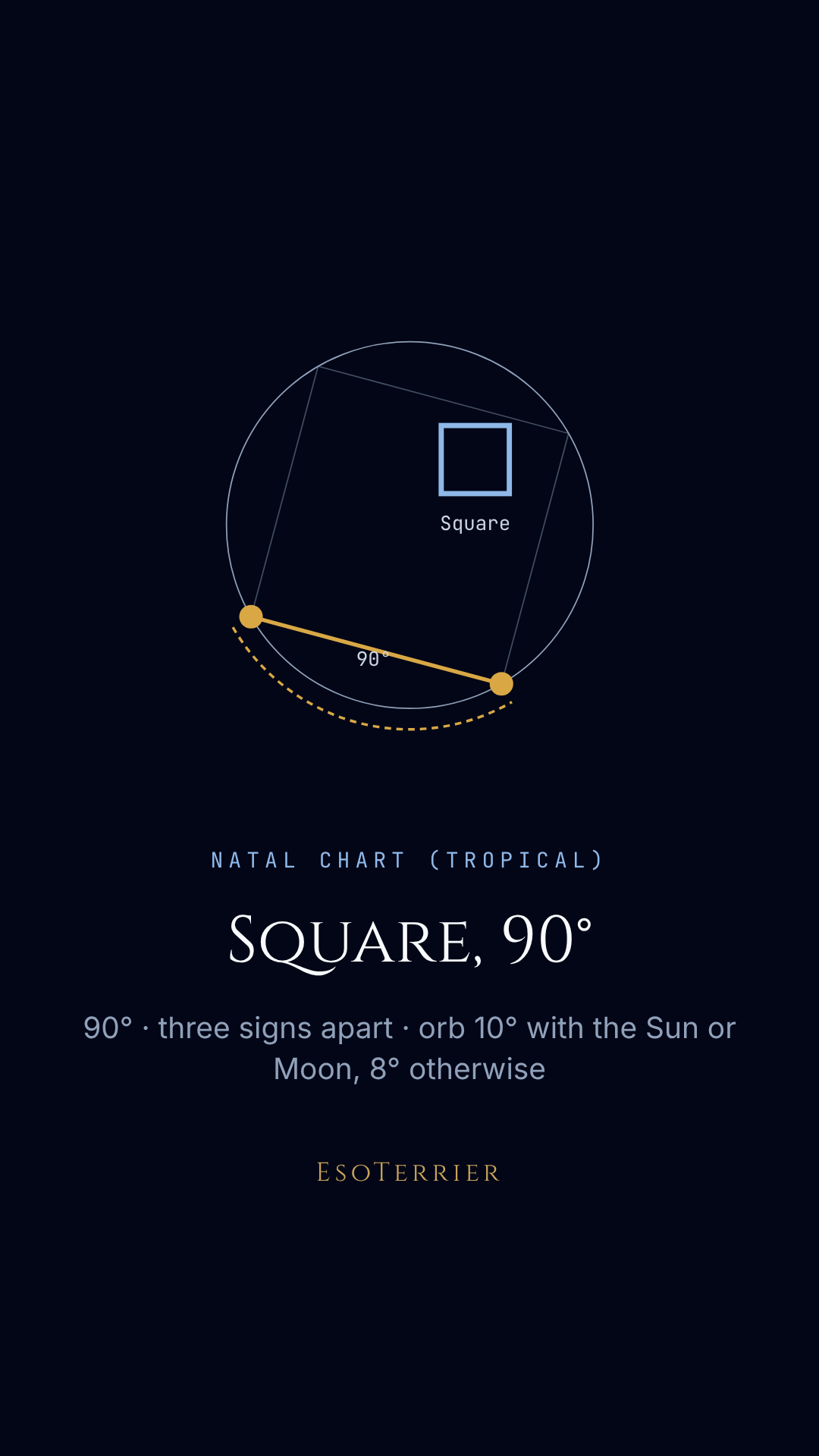
A circle with two points 90° apart on its rim joined by a chord, the arc between them marked 90°, and the square glyph beside it. 90° Square
The square: two bodies 90° apart along the zodiac, a quarter of the circle. Our drawing.

Facts

Angle
90°, a quarter of the circle
Signs apart
Three signs apart, same modality
Ptolemy's class
Disharmonious
Modern class
Hard or challenging
Our orb with the Sun or Moon
10°
Our orb otherwise
8°
Our orb to a point
Half: 5° with the Sun or Moon, 4° otherwise (Chiron, the North Node, the Ascendant, the Midheaven)
Marked exact
Within 0.25°
Glyph
□︎ (U+25A1)

Meaning

A square is a quarter of the circle, the side of a square drawn inside the zodiac. Counted by signs it joins signs three apart, which share their modality, cardinal with cardinal or fixed with fixed, but differ in element and in Ptolemy's kind, one masculine and one feminine. That unlikeness is why Ptolemy, who calls it the quartile, classes it with the opposition as discordant.

The tradition reads the square as friction and challenge: two drives at cross purposes, each getting in the other's way, which forces a person to act. Modern readings add that it builds strength by the effort it demands. Modern astrology calls it a hard aspect; our readings call it tension and effort, never misfortune.

Our orbs

We allow 10° when the Sun or Moon is one of the pair and 8° otherwise, and half that to Chiron, the North Node, the Ascendant and the Midheaven. Within a quarter of a degree a square is marked exact, and each is labelled applying or separating from the speeds of the two bodies. Our chart draws squares and oppositions as solid lines.

In the sample chart on our system page the Sun at the very end of Capricorn squares Mars at the very start of Taurus, less than half a degree from exact and applying. Capricorn and Taurus are four signs apart, the distance of a trine, so this is an "out of sign" square: we count aspects by degrees, while whole-sign schools would not call it a square at all.

Other schools

astro.com's default gives every major aspect but the sextile 10°; its classical style scales by planet. CHANI counts by sign, so bodies three signs apart are square whatever their degrees. Jyotisha has no square as such: its drishti are cast by sign, and Mars, Jupiter and Saturn have special ones of their own.

Correspondences

Each item with how it stands: “sourced” is in the work cited, “our construction” is EsoTerrier’s own, and “disputed” means the sources disagree.

Angle (Ptolemy)
90° sourced
Class (Ptolemy, in Ashmand)
disharmonious sourced
Modern class
hard or challenging sourced
A musical interval
A modern table; Kepler built aspects on harmonic ratios in 1619, Ptolemy on halves and thirds of the circle disputed
Invented by Ptolemy
No: in use before him; "Ptolemaic" records his later authority disputed
One standard orb
No: orbs differ by school disputed
Our orbs
10° with the Sun or Moon, 8° otherwise, half to the points our construction

How the schools read it

Ptolemy (2nd century CE)
Disharmonious: it joins signs of unlike kind.
astro.com default
10° for every pair, points at half.
astro.com classical style
Orbs by planet: luminaries 9°, Mercury, Venus and Mars 7°, the outer planets 5°.
CHANI
Aspects counted by whole sign, not by degree.
Kepler (1619)
Built the aspects on harmonic ratios and added the quintile, biquintile and sesquiquadrate.
Jyotisha
No aspects by degree: each graha aspects the seventh sign from it, and Mars, Jupiter and Saturn further signs.
EsoTerrier
10° with a luminary, 8° otherwise; applying or separating; called tense.

Claims about it

  • Ptolemy invented the five major aspects, which is why they are called Ptolemaic.

    disputed

    What the record shows: He lists the configurations, but the aspects were in use before him and Valens uses them without crediting him; "Ptolemaic" records his later authority, not an invention.

  • One set of orbs, such as 10° for every aspect, is the standard.

    disputed

    What the record shows: Orbs differ by school: Lilly gave each planet its own; astro.com's default is a flat 10°, 6° for the sextile; others scale by planet; CHANI counts by sign. Ours are printed with every chart.
Elsewhere on EsoTerrier

Sources

Primary texts (5)
  1. Claudius Ptolemy; tr. J. M. Ashmand, Ptolemy's Tetrabiblos, or Quadripartite: being four books of the influence of the stars, translated by J. M. Ashmand (from the paraphrase of Proclus). Davis and Dickson, London, 1822. Public domain; quoted briefly. archive.org/details/b29293066
  2. Vettius Valens; tr. Mark T. Riley, Vettius Valens, Anthologies, translated by Mark T. Riley (preliminary translation, released 2010). Skyscript (hosting the author's PDF), 2010. The translator's copyright; facts and chapter references only. skyscript.co.uk/valens_riley.html
  3. William Lilly, Christian Astrology, modestly treated of in three books. Thomas Brudenell for John Partridge and Humphrey Blunden, London, 1647. Public domain; quoted briefly, from the 1647 edition. archive.org/details/b30338724
  4. Johannes Kepler, Harmonices mundi libri V. Linz, 1619. Public domain. en.wikipedia.org/wiki/Harmonice_Mundi
  5. Alan Leo (William Frederick Allan), Astrology for All, to which is added a complete system of predictive astrology for advanced students. Modern Astrology Office, London, 1899. Public domain; quoted briefly. archive.org/details/bub_gb_8CwSAAAAYAAJ
Studies and other sources (3)
  1. Astrodienst AG, Astrodienst (astro.com) chart defaults and FAQ pages: style defaults, aspects and orb tables, calculations (Part of Fortune), extra factors (Lilith), settings (orbs of points), house systems. Astrodienst, Zurich, 2026. Consulted for facts; never copied. astro.com/faq/fq_fh_calc_e.htm
  2. CHANI, CHANI: What whole sign houses are and why we use them; CHANI help: aspects used in the app. 2026. Consulted for facts; never copied. chani.com/astro-education/what-whole-sign-houses-are-and-why-we-use-them
  3. Wikipedia contributors, Wikipedia: Astrological aspect. 2026. CC BY-SA; consulted for facts. en.wikipedia.org/wiki/Astrological_aspect
Our own research (5)
  1. EsoTerrier, Natal and sidereal wheels: research for the rebuild (README, report-main.md, notes/). Research folder 2026-10-11-natal-sidereal, 2026.
  2. EsoTerrier, EsoTerrier chart engine: services/chart/ephemeris.py, calculation.py, jyotish.py, texts.py. python/esoterrier, services/chart, 2026.
  3. EsoTerrier, Calculation documentation: chart.md and chart_sidereal.md. Calculation documentation and sample data, 2026.
  4. EsoTerrier, EsoTerrier app: resources/js/support/natal.ts and components/Chart/NatalChartTropical.vue. The chart component in our app, 2026.
  5. EsoTerrier, Knowledge layer shared topics: _shared/zodiac and _shared/planets (accuracy pass, 2026-10-13). Knowledge layer, shared topics, 2026.

Your Natal Chart reading, $3.99. Includes this system's raw data. Written for you by AI. Read a sample. Charts and the written text are free in every account.

By EsoTerrier. Written with AI assistance from our research and checked against its sources; last revised 20 October 2026. How we write these pages.

First published ; last revised . Corrections: support@esoterrier.com.