Meaning
Tula is "of the shape of a person with scales (in his hand)", in the Brihat Jataka (I.5, Iyer 1885), and its other name there is Juka, one of those Iyer notes as Greek.
It is a movable sign, odd and masculine, with its triangle facing west, and a day sign that rises by its head. Shukra rules it. Shani is exalted in it at the 20th degree and Surya is debilitated here, each the mirror of its place in Mesha opposite.
Our chart's text for a Tula lagna speaks of balance, refinement and fair exchange, and of trusting one's own judgment so that weighing does not turn into hesitation.
Tula begins at 180°, in the middle of Chitra, near the star Spica, which gives the Lahiri ayanamsa its other name, Chitrapaksha. The ayanamsa places the star near this point, not exactly on it.
In the chart
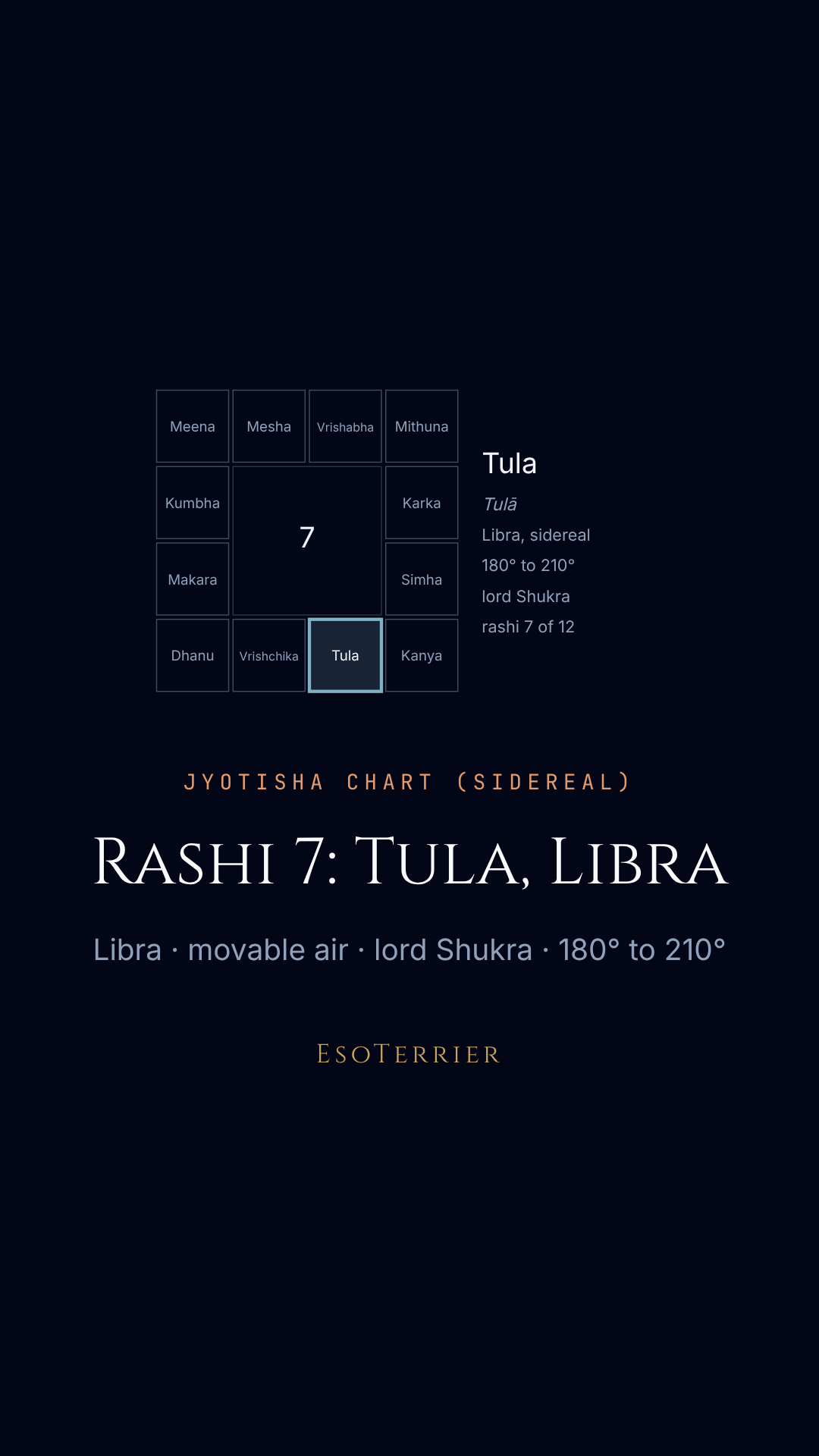
Tula is the seventh rashi, 180° to 210° of the sidereal zodiac, and it holds the last two padas of Chitra, Swati and the first three padas of Vishakha. In the whole-sign houses of the chart, the rashi of the lagna is the first bhava and each rashi after it the next, so Tula is the first bhava for a Tula lagna, the seventh for a Mesha lagna, and so on round the twelve.
Its navamsas begin with Tula: the nine parts of 3°20′ run Tula, Vrishchika, Dhanu, Makara, Kumbha, Meena, Mesha, Vrishabha and Mithuna, as the Brihat Jataka's rule gives them, the movable rashis starting from themselves, the fixed from the ninth and the dual from the fifth. In 2026 the rashi covers about 24°13′ Libra to 24°13′ Scorpio of the tropical zodiac, by the Lahiri measure, so a planet in tropical Libra is often in Kanya here; another ayanamsa would move the edges by up to about 2.5°.
Correspondences
Each item with how it stands: “sourced” is in the work cited, “our construction” is EsoTerrier’s own, and “disputed” means the sources disagree.
- Shape (Brihat Jataka I.5, Iyer 1885)
- "of the shape of a person with scales (in his hand)" sourced
- Other name (I.8)
- Juka, one of the names Iyer notes as Greek sourced
- Direction of its triangle (I.11)
- west sourced
- Day or night (I.10)
- a day sign, powerful by day; rises by its head sourced
- Exalted here (I.13)
- Shani, at 20° sourced
- Debilitated here (I.13)
- Surya sourced
- Themes in our chart's text, our words
- balance, refinement and fair exchange our construction
How the schools read it
- The Brihat Jataka (Varahamihira, 6th century; Iyer 1885)
- "A person with scales (in his hand)"; called Juka; movable, odd and masculine; its triangle faces west; a day sign rising by its head; lord Venus; Saturn exalted at 20°, the Sun debilitated.
- Modern Jyotisha
- A movable air rashi ruled by Shukra, its element and quality grouped as in the Western triplicities.
- Western tropical astrology
- Libra, the same twelfth of the circle counted from the March equinox, about 24° ahead in 2026.
- Other ayanamsas
- Raman's about 1.5° smaller than Lahiri's, Krishnamurti's about 5′ smaller, Fagan-Bradley's about 53′ larger: a placement near an edge can change rashi.
- The chart forms
- South Indian: Tula has its own fixed box; North Indian: the boxes are the bhavas and the rashi's number, 7, moves with the lagna.
- EsoTerrier
- Our chart's text for a Tula lagna: "With Tula as lagna, a movable air rashi ruled by Shukra, the person tends toward balance, refinement and fair exchange. The symbol of a figure holding scales in the marketplace speaks of weighing and trade, and trusting one's own judgment keeps that search for fairness from becoming hesitation." Our words.
Claims about it
-
The sidereal rashi shows the sky as it really is: it is the constellation of that name.
falseWhat the record shows: Both zodiacs measure the same positions from different starting points. A rashi is an equal 30° division counted from a point set by the ayanamsa, not the constellation of the same name.
-
The Lahiri ayanamsa is accepted everywhere.
falseWhat the record shows: Lahiri is India's national standard and by far the most used, but the KP school, B. V. Raman's followers and Western siderealists use other values, up to about 2.5° apart; a placement near a rashi's edge can change rashi between them.
-
The sidereal signs sit about 24° behind the tropical ones whichever ayanamsa is used.
disputedWhat the record shows: True for Lahiri (about 24°13′ in 2026) and close for Krishnamurti; Raman's is about 1.5° less and Fagan-Bradley's about 0°53′ more.
-
The Lahiri ayanamsa fixes the zodiac exactly on Spica, at 0° Tula.
disputedWhat the record shows: Lahiri is defined by a value at an epoch (23°15′00″ on 21 March 1956). Spica sits near 0° Tula under it, about a minute of arc off, and drifts by its own motion; the ayanamsa that holds Spica at exactly 180° is a different one, True Chitrapaksha.