Skip to content

Jyotisha Chart (Sidereal) · Nakshatra 13 of 27

Hasta, the hand of the crafts

Hasta, "the hand", is the five stars of Corvus, the Crow, wholly inside Kanya. Savitar, the radiant Sun, is its deity in every list; its emblem is an open hand, as in the medieval lists, and Chandra is its Vimshottari lord.

Is this your Moon's nakshatra?

Draw your free chart: Jyotisha chart No email needed
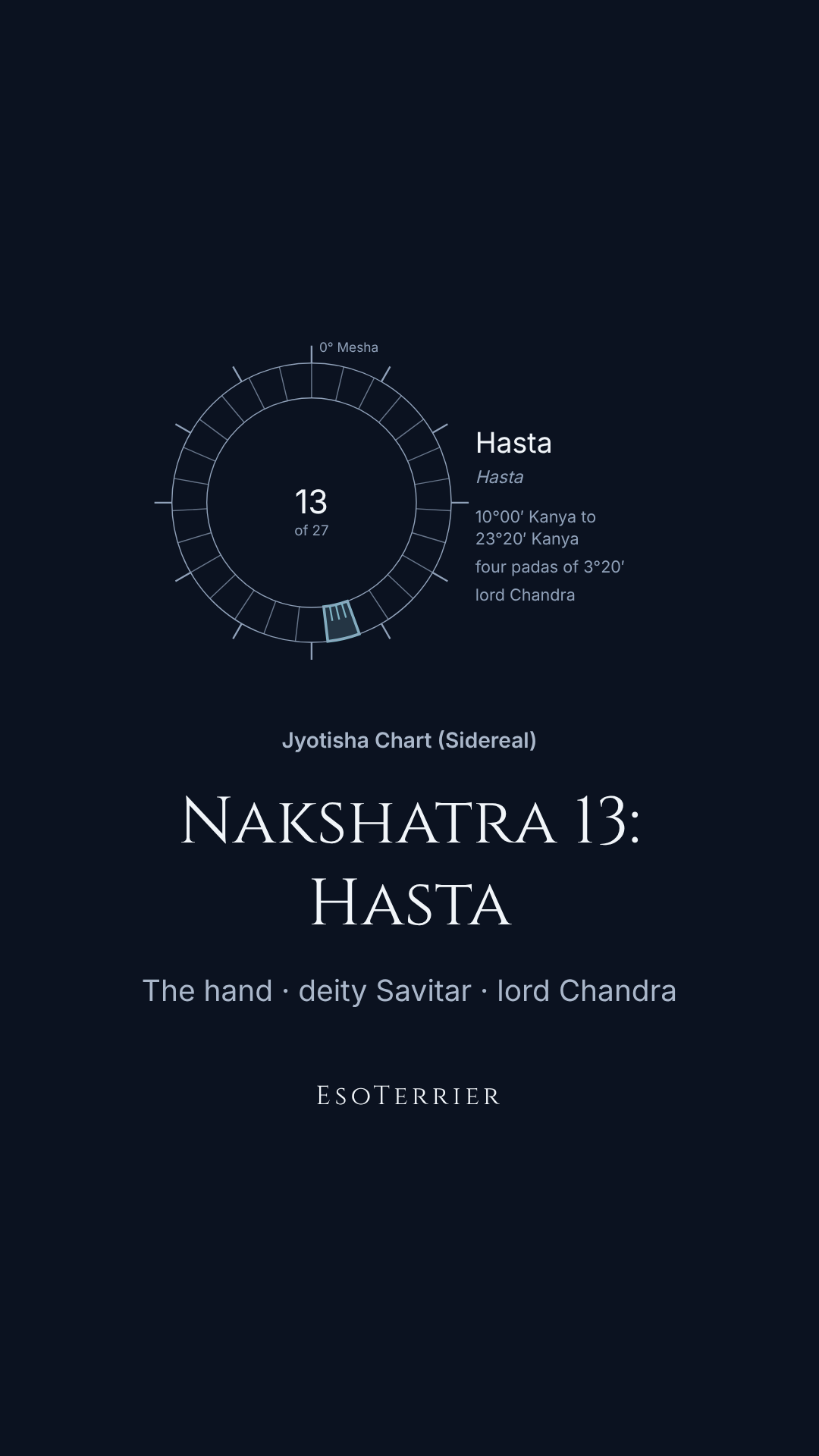
The ring of the 27 nakshatras with Hasta, number 13, marked from 10°00′ Kanya to 23°20′ Kanya, its four padas ticked inside the arc; beside it the name in IAST, Hasta, and its lord, Chandra. 0° Mesha 13 of 27 Hasta Hasta 10°00′ Kanya to 23°20′ Kanya four padas of 3°20′ lord Chandra
Hasta on the ring of the 27 nakshatras: Ashwini starts at 0° Mesha at the top and the count runs clockwise; the longer ticks are the twelve rashis. Our drawing.

Facts

Position
Nakshatra 13 of 27, counted from Ashwini at 0° Mesha
Name
Hasta; IAST Hasta; हस्त
The name means
the hand
Span, sidereal
10°00′ Kanya to 23°20′ Kanya
In the tropical zodiac, 2026
about 4°13′ Libra to 17°33′ Libra, by the Lahiri measure
Vimshottari lord
Chandra (the Moon), 10 years
Padas and their navamsas
1 Mesha · 2 Vrishabha · 3 Mithuna · 4 Karka
Stars of the name
α to ε Corvi

Meaning

Hasta means "the hand", and its five stars, alpha to epsilon Corvi, are read as the fingers.

Modern readings take the hand as a maker's: skill, craft and dexterity, the power to shape things, cleverness and resource, and the control that can tip into wanting to manage everything. Our chart's text adds that trusting the work of one's hands, without holding too tight to the result, brings ease.

Chandra, the Moon, is its lord in the Vimshottari order, with ten years. Hasta sits in the middle of Kanya, 10° to 23°20′, so all four of its padas lie in one rashi.

Deity and emblem

Savitar, the sun as the god who sets things in motion, is Hasta's deity in the Taittiriya Samhita (as Savitr) and today.

The emblem is an open hand, and the medieval lists give a hand too, so modern books and the old figure agree.

In the chart

Hasta runs from 10°00′ Kanya to 23°20′ Kanya of the sidereal zodiac, the thirteenth of 27 equal parts of 13°20′. It lies wholly within Kanya (Virgo). Its four padas of 3°20′ fall in the navamsas of Mesha, Vrishabha, Mithuna and Karka, so a graha in its first pada stands in Mesha in the D9.

Its Vimshottari lord is Chandra, whose period is ten years. When the Moon stands here at birth, the reckoning opens in Chandra's period and counts only the part still to run, in proportion to the part of Hasta the Moon has yet to cross. In 2026 the same stretch of sky is about 4°13′ Libra to 17°33′ Libra in the tropical zodiac, by the Lahiri measure; another ayanamsa moves the edges, and a Moon or lagna within a few minutes of arc of an edge can fall in the neighbouring nakshatra in another tool.

Correspondences

Each item with how it stands: “sourced” is in the work cited, “our construction” is EsoTerrier’s own, and “disputed” means the sources disagree.

Deity, as used today
Savitar, the radiant Sun sourced
Deity in the Taittiriya Samhita (iv.4.10)
Savitr sourced
Symbol, the modern tradition's
open hand sourced
Figure in the medieval lists (Burgess, 1860)
a hand sourced
Themes in modern readings, our summary
skill, craft and dexterity; the power to make and shape our construction

How the schools read it

The Vedic lists (Taittiriya Samhita iv.4.10, Keith 1914)
Savitr, as today; the Taittiriya list begins with Krittika.
The medieval lists (Burgess and Whitney, 1860)
The figure of the asterism: a hand, after the Ratnamala and the Muhurta Chintamani.
Modern Jyotisha
Skill, craft and dexterity; the power to make and shape; its symbol: open hand.
The 28-nakshatra scheme
Abhijit, in the stars of Lyra, stands between Uttara Ashadha and Shravana in the older lists; the equal division into 27 leaves it out.
Western sidereal (Fagan-Bradley)
The same 27 divisions, about 0°53′ further on than Lahiri's; Western siderealists rarely use them.
EsoTerrier
Our chart's text for a Moon here: "Hasta is ruled by Chandra and symbolized by the hand, pointing to skill, dexterity and the power to shape things. Its energy is resourceful, clever and practical, and trusting the work of one's hands without overcontrolling the outcome brings ease." Our words.

Claims about it

  • Hasta's deity and symbol are one fixed set handed down from the Vedas.

    disputed

    What the record shows: The deity, Savitar, is the same in the Taittiriya Samhita (iv.4.10) and today, but five other nakshatras have different deities in different Vedic lists. The symbol, open hand, is the modern tradition's; here it matches the figure of the medieval lists, a hand.

  • The nakshatra is a constellation, 13°20′ wide.

    false

    What the record shows: The nakshatras began as star groups of unequal size, 28 in the Atharvaveda with Abhijit. The equal division into 27 parts of 13°20′ is a later convention; the name points at stars, the division is arithmetic.
Elsewhere on EsoTerrier

Sources

Primary texts (3)
  1. Positional Astronomy Centre, India Meteorological Department, Rashtriya Panchang 1948 Saka (2026-27), online edition: ayanamsa by month, daily nirayana longitudes of the Sun and Moon, explanation page. Government of India, Kolkata, 2026. Official values cited; tables not reproduced. packolkata.imd.gov.in/panchang/index.php/en
  2. Parashara (attributed); tr. R. Santhanam, Brihat Parasara Hora Sastra of Maharshi Parasara, English translation with commentary. Ranjan Publications, New Delhi, 1984. In copyright; facts and chapter numbers only.
  3. Arthur Berriedale Keith (translator), The Veda of the Black Yajus School, entitled Taittiriya Sanhita, part 2 (Kandas IV to VII). Harvard Oriental Series vol. 19, Harvard University Press, 1914. Public domain; the deity list of iv.4.10. archive.org/details/vedaofblackyajus02keit
Studies and other sources (4)
  1. Astrodienst AG (Dieter Koch, Alois Treindl), Swiss Ephemeris programming interface and general documentation (sections 2.2 lunar nodes and apogees, 2.8 sidereal and ayanamsha, 6.3 to 6.4 Vertex and polar houses, Appendix E published ayanamsha values). Astrodienst, Zurich, 2022. Read as documentation only; facts. astro.com/swisseph/swisseph.htm
  2. Wikipedia, Nakshatra. Read 2026-10-12. en.wikipedia.org/wiki/Nakshatra
  3. Wikipedia, Dasha (astrology). Read 2026-10-12. en.wikipedia.org/wiki/Dasha_(astrology)
  4. Ebenezer Burgess (with William Dwight Whitney), Translation of the Surya-Siddhanta, a Text-Book of Hindu Astronomy; with Notes, and an Appendix. Journal of the American Oriental Society 6, 1860. Public domain; the notes to chapter VIII, verse 9. archive.org/details/jstor-592174
Our own research (2)
  1. EsoTerrier (main research agent), Natal and sidereal wheels: research for the rebuild (README, report-main.md, notes/). 2026; research/2026-10-11-natal-sidereal/. Our dated research: tools, names and transliteration, dignities, the claim audit.
  2. EsoTerrier, EsoTerrier chart engine: services/chart/ephemeris.py, calculation.py, jyotish.py, texts.py. 2026; python/esoterrier/esoterrier/services/chart/. Our engine; the readings in it are our own words.

Your Jyotisha Chart reading, $3.99. Includes this system's raw data. Written for you by AI. Read a sample. Charts and the written text are free in every account.

By EsoTerrier. Written with AI assistance from our research and checked against its sources; last revised 20 October 2026. How we write these pages.

First published ; last revised . Corrections: support@esoterrier.com.