Meaning
"The Moon is the mind," the Brihat Jataka says of the cosmic person, and with the Sun it is one of the two kings among the grahas (II.1, Iyer 1885). The same text calls it white and gives it the north-west, and Iyer's note gives it the element water.
In Jyotisha the Moon carries more of the chart than the Sun does. The rashi it stands in is the sign most people name as theirs; its nakshatra is the janma nakshatra, which starts the Vimshottari dasha and gives the first syllable of a name in many families; and the tradition counts transits from it. Modern readings make Chandra the graha of feeling, receptivity and nourishment, of the mother and of a mind that waxes and wanes like the Moon itself.
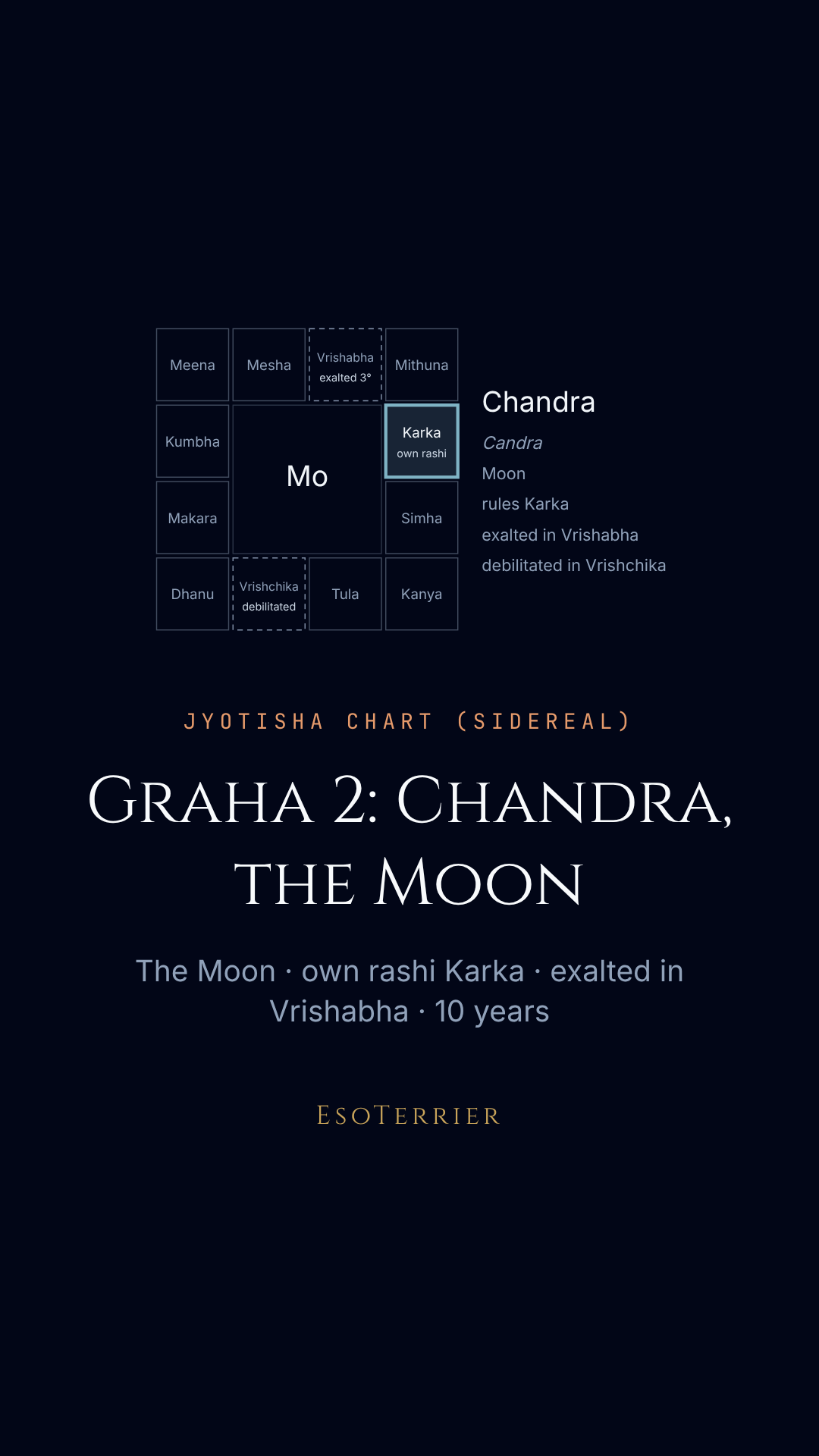
The Brihat Jataka calls it benefic when waxing and malefic when waning, a judgement of the graha, not of the person born under it. In the chart it is written Mo.
Rashis and dignities
Chandra rules Karka. It is exalted at the 3rd degree of Vrishabha, debilitated in Vrishchika, and its moolatrikona is Vrishabha, the rashi of its exaltation (Brihat Jataka I.6, I.13 and I.14). Its drishti falls on the seventh rashi from itself. It is the Vimshottari lord of Rohini, Hasta and Shravana.
Its period
In the Vimshottari dasha Chandra holds ten of the cycle's 120 years, the fourth period in the order Ketu, Shukra, Surya, Chandra, Mangala, Rahu, Guru, Shani, Budha. A person whose Moon stands in Rohini, Hasta or Shravana at birth begins life in Chandra's period, counting only the part still to run; for any other Moon it comes later in the sequence. Each period is divided into nine sub-periods in the same order.
Our chart's reading of the period, in our words: "A Chandra mahadasha, lasting ten years, tends to bring emotions, home, nurturing and connection with the public to the foreground. The mind may feel more receptive and changeable, and attending to inner peace often shapes how the period is experienced." The tradition's reading of this period, not a prediction of events, and not advice on health, money, legal matters or relationships. The dates follow the chart's conventions, years of 365.25 days and the Lahiri ayanamsa; other tools differ from ours by days.
Correspondences
Each item with how it stands: “sourced” is in the work cited, “our construction” is EsoTerrier’s own, and “disputed” means the sources disagree.
- To the Kalapurusha (Brihat Jataka II.1, Iyer 1885)
- "The Moon is the mind" sourced
- Rank among the grahas (II.1)
- a king, with the Sun sourced
- Natural nature (Brihat Jataka)
- benefic when waxing, malefic when waning sourced
- Moolatrikona rashi (I.14)
- Vrishabha sourced
- Element and gender (II.6)
- water (in Iyer's note); female sourced
- Themes in modern readings, our summary
- feeling, receptivity, nourishment, the mother and the changing mind our construction
How the schools read it
- The Brihat Jataka (Varahamihira, 6th century; Iyer 1885)
- The mind of the Kalapurusha and, with the Sun, a king; lord of Karka; exalted at 3° Vrishabha and debilitated in Vrishchika; benefic when waxing, malefic when waning; colour white; the north-west.
- The Brihat Parashara Hora Shastra, as printed
- Ten years in the Vimshottari order; the lord of Rohini, Hasta and Shravana.
- Modern Jyotisha
- Feeling, receptivity, nourishment, the mother and the changing mind.
- Western tropical astrology
- The Moon of the Western chart, the same body measured from the equinox; Western readings give the Sun the lead, Jyotisha the Moon.
- EsoTerrier
- Shown as Mo in the boxes, with its degree; R beside it when it is retrograde (vakri).
Claims about it
-
The dasha of this graha foretells events to the day.
unverifiedWhat the record shows: Dasha dates move with the ayanamsa, the year length and the Moon's degree; tools differ by days. We give the period with its conventions stated, as the tradition's theme for a stretch of years.
-
This graha's place foretells illness, wealth or marriage, and doshas cause misfortune.
unverifiedWhat the record shows: These are claims of the tradition and of the commercial kundli. We compute no doshas.
-
The Moon's nakshatra reveals the hidden depths of the mind.
unverifiedWhat the record shows: In the tradition the janma nakshatra starts the dasha, gives the name syllable and is used for chosen times and matching; the psychological language is modern and Western.
Elsewhere on EsoTerrier
- Rashi 4: Karka, Cancer its own rashi
- Rashi 2: Vrishabha, Taurus where it is exalted
- Nakshatra 4: Rohini a nakshatra it rules as Vimshottari lord
- Nakshatra 13: Hasta a nakshatra it rules as Vimshottari lord
- Nakshatra 22: Shravana a nakshatra it rules as Vimshottari lord
- Natal Chart (Tropical): Moon the same body in the Western chart