Meaning
Ketu is the descending node of the Moon, the point where its orbit crosses the Sun's path going south, always 180° from Rahu and moving backwards with it.
In the story of the churning it is the body of the demon whose head became Rahu, made deathless by the nectar and still in pursuit of the Sun and Moon; we tell it as lore. The Brihat Jataka knows it by the name Sikhi.
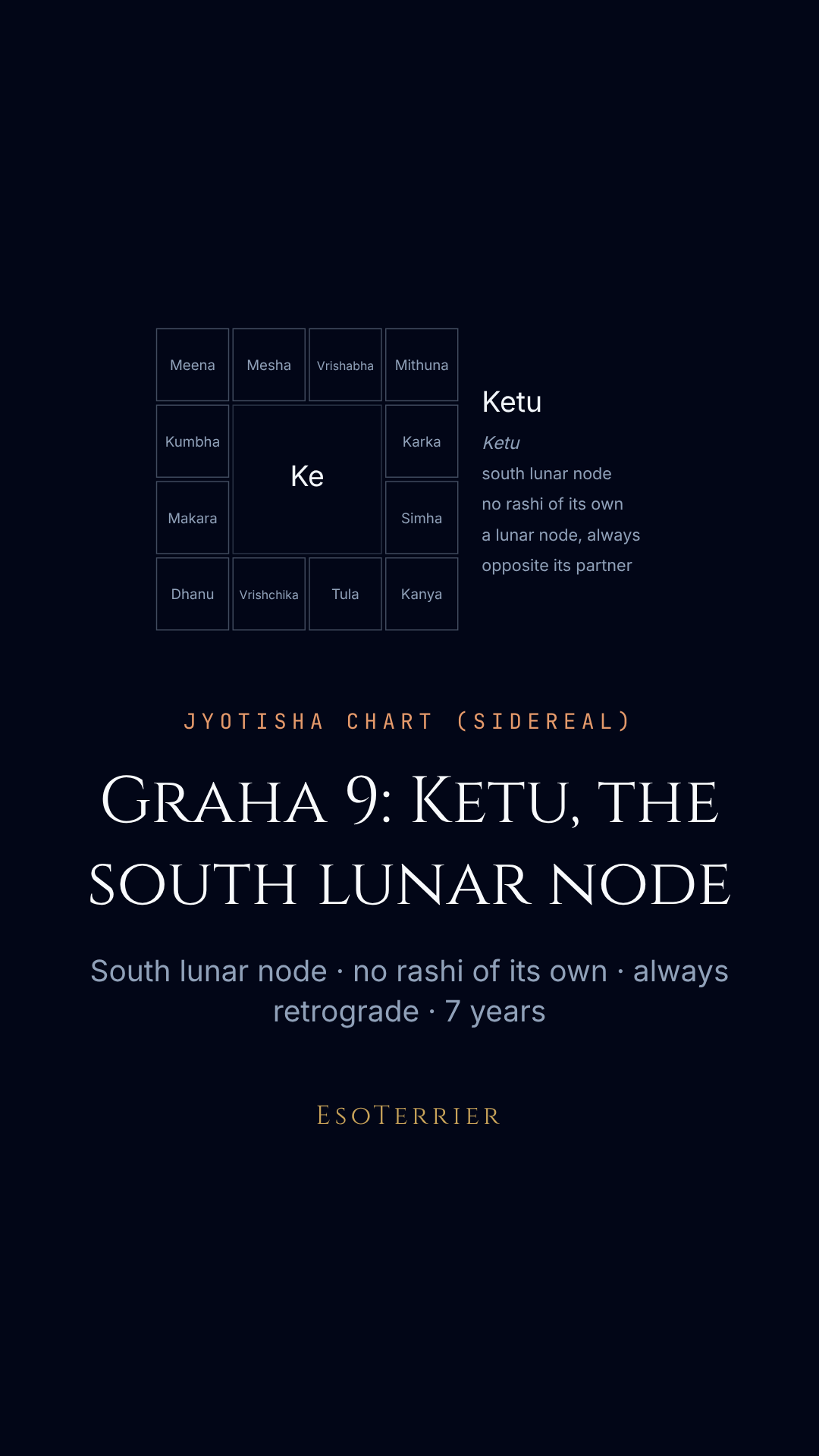
Modern readings make Ketu the graha of detachment and letting go, of inner insight, spiritual questions and the mystical, a counterweight to Rahu's appetite; the tradition also says that it acts like Mangala. Our chart's text for its period speaks of simplifying and turning inward. In the chart it is written Ke, from the mean node by default.
Rashis and dignities
Like Rahu, Ketu rules no rashi in the Brihat Jataka and has no exaltation there; the later schemes give it Vrishchika or Dhanu, and we show neither as fact. Many give it the drishti on the fifth, seventh and ninth rashis, which is disputed. It is the Vimshottari lord of Ashwini, Magha and Mula, the first nakshatras of the three rounds, so its period is the first in the cycle.
Its period
In the Vimshottari dasha Ketu holds seven of the cycle's 120 years, the first period in the order Ketu, Shukra, Surya, Chandra, Mangala, Rahu, Guru, Shani, Budha. A person whose Moon stands in Ashwini, Magha or Mula at birth begins life in Ketu's period, counting only the part still to run; for any other Moon it comes later in the sequence. Each period is divided into nine sub-periods in the same order.
Our chart's reading of the period, in our words: "A Ketu mahadasha, lasting seven years in the Vimshottari system, often turns attention inward, toward detachment, spiritual questions and releasing what no longer fits. It can be a season of simplifying, where inner insight tends to matter more than outward display." The tradition's reading of this period, not a prediction of events, and not advice on health, money, legal matters or relationships. The dates follow the chart's conventions, years of 365.25 days and the Lahiri ayanamsa; other tools differ from ours by days.
Correspondences
Each item with how it stands: “sourced” is in the work cited, “our construction” is EsoTerrier’s own, and “disputed” means the sources disagree.
- Names in the Brihat Jataka (II.3)
- Sikhi sourced
- Natural nature
- malefic in later tradition; the Brihat Jataka's list leaves the nodes out sourced
- Exaltation
- Vrishchika, or Dhanu, in two later schemes; neither in the Brihat Jataka disputed
- Node
- the mean node by default; the true node, up to about 2° away, as an option sourced
- Themes in modern readings, our summary
- detachment, letting go, inner insight and the mystical our construction
How the schools read it
- The Brihat Jataka (Varahamihira, 6th century; Iyer 1885)
- Named Sikhi; no rashi, exaltation or nature in the verses on the seven grahas.
- The Brihat Parashara Hora Shastra, as printed
- Seven years in the Vimshottari order; the lord of Ashwini, Magha and Mula.
- Modern Jyotisha
- Detachment, letting go, inner insight and the mystical.
- True-node users
- The osculating node, up to about 2° from the mean (1.95° at most between 1950 and 2050); some Indian software defaults to it.
- Western tropical astrology
- The South Node of the Western chart, opposite the North Node; the same point measured from the equinox.
- EsoTerrier
- Shown as Ke in the boxes, with its degree; retrograde always, as the tradition reads the nodes.
Claims about it
-
The dasha of this graha foretells events to the day.
unverifiedWhat the record shows: Dasha dates move with the ayanamsa, the year length and the Moon's degree; tools differ by days. We give the period with its conventions stated, as the tradition's theme for a stretch of years.
-
This graha's place foretells illness, wealth or marriage, and doshas cause misfortune.
unverifiedWhat the record shows: These are claims of the tradition and of the commercial kundli. We compute no doshas.
-
Rahu and Ketu are the severed head and body of a demon who swallows the Sun and Moon.
told as loreWhat the record shows: The story explains eclipses. Rahu and Ketu are the Moon's nodes, the two points where its path crosses the Sun's; eclipses happen when the Sun and Moon are near them.
-
Rahu and Ketu have exaltation rashis.
disputedWhat the record shows: The Brihat Jataka gives exaltations for the seven visible grahas only, and al-Biruni recorded in 1029 that Indian astrologers did not recognise exaltations of the nodes. The two modern schemes (Vrishabha and Vrishchika, or Mithuna and Dhanu) are later; we show neither as fact.
-
Only the mean node (or only the true node) is the correct Rahu and Ketu.
disputedWhat the record shows: Both are conventions, up to about 2° apart. The official Rashtriya Panchang tabulates the mean node; some tools default to the true one. Ours uses the mean node, labelled, with the true node as an option.
Elsewhere on EsoTerrier
- Nakshatra 1: Ashwini a nakshatra it rules as Vimshottari lord
- Nakshatra 10: Magha a nakshatra it rules as Vimshottari lord
- Nakshatra 19: Mula a nakshatra it rules as Vimshottari lord
- Graha 8: Rahu, the north lunar node the other node, always opposite
- Natal Chart (Tropical): the South Node the Western chart's lunar node