Meaning
Magha means "the mighty" or "the bountiful", and its star is Regulus, the bright heart of the Lion.
Its deities are the ancestors, and modern readings follow them: lineage, dignity and inherited honour, the seat one is born to and the duty owed to those who came before. Our chart's text calls it regal and generous, and says that ancestral pride is best held lightly.
Magha opens Simha at 0° and opens the second round of the Vimshottari lords: Ketu rules it, as Ketu rules Ashwini and Mula, the first nakshatras of the other two rounds. Each of those three begins at the start of a fire rashi.
Deity and emblem
The Taittiriya Samhita gives the Maghas to the fathers, the Pitris, the honoured dead of the family line, and today's books keep them.
The modern emblem is a royal throne; the medieval lists give a house, as they also do for Punarvasu.
In the chart
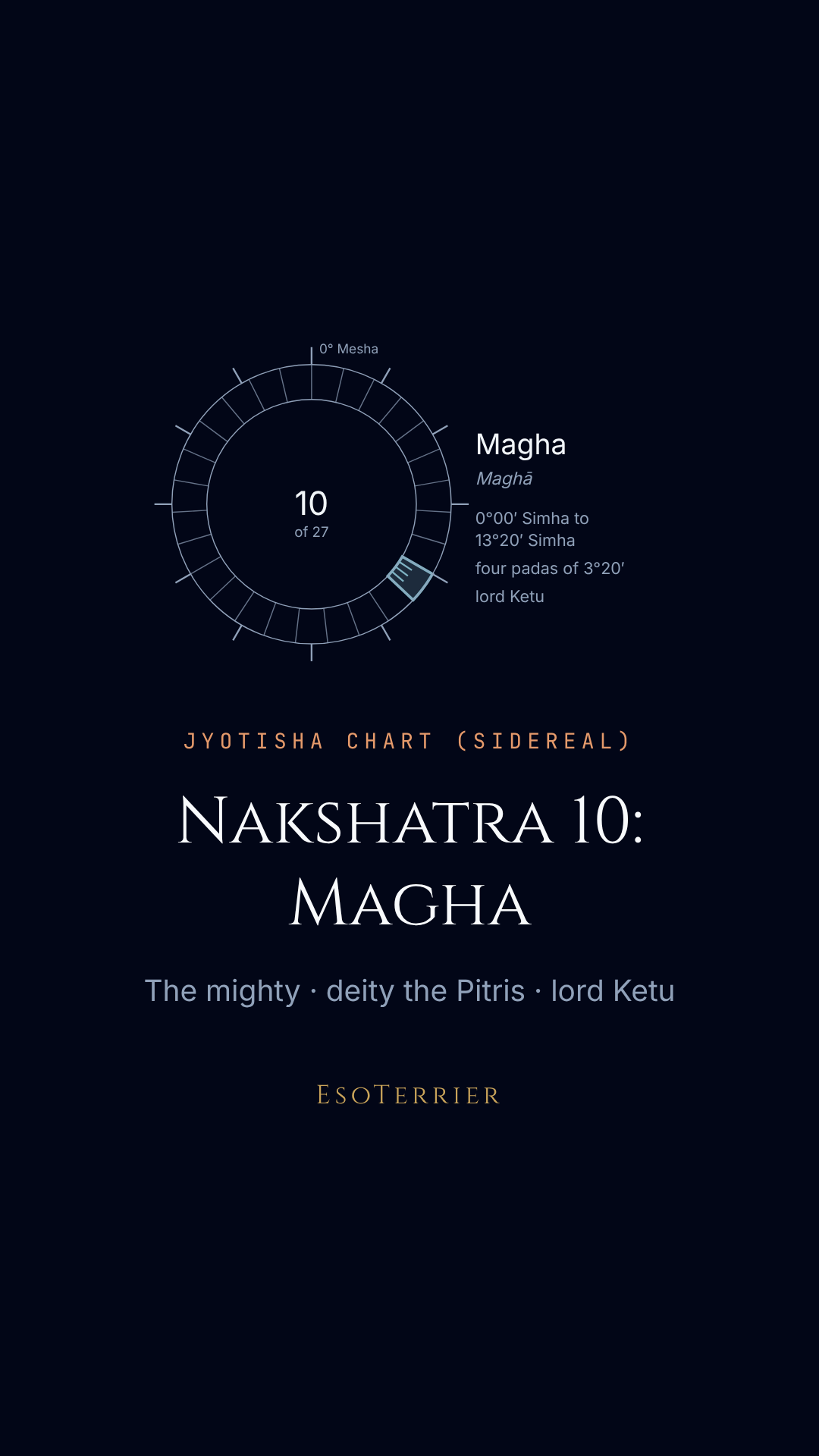
Magha runs from 0°00′ Simha to 13°20′ Simha of the sidereal zodiac, the tenth of 27 equal parts of 13°20′. It lies wholly within Simha (Leo). Its four padas of 3°20′ fall in the navamsas of Mesha, Vrishabha, Mithuna and Karka, so a graha in its first pada stands in Mesha in the D9.
Its Vimshottari lord is Ketu, whose period is seven years. When the Moon stands here at birth, the reckoning opens in Ketu's period and counts only the part still to run, in proportion to the part of Magha the Moon has yet to cross. In 2026 the same stretch of sky is about 24°13′ Leo to 7°33′ Virgo in the tropical zodiac, by the Lahiri measure; another ayanamsa moves the edges, and a Moon or lagna within a few minutes of arc of an edge can fall in the neighbouring nakshatra in another tool.
Correspondences
Each item with how it stands: “sourced” is in the work cited, “our construction” is EsoTerrier’s own, and “disputed” means the sources disagree.
- Deity, as used today
- the Pitris, the ancestors sourced
- Deity in the Taittiriya Samhita (iv.4.10)
- the fathers sourced
- Symbol, the modern tradition's
- royal throne; no dated source found disputed
- Figure in the medieval lists (Burgess, 1860)
- a house sourced
- Themes in modern readings, our summary
- lineage, dignity, inherited honour, duty to those who came before our construction
How the schools read it
- The Vedic lists (Taittiriya Samhita iv.4.10, Keith 1914)
- the fathers, as today; the Taittiriya list begins with Krittika.
- The medieval lists (Burgess and Whitney, 1860)
- The figure of the asterism: a house, after the Ratnamala and the Muhurta Chintamani.
- Modern Jyotisha
- Lineage, dignity, inherited honour, duty to those who came before; its symbol: royal throne.
- The 28-nakshatra scheme
- Abhijit, in the stars of Lyra, stands between Uttara Ashadha and Shravana in the older lists; the equal division into 27 leaves it out.
- Western sidereal (Fagan-Bradley)
- The same 27 divisions, about 0°53′ further on than Lahiri's; Western siderealists rarely use them.
- EsoTerrier
- Our chart's text for a Moon here: "Ruled by Ketu, Magha carries dignity, tradition and a sense of inherited honor, and its name means the great or bountiful one. Its energy is regal and generous, and holding ancestral pride lightly allows it to inspire rather than set one apart." Our words.
Claims about it
-
Magha's deity and symbol are one fixed set handed down from the Vedas.
disputedWhat the record shows: The deity, the Pitris, is the same in the Taittiriya Samhita (iv.4.10) and today, but five other nakshatras have different deities in different Vedic lists. The symbol, royal throne, is the modern tradition's and has no dated source we found; the medieval lists give a house.
-
The nakshatra is a constellation, 13°20′ wide.
falseWhat the record shows: The nakshatras began as star groups of unequal size, 28 in the Atharvaveda with Abhijit. The equal division into 27 parts of 13°20′ is a later convention; the name points at stars, the division is arithmetic.