The image
A woman holds a cup she has just drunk from and studies the wet leaves left in it, turning the cup to see the shapes they make. Tea-leaf reading is an old household custom, done at a kitchen table rather than in a temple. The picture shows the looking, the patient attention to something most people would rinse away.
The custom is described here as an image, and nothing on this page claims that it shows anything to come.
Meaning
Our keyword is "Reading small signs", and our keynote: meaning is found in the residue of the ordinary. Both are ours.
What interests us in the picture is the attention. The woman takes the leftovers of a daily habit and treats them as worth reading. We read the degree as the human urge to find pattern and significance in small things, and as the kind of noticing that turns an everyday moment into an occasion for reflection. One way to see it is in a person who reads moods, details and gestures closely, or who uses small rituals to think through larger questions. The image can also be read as the risk of seeing more in the cup than is there. The Sabian tradition calls its own images descriptions, and this page reads the tea leaves the same way.
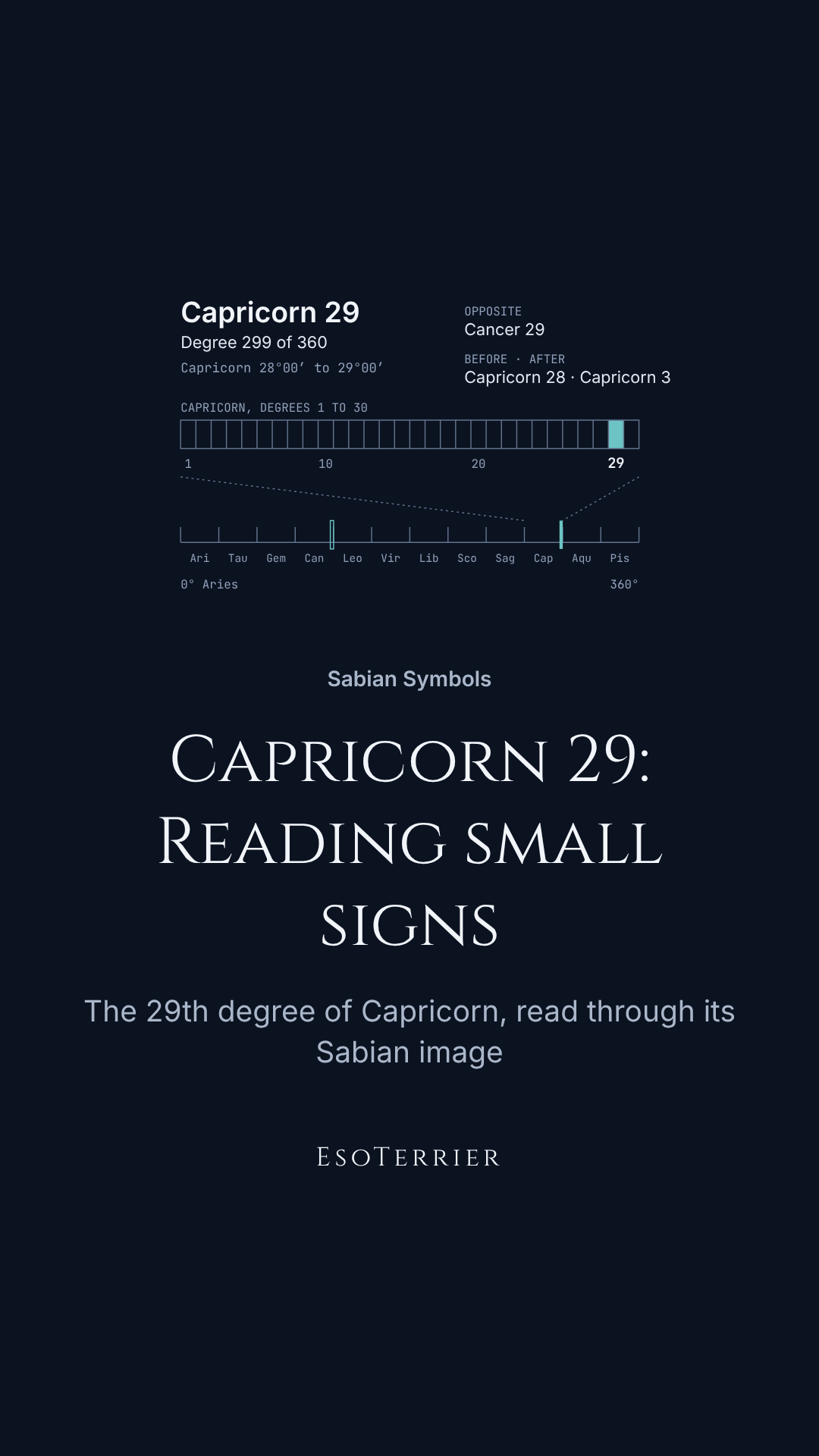
Lynda Hill draws the neighbours in: the former as the place this image starts, the latter as where it leans. Before it is Capricorn 28, a great cage full of birds, a crowd of lives in one structure; here the attention narrows to a few leaves. After it comes Capricorn 30, a closed-door meeting of businessmen, where private reflection over a cup becomes private planning among a few.
As a reading aid, the opposite degree is Cancer 29, a Muse weighing a pair of twins. Both images are about judgement; the Muse weighs two equal possibilities, the woman searches for a shape among many, and the pair sets careful weighing beside careful looking.
In a chart
A planet or point anywhere from Capricorn 28°00′ up to, but not including, Capricorn 29°00′ takes this degree. The rule is to count the degree a position is in from one, so a Moon at Capricorn 28°34′ reads Capricorn 29, and so does one at Capricorn 28°57′. Close to either edge, a small change in the birth time or the ephemeris moves a placement into the next image: into Capricorn 30 after Capricorn 28°59′, or back into Capricorn 28 before Capricorn 28°00′. That is why the chart shows the minute beside the degree. In EsoTerrier's Sabian chart the Sun, the Moon and the Ascendant are read first, then the Midheaven and the planets; each placement in Capricorn 29 carries the image, keyword and keynote above, with Capricorn 28, Capricorn 30 and Cancer 29 beside it.
Correspondences
Each item with how it stands: “sourced” is in the work cited, “our construction” is EsoTerrier’s own, and “disputed” means the sources disagree.
- Where the image comes from
- Recorded by Marc Edmund Jones in Balboa Park, San Diego, in 1925, as the clairvoyant Elsie Wheeler described the picture she saw for an unseen card; one of 360 done in a single day; published by Jones in 1953 sourced
- Degree before and after
- Capricorn 28 and Capricorn 30, read beside this degree after Lynda Hill, who calls them its Karmic Condition and its Quest Degree sourced
- Degree opposite
- Cancer 29, 180° away, offered as a reading aid; it is arithmetic, not a rule of Jones's our construction
- A position at Capricorn 28°00′00″
- Our engine, Hill's rule and every calculator we checked read it as Capricorn 29; the Sabian Assembly's sunrise page reads it as Capricorn 28. A computed chart practically never lands on it disputed
How the schools read it
- Marc Edmund Jones (1953)
- Gives the degree a symbol line, a commentary, a one-word keyword and a positive and a negative reading. We quote none of it.
- Dane Rudhyar (1973)
- Rewords the image and adds a keynote and a commentary of his own, numbering the degrees as Jones did. In copyright to 2068; not used, and the place he gives the degree in his own structure is not shown.
- Lynda Hill (1995, 2004)
- Uses the symbols as an oracle, with her own commentary, and reads each degree beside the one before and the one after. Her rule and her two names are cited here; her text is not used.
- The Sabian Assembly
- Jones's own study group serves the 1953 image and keyword of a degree in its oracle, without commentary, on purpose.
- EsoTerrier
- Our keynote: Meaning is found in the residue of the ordinary.
Claims about it
-
The image line on this page, or on any site, is Elsie Wheeler's own wording.
falseWhat the record shows: Her words survive only as Jones's pencilled notes of 1925. Jones reworded them in 1931 and 1953, Rudhyar in 1936 and 1973, and Hill in her books.
-
Reading the degree before and the degree after is part of how the zodiac is built, or of Jones's method.
falseWhat the record shows: It is Lynda Hill's practice, and the two names are hers. We show the two degrees with her name.
-
Dane Rudhyar's 1973 lines are the Sabian symbols and free to print.
falseWhat the record shows: They are his rewording, with his own keynotes and commentary, renewed in 2002 and in US copyright to the end of 2068. None of them is used here.
Elsewhere on EsoTerrier
- Capricorn 28: Contained variety the degree before, which Lynda Hill reads as its background
- Capricorn 30: Closed doors the degree after, which Hill reads as where it is heading
- Cancer 29: Weighing alternatives the degree opposite, read beside it as a reading aid
- Capricorn in the natal chart the sign these thirty degrees belong to