Meaning
Where the first hexagram has no yin, the second has no yang: six broken lines, the earth trigram set over itself. Its statement repeats the four qualities of hexagram 1 and gives the last of them to a mare, "the firmness of a mare", in Legge's English: strong, steady, and a follower. The superior man of the text goes astray if he takes the lead and finds his way if he follows. The Image is the earth carrying everything on it.
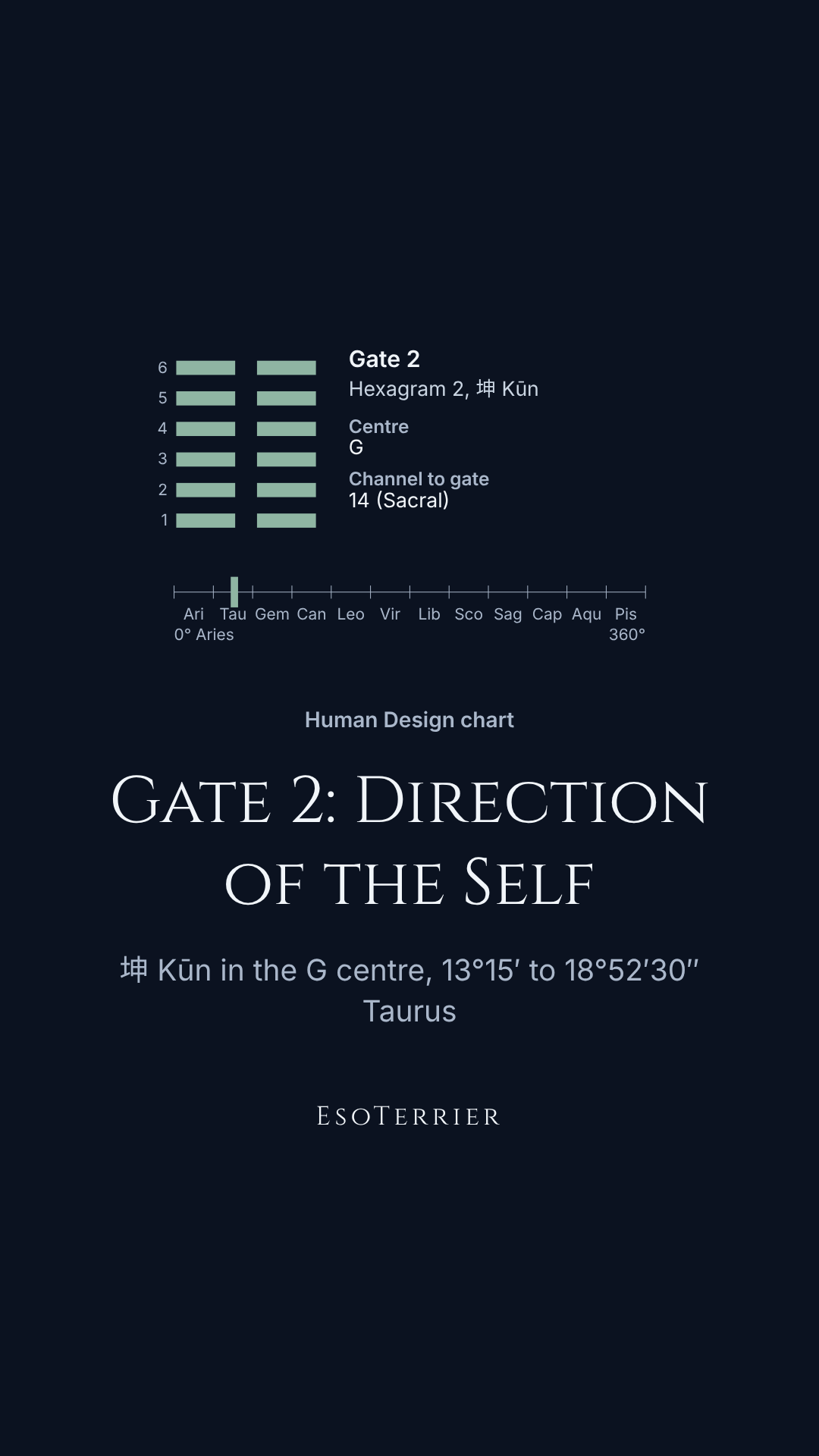
The gate stands exactly opposite gate 1 on Ra Uru Hu's wheel, from 13°15′ to 18°52′30″ Taurus, and its figure is gate 1's with every line turned over. Like gate 1 it sits in the G centre, which the system ties to identity and direction. Its one channel, which the school names The Beat, runs to gate 14 in the Sacral, one of the four centres the system treats as motors; both belong to the Knowing circuit of the Individual group.
The pairing is the clearest case on the wheel of the system using a hexagram's figure rather than its text: the two first hexagrams of the book face each other across the circle, as they face each other at the opening of the I Ching. We read gate 2, in our own words, as direction that is found rather than imposed. The earth hexagram does not lead, but it is not passive either; it carries what heaven starts and brings it to completion. Set where the system puts direction, and joined to the motor it ties to sustained work, it can be read as knowing which way to go because the effort is already underway.
The engine names the gate Direction of the Self. The Definitive Book, as the pyhd tables record it, titles it with the article, The Direction of the Self; the difference is only one of form.
On the wheel
Gate 2 covers 5°37′30″ of the zodiac, from 13°15′ to 18°52′30″ Taurus, the 19th gate counting from gate 41. In 2026 the Sun passes through it from 3 May to 9 May, and within a day of those dates in other years. Each of its six lines covers 56′15″:
- Line 1: 13°15′ to 14°11′15″ Taurus
- Line 2: 14°11′15″ to 15°07′30″ Taurus
- Line 3: 15°07′30″ to 16°03′45″ Taurus
- Line 4: 16°03′45″ to 17°00′ Taurus
- Line 5: 17°00′ to 17°56′15″ Taurus
- Line 6: 17°56′15″ to 18°52′30″ Taurus
In a chart the gate is active when any of the 26 positions falls in it, and the channel The Beat is defined only when gate 14 is active too, by either set.
When the Personality Sun is in this gate, the school's table names the cross by the angle of the profile: the Right Angle Cross of the Sphinx (2/1 | 13/7), the Juxtaposition Cross of the Driver (2/1 | 49/4) or the Left Angle Cross of Defiance (2/1 | 49/4). The four numbers are the Personality Sun and Earth, then the Design Sun and Earth. We give the names only.
Correspondences
Each item with how it stands: “sourced” is in the work cited, “our construction” is EsoTerrier’s own, and “disputed” means the sources disagree.
- Hexagram (the I Ching)
- 2 坤 Kūn ䷁: Earth doubled; Legge (1882) spells it Khwăn sourced
- Wheel position (Ra Uru Hu's wheel)
- 13°15′ to 18°52′30″ Taurus, 43.25° to 48.875° of the tropical zodiac: a modern placing, not the I Ching's sourced
- Centre (the system's association)
- G: the system ties it to identity and direction. A name and an association, not anatomy sourced
- Channel and circuit
- 2-14 The Beat, to gate 14 in the Sacral: Knowing circuit, Individual group sourced
- Gate opposite on the wheel
- Gate 1, Self-Expression, 180° away; its hexagram has every line of this one flipped sourced
- Crosses named from this gate
- Right Angle Cross of the Sphinx (2/1 | 13/7); Juxtaposition Cross of the Driver (2/1 | 49/4); Left Angle Cross of Defiance (2/1 | 49/4) sourced
- Gate name
- Direction of the Self: the name the engine prints. The Definitive Book (2011), as the pyhd tables record it, titles the gate "The Direction of the Self". A name, not the hexagram's disputed
- Gene Keys (Richard Rudd, 2009)
- Key 2, from the same hexagram at the same place on the wheel; our Gene Keys Profile page for it gives our own words sourced
- Our reading
- The receptive hexagram in the centre of direction: read as a sense of where to go that comes from attending rather than pushing, fed by the working energy below it. our construction
How the schools read it
- The I Ching, in Legge's translation (1882)
- “Khwăn (represents) what is great and originating, penetrating, advantageous, correct and having the firmness of a mare.”
- Human Design (Ra Uru Hu; the school)
- Names the gate Direction of the Self and sets it in the G centre, at one end of the channel The Beat. Its descriptions of the gate and its six lines are in Ra Uru Hu's books, in copyright; we do not quote or paraphrase them.
- The independent schools
- Zeno Dickson and Chaitanyo Taschler, Chetan Parkyn, Karen Curry Parker and later teachers compute the same gate at the same place, and read it in their own words.
- EsoTerrier
- The receptive hexagram in the centre of direction: read as a sense of where to go that comes from attending rather than pushing, fed by the working energy below it.
Claims about it
-
Gate 2's place on the zodiac, 13°15′ to 18°52′30″ Taurus, is where the I Ching itself puts hexagram 2.
falseWhat the record shows: The wheel is Ra Uru Hu's arrangement: Shao Yong's 11th-century circle of the 64, rotated so that hexagram 41 starts at 2° Aquarius. No Chinese source ties a hexagram to degrees of the zodiac.
-
The G centre, where gate 2 sits, is an organ or gland, and the gate tells something about the body.
unverifiedWhat the record shows: The centre's name is a name. The schools' pairing of the centres with organs and glands, taken from the chakra books of the 1920s, has no physiological correspondence that anyone has shown, and we never read a gate or a centre as the body or its health.
-
Gate 2 is one of the 64 codons of the genetic code, so it marks something in a person's genes.
falseWhat the record shows: Both sets have 64 members because both are built from a small alphabet in groups: two kinds of line in six places, four bases in three. Nothing beyond the count matches.
-
Gate 2 has one canonical name.
disputedWhat the record shows: Several sets circulate. The engine prints "Direction of the Self"; the Definitive Book, as the pyhd tables record it, has "The Direction of the Self". We keep the engine's so the chart and the page agree.