Meaning
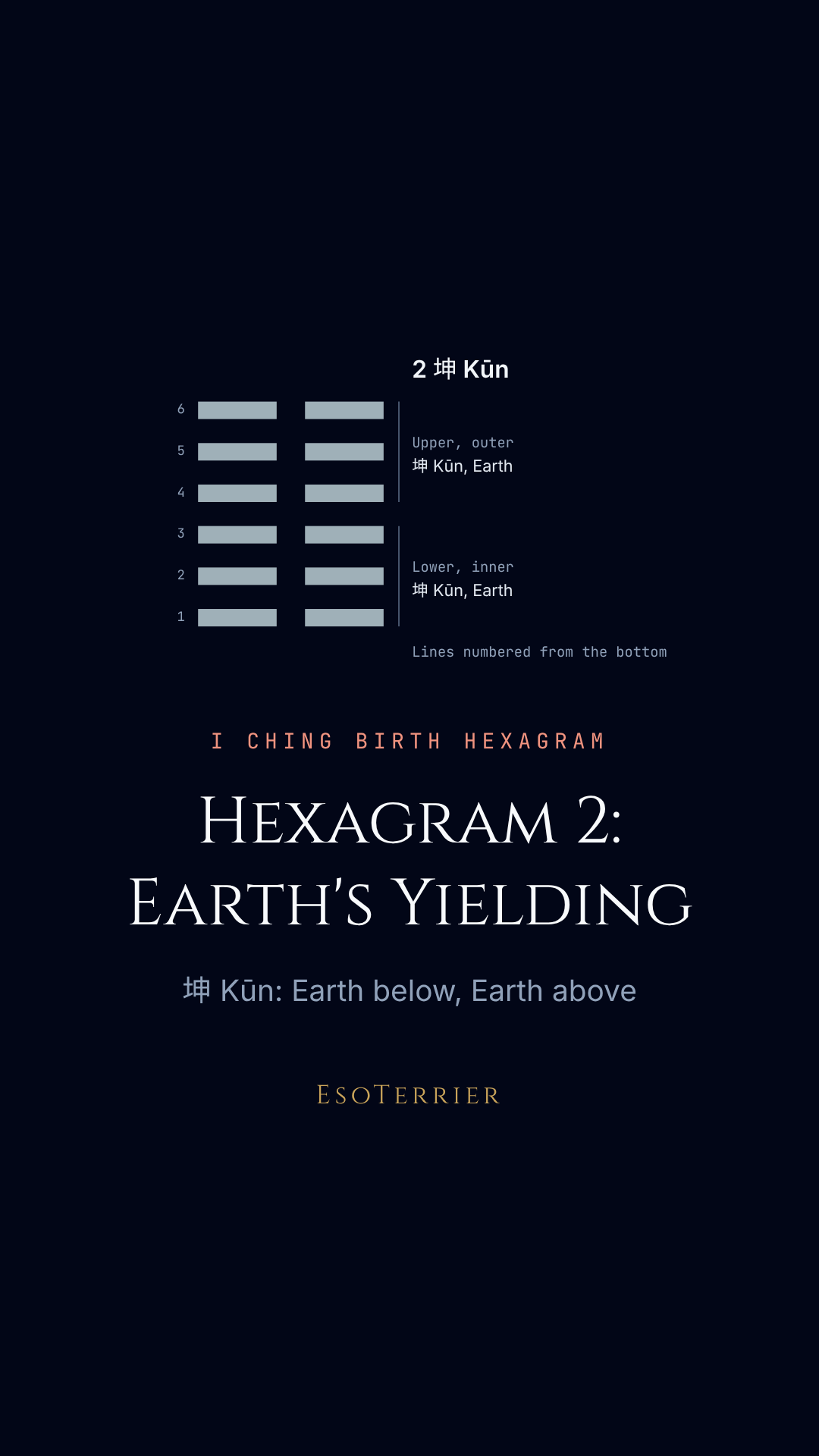
Where 乾 has no yin, 坤 has no yang: six broken lines, the earth trigram over itself. Its statement repeats the four qualities of the first hexagram and then qualifies the last of them, firmness, with an animal, the mare: strong, but a follower. The superior man of the text goes astray if he takes the lead and finds his proper lord if he follows; he gains friends in the south-west and loses them in the north-east. Legge explains the directions by the Later Heaven placing of the trigrams, in which 坤 stands in the south-west.
The Image is the earth that bears everything, and asks a person to carry others with a broad generosity. In our own reading this is not weakness but capacity: the power to receive, to hold and to bring to completion what someone else began. The Wings pair the two first hexagrams as heaven and earth, father and mother, and the rest of the book unfolds between them.
The lines
The lines open with a warning about small beginnings: the first line is "treading on hoarfrost", in Legge's English, and the hard ice is coming. The second line is "straight, square, and great", which Legge takes as the old picture of the earth as a cube; the third keeps its excellence under restraint and serves without claiming the credit; the fourth is a sack tied shut, deserving neither blame nor praise; the fifth is the yellow lower garment, yellow being, for the commentators, the colour of the centre. At the top, yin pushed too far turns into a dragon of its own and fights in the wild, and "their blood is purple and yellow", the colours of heaven and earth. As in hexagram 1, a seventh statement follows for the case where every line moves.
Among the twelve hexagrams of the Han calendars, 坤 is the tenth lunar month, the depth of yin before the turn at the winter solstice.
In the birth cast
The time cast arrives at 坤 when the year, month and day leave 0, counted as 8 on eight, which puts 坤 earth above, and the same total with the hour added leaves 0, counted as 8, which puts 坤 earth below. Which line moves depends on what the whole total leaves on six, and each line turns the figure into a different hexagram:
- Line 1 (初六) moving: becomes 24 復 Fù, Return
- Line 2 (六二) moving: becomes 7 師 Shī, The Army
- Line 3 (六三) moving: becomes 15 謙 Qiān, Modesty
- Line 4 (六四) moving: becomes 16 豫 Yù, Readiness
- Line 5 (六五) moving: becomes 8 比 Bǐ, Alliance
- Line 6 (上六) moving: becomes 23 剝 Bō, Stripping Away
Lines 2 to 5 give the hexagram within, 2 坤 Kūn, Earth's Yielding. Everyone born in the same lunar day and double hour has the same cast, so the figure describes a moment, not a person.
Correspondences
Each item with how it stands: “sourced” is in the work cited, “our construction” is EsoTerrier’s own, and “disputed” means the sources disagree.
- Trigram virtues (Shuogua, chapter 7)
- 坤 yielding, compliant, doubled, in our English sourced
- Trigram family places (Shuogua)
- mother, doubled sourced
- Trigram body and animal images (Shuogua)
- belly and ox, doubled sourced
- Trigram phases (a classical correspondence: the Plum Blossom text's table)
- Earth, doubled. The Han assignment of 梅花易數, book 1, also used by Jing Fang; not stated as such in the Zhouyi sourced
- Month in the Han calendars (sovereign hexagram)
- The tenth lunar month (亥), with no yang lines sourced
- Inverse and opposite
- Upside down it is itself; every line flipped: 1 乾 Qián, Heaven's Strength sourced
- Human Design gate
- Gate 2, from 43.25° to 48.875° of the tropical zodiac on Ra Uru Hu's wheel (1987): a modern placing, not the I Ching's sourced
- Our English title
- Earth's Yielding: EsoTerrier's own, from the sense of 坤 our construction
How the schools read it
- The Zhouyi, in Legge's translation (1882)
- “Khwăn (represents) what is great and originating, penetrating, advantageous, correct and having the firmness of a mare.”
- The Image (大象), one of the Wings, in our paraphrase
- The sustaining power of the earth; the superior man supports people and things with his large virtue.
- The Han calendars (1st century BCE)
- The hexagram of the tenth lunar month, the month of 亥: yin at its height.
- The Plum Blossom method (Ming)
- A figure reached by numbers: 坤 above when the year, month and day leave 0 on eight, 坤 below when the same total with the hour leaves 0.
- Human Design (Ra Uru Hu, 1987)
- Takes the number for its gate 2 and puts it on the zodiac; its own reading, which we do not quote.
- EsoTerrier
- Earth doubled: the strength that carries and completes what another began, steady like a mare on her path, finding its way by following.
Claims about it
-
Gate 2 of Human Design, at 43.25° to 48.875° of the zodiac, is where the I Ching itself places hexagram 2.
falseWhat the record shows: The wheel is Shao Yong's circle rotated by Ra Uru Hu in 1987 to 1989 so that hexagram 41 starts at 2° Aquarius. No Chinese source we found puts the hexagrams on degrees of the zodiac.
-
Being born under 坤 Kūn fixes a person's character.
unverifiedWhat the record shows: A modern reading with no source in the tradition. The Zhouyi has no birth hexagram; the cast reads a figure, not a person, and everyone born in the same lunar day and double hour shares it.
-
The numbering of the trigrams that puts 坤 first is as old as the hexagram itself.
falseWhat the record shows: The Earlier Heaven order, 乾 1 to 坤 8, is Shao Yong's, of the 11th century, first printed by Zhu Xi in 1188; the Song school credited it to Fuxi. The Zhouyi numbers only the hexagrams.
-
Hexagram 2 is a digit of the world's oldest binary code.
falseWhat the record shows: Read with yin as 0 and yang as 1, Shao Yong's 11th-century arrangement counts from 0 to 63; the Zhouyi's own order does not, and Leibniz had binary arithmetic before he saw the diagram.