Meaning
The lightest of the trigrams, the lake, walks beneath the strongest, heaven, and the hexagram is about conduct where a wrong step would be dangerous. Its Judgment is one of the most remembered images in the book: "one treading on the tail of a tiger, which does not bite him", in Legge's English, and there is progress and success. The Image draws from sky and marsh the lesson of distinguishing high from low, each in its place.
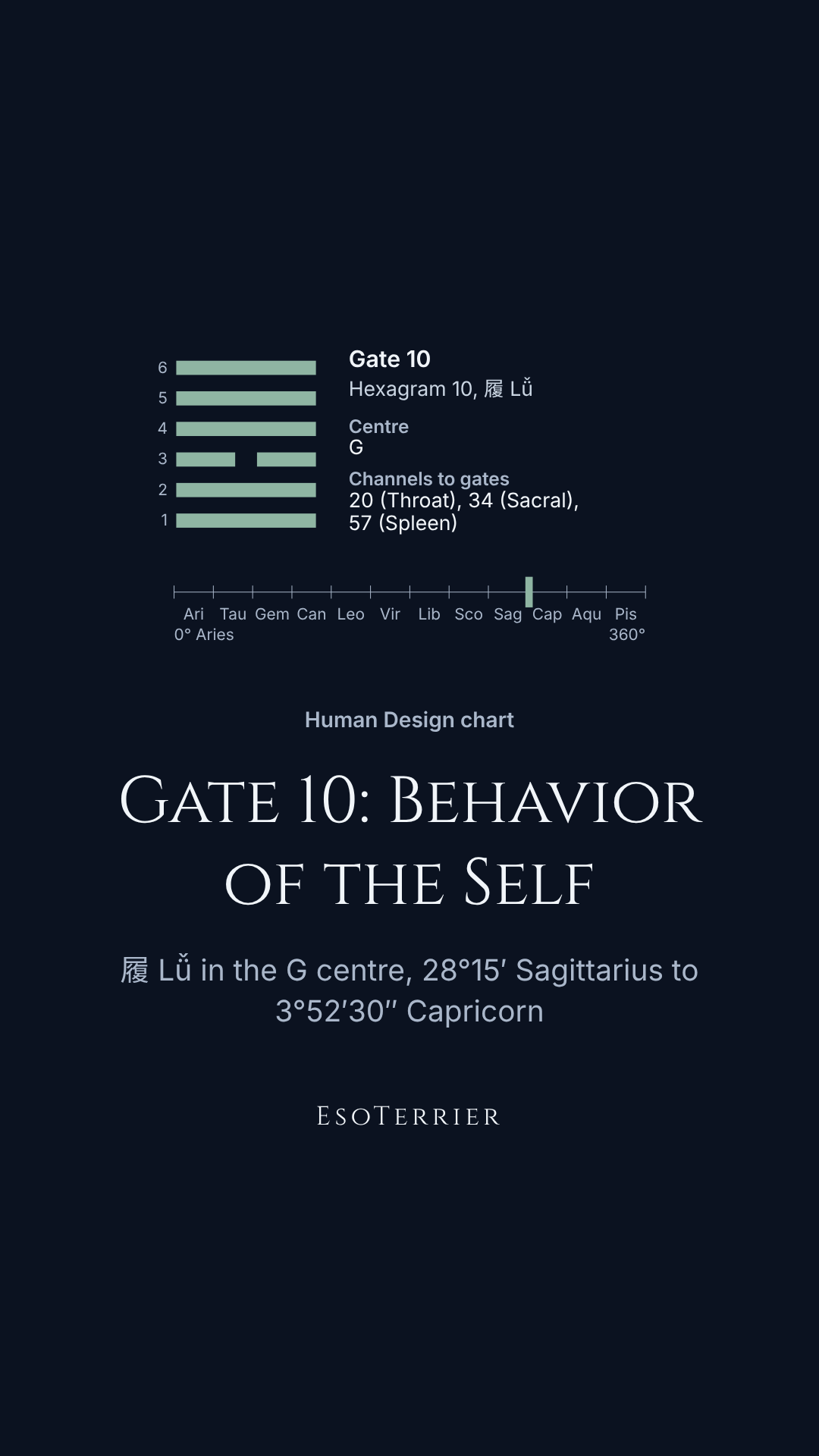
Human Design places gate 10 from 28°15′ Sagittarius to 3°52′30″ Capricorn, in the G centre, which it ties to identity and direction. It is one of four gates that end three channels: Awakening to gate 20 in the Throat, Exploration to gate 34 in the Sacral, and Perfected Form to gate 57 in the Spleen. The school puts all three in its Individual group, two of them in the circuit it calls Integration and one in Centering.
We read the gate, in our own words, as conduct itself: how a person moves among others, here set at the centre the system associates with identity. The tiger in the hexagram is not fought or avoided; it is walked past with care, and it does not bite. With three channels the gate can be read three ways, as behaviour put into words through the Throat, carried by the working energy of the Sacral, or guided by the instinct the system ties to the Spleen. The hexagram asks for the same thing in each: tact, not timidity.
The engine's name is Behavior of the Self; the Definitive Book, as the pyhd tables record it, has The Behavior of the Self, a difference only of form. Opposite gate 10 on the wheel is gate 15, the hexagram of modesty, the mountain hidden in the earth.
On the wheel
Gate 10 covers 5°37′30″ of the zodiac, from 28°15′ Sagittarius to 3°52′30″ Capricorn, the 59th gate counting from gate 41. In 2026 the Sun passes through it from 20 December to 25 December, and within a day of those dates in other years. Each of its six lines covers 56′15″:
- Line 1: 28°15′ to 29°11′15″ Sagittarius
- Line 2: 29°11′15″ Sagittarius to 0°07′30″ Capricorn
- Line 3: 0°07′30″ to 1°03′45″ Capricorn
- Line 4: 1°03′45″ to 2°00′ Capricorn
- Line 5: 2°00′ to 2°56′15″ Capricorn
- Line 6: 2°56′15″ to 3°52′30″ Capricorn
In a chart the gate is active when any of the 26 positions falls in it, and each of its channels is defined only when the gate at its other end is active too, by either set: Awakening with gate 20, Exploration with gate 34, Perfected Form with gate 57.
When the Personality Sun is in this gate, the school's table names the cross by the angle of the profile: the Right Angle Cross of the Vessel of Love (10/15 | 46/25), the Juxtaposition Cross of Behavior (10/15 | 18/17) or the Left Angle Cross of Prevention (10/15 | 18/17). The four numbers are the Personality Sun and Earth, then the Design Sun and Earth. We give the names only.
Correspondences
Each item with how it stands: “sourced” is in the work cited, “our construction” is EsoTerrier’s own, and “disputed” means the sources disagree.
- Hexagram (the I Ching)
- 10 履 Lǚ ䷉: Lake / marsh below, Heaven above; Legge (1882) spells it Lî sourced
- Wheel position (Ra Uru Hu's wheel)
- 28°15′ Sagittarius to 3°52′30″ Capricorn, 268.25° to 273.875° of the tropical zodiac: a modern placing, not the I Ching's sourced
- Centre (the system's association)
- G: the system ties it to identity and direction. A name and an association, not anatomy sourced
- Channels and circuits
- 10-20 Awakening, to gate 20 in the Throat: Integration circuit, Individual group; 10-34 Exploration, to gate 34 in the Sacral: Centering circuit, Individual group; 10-57 Perfected Form, to gate 57 in the Spleen: Integration circuit, Individual group sourced
- Gate opposite on the wheel
- Gate 15, Extremes, 180° away; its hexagram has every line of this one flipped sourced
- Crosses named from this gate
- Right Angle Cross of the Vessel of Love (10/15 | 46/25); Juxtaposition Cross of Behavior (10/15 | 18/17); Left Angle Cross of Prevention (10/15 | 18/17) sourced
- Gate name
- Behavior of the Self: the name the engine prints. The Definitive Book (2011), as the pyhd tables record it, titles the gate "The Behavior of the Self". A name, not the hexagram's disputed
- Gene Keys (Richard Rudd, 2009)
- Key 10, from the same hexagram at the same place on the wheel; our Gene Keys Profile page for it gives our own words sourced
- Our reading
- Conduct in a delicate place: read as the way a person carries themselves, which can be voiced, powered or sensed through its three channels. our construction
How the schools read it
- The I Ching, in Legge's translation (1882)
- “(Lî suggests the idea of) one treading on the tail of a tiger, which does not bite him. There will be progress and success.”
- Human Design (Ra Uru Hu; the school)
- Names the gate Behavior of the Self and sets it in the G centre, at one end of the channels Awakening, Exploration and Perfected Form. Its descriptions of the gate and its six lines are in Ra Uru Hu's books, in copyright; we do not quote or paraphrase them.
- The independent schools
- Zeno Dickson and Chaitanyo Taschler, Chetan Parkyn, Karen Curry Parker and later teachers compute the same gate at the same place, and read it in their own words.
- EsoTerrier
- Conduct in a delicate place: read as the way a person carries themselves, which can be voiced, powered or sensed through its three channels.
Claims about it
-
Gate 10's place on the zodiac, 28°15′ Sagittarius to 3°52′30″ Capricorn, is where the I Ching itself puts hexagram 10.
falseWhat the record shows: The wheel is Ra Uru Hu's arrangement: Shao Yong's 11th-century circle of the 64, rotated so that hexagram 41 starts at 2° Aquarius. No Chinese source ties a hexagram to degrees of the zodiac.
-
The G centre, where gate 10 sits, is an organ or gland, and the gate tells something about the body.
unverifiedWhat the record shows: The centre's name is a name. The schools' pairing of the centres with organs and glands, taken from the chakra books of the 1920s, has no physiological correspondence that anyone has shown, and we never read a gate or a centre as the body or its health.
-
Gate 10 is one of the 64 codons of the genetic code, so it marks something in a person's genes.
falseWhat the record shows: Both sets have 64 members because both are built from a small alphabet in groups: two kinds of line in six places, four bases in three. Nothing beyond the count matches.
-
Gate 10 has one canonical name.
disputedWhat the record shows: Several sets circulate. The engine prints "Behavior of the Self"; the Definitive Book, as the pyhd tables record it, has "The Behavior of the Self". We keep the engine's so the chart and the page agree.
Elsewhere on EsoTerrier
- Gate 20: The Now the other end of the channel Awakening, in the Throat
- Gate 34: Power the other end of the channel Exploration, in the Sacral
- Gate 57: Intuitive Clarity the other end of the channel Perfected Form, in the Spleen
- Gate 15: Extremes the gate opposite on the wheel
- Hexagram 10: Treading the I Ching hexagram the gate takes its number from
- Gene Keys Profile: key 10 Rudd's system at the same place, in our own words