How it works
Every day of the count carries a number from 1 to 13 and one of twenty named day signs, and the two advance together: 1 Imox, 2 Iq', 3 Aq'ab'al, and so on, until 13 Aj is followed by 1 I'x. Because 13 and 20 share no factor, every number meets every sign once, and the round closes after 13 × 20 = 260 days.
The day. The result is your calendar date of birth, as every calculator and printed table gives it. The living highland tradition begins the day at sunset, so with a birth time and place the engine works out local sunset and, for a birth after it, adds a note naming the next day.
Joining the count to our calendar. We count the days since the Long Count's starting date with the Goodman-Martínez-Thompson correlation, 584283, which puts 13.0.0.0.0, 4 Ajaw 3 K'ank'in, on 21 December 2012. It is the scholars' working standard and the one that matches the living count: 8 B'atz' fell on 18 January 2025, 5 October 2025 and 22 June 2026, and 1 Kej opened the highland year on 18 February 2026, as the Guatemalan Ministry of Culture and the Maya' Wuj table give them. We checked the arithmetic on every day from the year 1 to 2100 against a textbook implementation, on all 579 days of the printed Maya' Wuj table, and against six libraries and five calculators.
The names. Each sign is named first in K'iche', in the unified alphabet of 1987 and the forms of the Komon Tohil daykeepers' sheet (Imox, Iq', Aq'ab'al … Ajpu), then in Yucatec (Imix, Ik', Ak'b'al … Ajaw), the names scholars use, then with a one-word English gloss of our own. The colonial spellings, such as Cimi or Cauac, are kept only so that searches find them.
The number. In the highland ethnography the number gives the day its force: the low numbers gentle, the high ones strong. The principle comes from Barbara Tedlock's fieldwork at Momostenango as others report it and from Ruth Bunzel's Chichicastenango; which numbers count as good differs from town to town in Thompson's survey. We group the numbers into three bands, mild (1 to 3), middle (4 to 9) and strong (10 to 13): the grouping and its edges are ours, not a published scheme.
Around the day. The chart also shows:
- the thirteen-day run (trecena) the day falls in, as a position, with no reading of its own;
- the nawal cross of Guatemalan practice: the days 8 before (conception) and 8 after (destiny), 6 before (the right hand) and 6 after (the left hand), number and sign moving together; a calculator from Guatemala matched all sixteen cross signs we tested;
- the year bearer as it is kept in the highlands: the year that 1 Kej opened on 18 February 2026, counted back in steps of 365 days, whose bearer is always Kej, E, No'j or Iq', with its number rising by one each year;
- the Haab', labelled "Classic alignment": the 365-day count as the scholars' converters and the Maya' Wuj table place it, with days numbered 0 to 19 from the month's seating; highland ceremonies count their year, the Ab', from about forty days earlier, so the highland month differs;
- the Long Count of the day, and the Lord of the Night, Glyph G of the Classic inscriptions, as a datum with no reading, since the Maya names of the nine are not known.
What you read. The day-sign and number texts are ours, written in 2026 from the published highland sources: the Komon Tohil daykeepers of Zunil as the Smithsonian published their sheet, the Maya' Wuj calendar manual, and the Momostenango daykeeper Andrés Xiloj's words of 2005. In the living tradition a daykeeper's reading is done in person, by counting tz'ite seeds through the days. We give the Dreamspell name of a date once, in the chart, so that a reader who met it elsewhere can see why it differs.
Origins and history
The count is older than any surviving book: its earliest record is a painted day, and its fullest description comes from the people who kept it under colonial rule.
| When | Who | What happened |
|---|---|---|
| 300 to 200 BCE | Maya scribes at San Bartolo, Guatemala | A mural fragment carries the day "7 Deer" (7 Manik', in K'iche' 7 Kej): the earliest securely dated record of the 260-day count. Older candidates, such as a painting at Oxtotitlan, are debated. |
| 36 and 32 BCE | Chiapa de Corzo and Tres Zapotes, outside the Maya area | The earliest Long Count dates, written with a zero; the first reading is not certain. |
| About 250 to 909 CE | The lowland Maya kingdoms | Thousands of monuments dated in the Long Count, with the Lords of the Night; the last Long Count date was carved at Toniná in 909. |
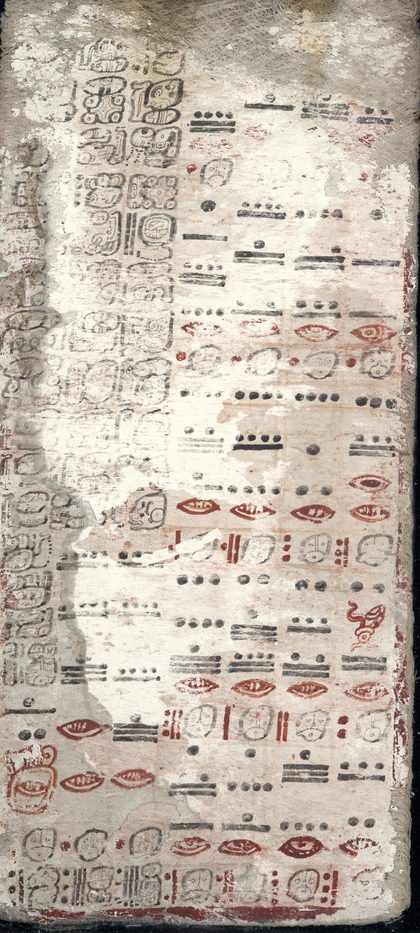
| About 1200 to 1345 | Scribes in Yucatan | The Dresden Codex, one of four Maya books to survive, with its Venus and eclipse tables. |
| About 1554 to 1558 | K'iche' nobles of Santa Cruz del Quiché | The Popol Vuh written down in K'iche' in the Latin alphabet, with gods whose names are day names. |
| 1562 to about 1566 | Diego de Landa, Franciscan friar | Burns the Maya books at Maní, then records the day and month signs and the year bearers of Yucatan in his Relación, with a year that began in July 1553: the colonial anchor of the correlation. |
| 1685, 1722 and 1854 | K'iche' and Kaqchikel daykeepers | Three highland calendars written in Mayan languages, proof that the count was kept through the colonial period. |
| 1905 to 1927 | Joseph Goodman, Juan Martínez Hernández, J. Eric S. Thompson | Three steps of one argument that ties the Long Count to our calendar, from Landa's year and the k'atun record. |
| 1915 | Sylvanus G. Morley | An Introduction to the Study of the Maya Hieroglyphs draws the day signs from the inscriptions and the codices; our glyphs are traced from his figure 17. |
| 1935 to 1950 | J. Eric S. Thompson | Compares the living counts of the K'iche', Kaqchikel, Jakaltek and others with Landa's and finds them within a day or two; settles on 584283 in 1950. |
| 1942 and 1947 | J. Steward Lincoln; Oliver La Farge | Record the Ixil and Q'anjob'al counts, their year bearers and the day that begins at sunset. |
| 1966 | Michael D. Coe | One sentence in The Maya about the end of the thirteenth b'ak'tun, the seed of the 2012 craze. |
| 1970s to 1982 | Barbara and Dennis Tedlock, Momostenango | Train for 260 days with a daykeeper and are initiated; her Time and the Highland Maya (1982) becomes the standard ethnography of the K'iche' count. |
| 1987 and 1990 | José and Lloydine Argüelles | The Harmonic Convergence, then Dreamspell, a separate count with its own names. |
| 1987 | Government of Guatemala | The unified alphabets of the Mayan languages become official, the source of the spellings Imox, Iq' and Ajpu. |
| 1995 and 1996 | Government of Guatemala and the URNG | The accord on Indigenous identity and rights recognises Maya spirituality; with the peace, daykeepers' ceremonies move into public life. |
| 1997 | Kenneth Johnson | First English description of the nawal cross. |
| 21 December 2012 | 13.0.0.0.0: the thirteenth b'ak'tun completes and the fourteenth begins. | |
| 2013 | Douglas Kennett and others | Radiocarbon dating of a lintel from Tikal supports the scholars' family of correlations. |
| 2018 | Unicode 11.0 | Encodes the bar-and-dot numerals; the day signs are not yet encoded. |
| 2025 and 2026 | Guatemala's Ministry of Culture; Editorial Maya' Wuj | Announce 8 B'atz' and the year bearer and print the day table: the living count, matching 584283 on every day. |
Landa is both the man who burned the books and the source that later made the correlation possible: the same friar who called the books superstition recorded the year bearers and the signs that Goodman and Thompson used to fix the dates.
The twenty day signs and the thirteen numbers
Each sign and each number has its own page: its names, the glyph or the numeral, what scholars, the colonial sources and today's daykeepers say of it, our own reading labelled as ours, and the claims made about it.
The twenty day signs
- Day sign 1: Imox (Imix)
- Day sign 2: Iq' (Ik')
- Day sign 3: Aq'ab'al (Ak'b'al)
- Day sign 4: K'at (K'an)
- Day sign 5: Kan (Chikchan)
- Day sign 6: Kame (Kimi)
- Day sign 7: Kej (Manik')
- Day sign 8: Q'anil (Lamat)
- Day sign 9: Toj (Muluk)
- Day sign 10: Tz'i' (Ok)
- Day sign 11: B'atz' (Chuwen)
- Day sign 12: E (Eb')
- Day sign 13: Aj (B'en)
- Day sign 14: I'x (Ix)
- Day sign 15: Tz'ikin (Men)
- Day sign 16: Ajmaq (Kib')
- Day sign 17: No'j (Kab'an)
- Day sign 18: Tijax (Etz'nab')
- Day sign 19: Kawoq (Kawak)
- Day sign 20: Ajpu (Ajaw)
The thirteen numbers
- Number 1: one dot
- Number 2: two dots
- Number 3: three dots
- Number 4: four dots
- Number 5: one bar
- Number 6: one bar and one dot
- Number 7: one bar and two dots
- Number 8: one bar and three dots
- Number 9: one bar and four dots
- Number 10: two bars
- Number 11: two bars and one dot
- Number 12: two bars and two dots
- Number 13: two bars and three dots
Variants and what we leave out
The same date can give different answers on different sites. Here is why, and what we do with each choice.
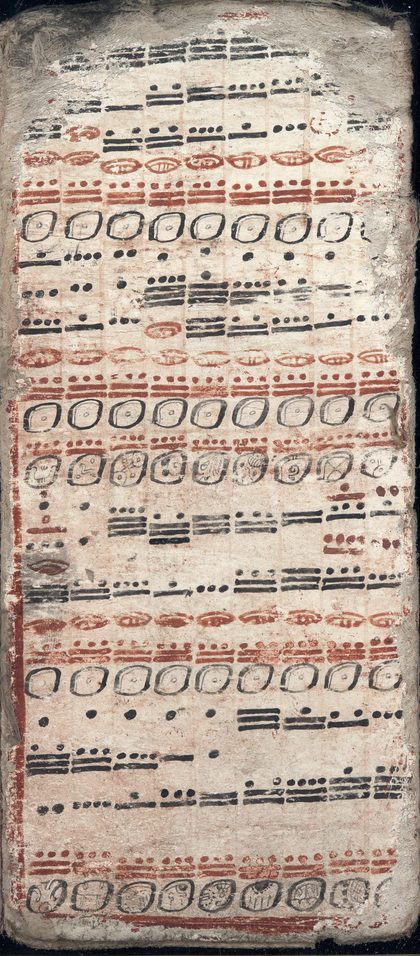
- Other correlations. 584285 (Thompson's own of 1927, later revived by Floyd Lounsbury, and FAMSI's "astronomical" option) fits some readings of the Dresden Venus table and puts every Maya date two days later in our calendar, so a birth date falls two days earlier in the count; 584286 (Martin and Skidmore, 2012) rests on one eclipse record and, by its authors' own account, breaks with the living count. We use 584283 and show the 584285 day as a footnote in the chart, without a switch, because a birth reading is about the count the daykeepers keep.
- The Haab' and the highland year. The converters' Classic alignment against the highland Ab', which begins about forty days earlier (18 February 2026). We show the Classic Haab', labelled, and take the year bearer from the highland new year.
- Three sets of year bearers. The Classic set (Ik', Manik', Eb' and Kab'an on 0 Pop) is the same four signs the highlands keep as Iq', Kej, E and No'j; Late Classic Campeche used Ak'b'al, Lamat, B'en and Etz'nab'; Landa's Yucatan used K'an, Muluk, Ix and Kawak. The Classic bearer of a year has the same sign as the highland one and a number one higher. We give the highland bearer and never imply that the other sets agree.
- Day numbering of the Haab'. Colonial Yucatec sources count 1 to 20; the Classic texts and the converters count 0 to 19 from the seating of the month. We use 0 to 19.
- When the day begins. Sunset in the living tradition, midnight in every calculator, sunrise in some reconstructions. We give the calendar date and the sunset note.
- Names. Some tools use Yucatec only, Guatemalan tools K'iche' only, Western sites English animal names, and Dreamspell its own coloured names. We give K'iche', Yucatec and our gloss, in that order.
- A nine-sign cross with a total. Some readers add arms and sum the numbers; every Guatemalan tool we checked, and Johnson, use five positions. We use five.
- Readings of the thirteen-day runs and of the Lords of the Night. Those in circulation come from the patrons of the Central Mexican codices or from modern authors, and the Maya names of the nine lords are unknown. Shown as positions, without readings.
- Dreamspell's oracle, colour families and thirteen-month year. Left out; the chart gives the Dreamspell name once, labelled.
- Directions, colours, guardian animals, jobs and matches between signs, which Western sites and apps attach to each sign. Only the year-bearer days have attested directions; the rest are left out.
- A numbered "Maya year" (5141 or 5142 for 2026, depending on the source). Left out: the sources disagree.
- The good and bad days of the highland manuscripts of 1685 to 1854, the 819-day count, the lunar series and the codices' Venus and eclipse tables. Historical layers, not computed and not used as readings.
Myths and disputed claims
What is said about the Maya count, who says it, and what the record shows. The label is ours.
-
Dreamspell is the Maya calendar, and its seal names and colours are the Maya day signs.
falseWho says it: Dreamspell's materials and calculators, which lead English searches for a "Mayan sign".
What the record shows: Dreamspell (José and Lloydine Argüelles, 1990) is a different count that skips every 29 February. For every day from 1900 to 2100 its day number differs from the traditional count's, by 26 to 75 days; at most the sign name can coincide. Its own promoters now say it is not the Maya calendar.
-
The thirteen numbers are cosmic "tones" with names such as Magnetic and Lunar, and these are Maya terms.
falseWho says it: Dreamspell (1990) and four of six English calculators we surveyed in 2026.
What the record shows: The names are Dreamspell's. The Maya count has numbers 1 to 13, and the highland tradition reads the number as the strength of the day.
-
The count was lost and was restored by José Argüelles or the Harmonic Convergence of 1987.
falseWho says it: Some Dreamspell and New Age writing.
What the record shows: It was never lost. Highland daykeepers kept it through the colonial period: K'iche' and Kaqchikel calendars survive from 1685, 1722 and 1854, and Thompson found the living counts within a day or two of Landa's sixteenth-century record.
-
The Maya calendar ran out on 21 December 2012, and the Maya foresaw a catastrophe or a world transformation for that day.
falseWho says it: The 2012 books and films, from Michael Coe's one sentence of 1966 onwards.
What the record shows: On that day the Long Count completed its thirteenth b'ak'tun and the fourteenth began, as a car's odometer rolls on. The two inscriptions that mention the date mark seventh-century dedications, not a prophecy, and Guatemalan Maya leaders spoke of a new cycle.
-
The nawal cross is an ancient Maya chart found in the inscriptions or the codices.
falseWho says it: Many English "Mayan cross" pages.
What the record shows: It is a practice of the living Guatemalan tradition, first described in English by Kenneth Johnson in 1997, who called it a creation of the contemporary Maya cultural renaissance. We show it labelled so.
-
Each of the thirteen numbers has a fixed traditional character, such as unity for 1 or transcendence for 13.
unverifiedWho says it: Calculators and sign books.
What the record shows: What the highland ethnography reports is strength: low numbers gentle, high numbers strong. Which numbers are good differs from town to town in Thompson's survey. Our keywords for the numbers are ours, labelled so.
-
The twentieth day's name means "radiant spiritual mastery".
falseWho says it: Western sign pages.
What the record shows: Ajaw means lord or ruler in Yucatec and other Mayan languages; the K'iche' name Ajpu means the blowgunner, the hero of the Popol Vuh.
-
The five Wayeb' days are perilous for everyone, with fixed taboos, and all Maya say so.
falseWho says it: Popular calendar pages.
What the record shows: The taboos come from colonial Yucatec sources. In the highlands today the days before the year bearer enters are described as a time of transition.
-
"Tzolk'in" is what the ancient Maya called the 260-day count.
falseWho says it: Most English writing on the calendar.
What the record shows: The word was coined by modern Mayanists from Yucatec. The ancient name is not known; in K'iche' today the count is the Cholq'ij.
-
The count is the oldest calendar in the world, used unchanged since the Olmec.
unverifiedWho says it: Many popular pages.
What the record shows: The earliest secure record is the San Bartolo day of 300 to 200 BCE, so about 2,300 documented years. Older figures come from the Long Count's mythic start in 3114 BCE, a date calculated backwards, not a record.
-
584285 is the correct correlation and 584283 is wrong.
disputedWho says it: Some astronomical readings of the Dresden Codex; Floyd Lounsbury; the FAMSI converter's "astronomical" option.
What the record shows: Both are in the accepted family. 584285 fits some readings of the Venus table; 584283 is the one the living highland count matches day for day. Radiocarbon dating supports the family and cannot choose within it.
-
A day sign has one fixed meaning and one fixed fortune for all Maya, in every period.
disputedWho says it: Sign books and calculators.
What the record shows: Thompson's tables show the readings and the good or bad days differing between Yucatan and the highlands, and even between K'iche' towns; the calendars of 1685 to 1854 show them changing over time.
Stories and lore
These are told as the tradition and its historians tell them.
The Hero Twins and the name Ajpu. In the Popol Vuh, written down by K'iche' nobles in the 1550s, the twins Hunahpu and Xbalanque go down to Xibalba, the underworld, to avenge their father and his brother, who were defeated by the lords One Death and Seven Death. They outwit the lords in the ballgame and the houses of trials and rise as the Sun and the Moon; their half-brothers become the monkeys of the day B'atz' and the patrons of the arts. Several of the names in the story are day names, which is why the K'iche' call the twentieth day Ajpu, the blowgunner, where Yucatec says Ajaw, the lord. Dennis Tedlock checked his 1985 translation line by line with a Momostenango daykeeper who still reckoned time by the count.
The books at Maní. Landa wrote that the Maya kept their knowledge in books, that his friars found many of them and burned them all as superstition, and that the Maya grieved greatly at it. Only four Maya books survive.
The count that did not die. Comparing the 260-day counts of the Aztecs, the Yucatec Maya and the highland towns in 1935, Thompson found them within two days of each other after four centuries, and wrote that the count had survived "without the loss of a single day", likening it to the giant lizards of Komodo, a hardy survivor of a past age (Thompson 1935, p. 81).
8 B'atz'. Every 260 days, on 8 B'atz', daykeepers from across the highlands gather, at Momostenango above all, to renew the count and initiate new ajq'ijab', in ceremonies that begin at dusk on the day before. A new daykeeper trains with a teacher for 260 days, about nine months, before the initiation, as Barbara and Dennis Tedlock described their own in 2005.
The year bearer's entry. In the K'iche' and Mam highlands the new year's bearer, the Mam, enters in February with ceremonies from the eve: 10 Kej on 19 February 2022, 13 Iq' on 18 February 2025, 1 Kej on 18 February 2026. In the north-western highlands the four bearers are tied to four mountains.
Harmonic Convergence. On 16 and 17 August 1987 José Argüelles, an art historian, led a worldwide meditation on dates he took from his book The Mayan Factor; from it came Dreamspell in 1990, a thirteen-month calendar and a swirling emblem sold as Maya that is in fact an Aztec textile design from a sixteenth-century codex. It is the story of a modern movement, not of the Maya.
2012. By John Hoopes' tracing, the idea grew from one sentence in Coe's The Maya (1966) through later writers into a flood of books and films. When the day came, Guatemalan Maya spokesmen called it a change of cycle, and the inscriptions that mention it, Tortuguero Monument 6 and a stairway at La Corona, turned out to anchor dedications of the seventh century. Robert Sitler found the date "largely unknown" among the Maya he worked with.
Evidence and criticism
The age of the count. The San Bartolo "7 Deer", in a building phase dated 300 to 200 BCE, is the earliest securely dated record; earlier claims are debated, and Prudence Rice argues for calendrical thinking from about 1200 BCE. "Thousands of years older" figures rest on the Long Count's start in 3114 BCE, a mythic date calculated backwards.
The correlation. Three kinds of evidence point to the scholars' family of correlations: the colonial records (Landa's year of 1553 and the k'atun count of the Chilam Balam books), the living highland counts, and the astronomy of the Dresden tables; radiocarbon dating of a Tikal lintel supports the family but cannot choose within it. Within it, 584283, 584285 and 584286 are still argued. Our choice is the daykeepers' count, and we say so.
Where the 260 days come from. Two of the explanations offered, the length of a human pregnancy and the interval between the Sun's passages overhead at about 15 degrees north, are hypotheses among several, not established facts.
The living tradition. Barbara Tedlock's Momostenango ethnography (1982, revised 1992), which we know through her 2005 interview and the scholars who cite it, and the studies of Garrett Cook (2000), Jean Molesky-Poz (2006) and Thomas Hart (2008) document the ajq'ijab', their training, their divination with tz'ite seeds and the number as the day's strength. After the 1995 accord and the 1996 peace the practice moved into public life, and Guatemala's ministries now announce 8 B'atz' and the year bearer; in some communities Evangelical converts oppose it.
Dreamspell and 2012. Sitler (2006) and Hoopes (2011) treat the 2012 current as a New Age appropriation with Western roots, and Matthew Restall and Amara Solari (2011) trace its end-of-the-age thinking to medieval Europe; Mark Van Stone, David Stuart and Anthony Aveni answered it from the inscriptions and the sky. A Maya elder, Don Alejandro Cirilo Pérez Oxlaj, as quoted in an interview, and the 2012 author John Major Jenkins both rejected Dreamspell's re-placed count. Our 2026 survey found Dreamspell leading English "Mayan sign" results and three calculators plainly wrong, which is why this page names the count it uses.
The meanings. The day glosses rest on the Yucatec dictionaries, the Classic readings where known and the K'iche' daykeepers' own teaching; the highland calendars of 1685 to 1854 show that readings have changed over time, and fixed characters per number, colours and animals have no source in the tradition. No Guatemalan daykeeper has reviewed our texts.
No evidence of effect. No study tests whether a day sign says anything about a person's character, and the system makes no testable claim: the calculation is arithmetic on a count of days.
Rights. The count belongs to no one; our glyphs are our own tracings of Morley's 1915 drawings, a public-domain US government publication, and our numerals are drawn from the Unicode block. Copyrighted sources, from the Komon Tohil sheet and the Maya' Wuj manual to Tedlock and the Popol Vuh translations, are used for facts only and are never quoted.
Terms
- Tzolk'in, Cholq'ij
- The 260-day count. Tzolk'in is a name coined by Mayanists from Yucatec words; in K'iche' the count is the Cholq'ij, and the Komon Tohil daykeepers write it Chol Q'ij.
- Day sign, nawal
- One of the twenty named days. In Guatemala the sign of a person's birth day is read as their nawal, a companion spirit and character; the word comes from Nahuatl nahualli through Spanish. Never a zodiac sign.
- Number
- The coefficient 1 to 13 that every day carries beside its sign. Some English writers call it a tone; we say number.
- Trecena
- Spanish for a run of thirteen days, from a day numbered 1 to the next day numbered 13. Twenty of them make the 260.
- Ajq'ij, ajq'ijab'
- A daykeeper, literally "one of the days": a K'iche' spiritual guide who keeps the count, reads it for people and leads its ceremonies. A new ajq'ij trains with a teacher, traditionally for 260 days.
- 8 B'atz', Waqxaqib' B'atz'
- The day 8 B'atz' (8 Chuwen in Yucatec), on which the count is renewed and new daykeepers are initiated, every 260 days.
- Haab', Ab'
- The 365-day count: eighteen months of twenty days and the five days of Wayeb'. It has no leap day, so it drifts against the seasons. In the highlands the year is the Ab'.
- Classic alignment
- Our label for the Haab' as the scholars' converters and the Maya' Wuj table place it (0 Pop on 30 March in 2025 and 2026). Highland ceremonies count their year from about forty days earlier.
- Year bearer, Mam
- The day that opens and carries a 365-day year; in K'iche' the Mam, "grandfather", in Spanish the cargador del año. In the highlands only Kej, E, No'j and Iq' can bear a year.
- Nawal cross
- The five days read around a birth by Guatemalan daykeepers: conception 8 days before, destiny 8 after, the right hand 6 before and the left hand 6 after. A modern practice, not in the ancient inscriptions.
- Long Count
- A count of days from a mythic starting date, 11 August 3114 BCE, in units of 1 (k'in), 20 (winal), 360 (tun), 7,200 (k'atun) and 144,000 days (b'ak'tun). The unit names b'ak'tun and higher are modern scholars' coinages.
- Calendar Round
- The 18,980 days, about 52 years, after which the same pair of a 260-day date and a Haab' date returns.
- Correlation, 584283
- The constant that ties the Maya count to our calendar, as a Julian Day number. The Goodman-Martínez-Thompson value 584283 is the scholars' working standard and the one that matches the living count.
- Lord of the Night, Glyph G
- A nine-day cycle in the Classic inscriptions, labelled G1 to G9 by J. Eric S. Thompson; the Maya names of the nine are not known. We show it with no reading.
- Dreamspell
- A modern system made by José and Lloydine Argüelles in 1990 with its own count, names and colours. It skips 29 February, so its days drift away from the Maya count; it is not the Maya calendar.