Skip to content

Mayan Calendar · Number 11 of 13

Eleven, a strong and restless number

Number 11 is the eleventh of the thirteen numbers of the 260-day count, written as two bars and one dot. It belongs to the strong high numbers of the highland reports; its first day in the count is 11 B'atz', the thread of time.

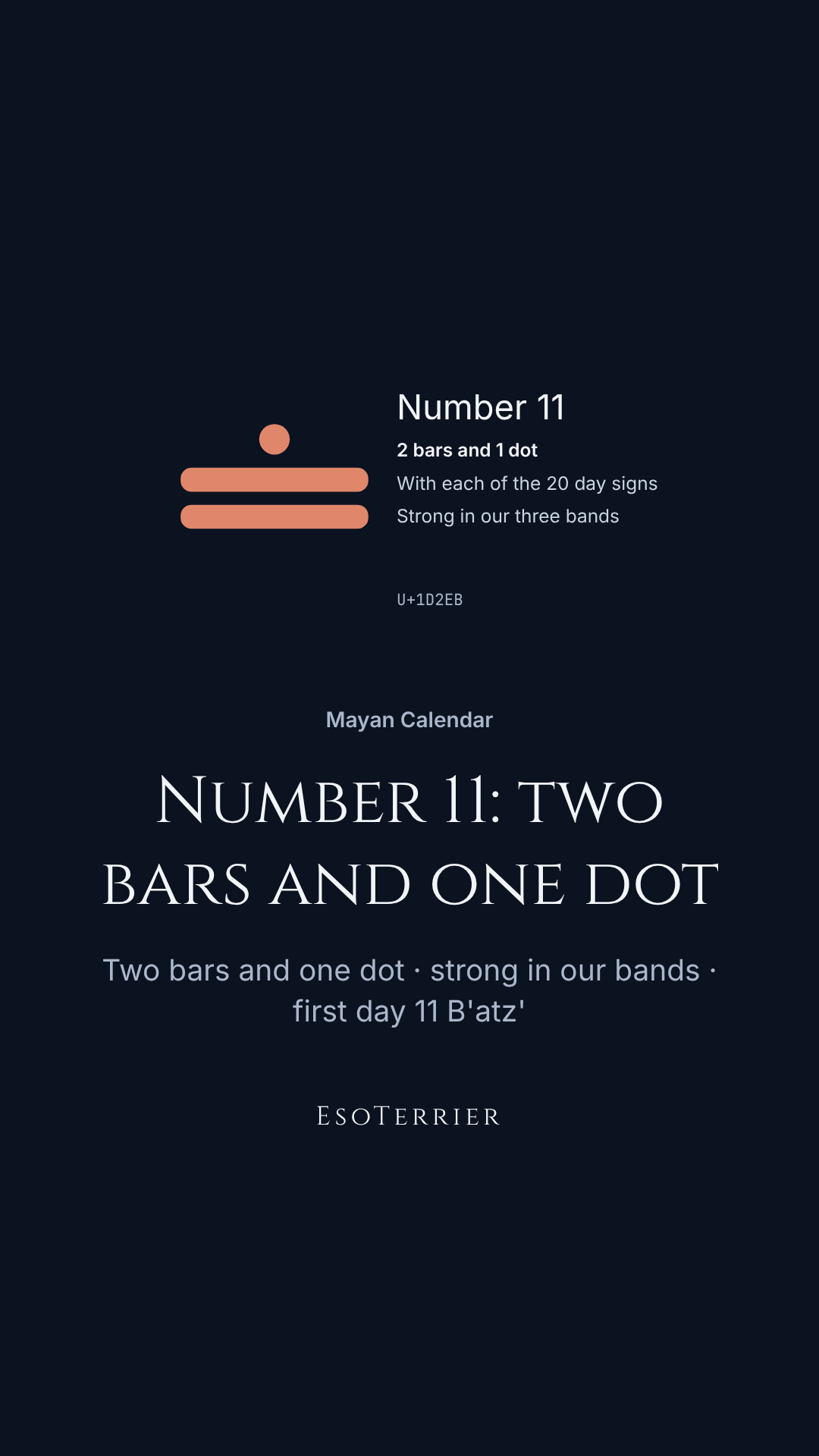
The Maya number 11 drawn as two bars and one dot, beside the words Number 11, two bars and one dot, strong in our three bands, and its Unicode code point U+1D2EB. Number 11 2 bars and 1 dot With each of the 20 day signs Strong in our three bands U+1D2EB
The number 11 as the Maya scribes wrote it, two bars and one dot, drawn by us; a bar is five and a dot is one.

Facts

Written
Two bars and one dot
Unicode
U+1D2EB, MAYAN NUMERAL ELEVEN (Unicode 11.0, 2018)
Strength in our three bands
strong (1 to 3 mild, 4 to 9 middle, 10 to 13 strong; our grouping)
First day in the count
11 B'atz', day 11 of the 260
Days with this number
Twenty in every 260: days 11, 24, 37 … 258
Head variant (Classic, after Thompson)
an earth god with the Kab'an sign
Highland year bearers with this number, 2018 to 2038
11 E from 19 February 2023; 11 No'j from 16 February 2036

Meaning

Eleven is one of the strong numbers in the highland reports. Our sources record no ceremony tied to eleven itself, and no traditional character for it; the band we place it in is our own grouping.

Our sentence: eleven is strong and restless, suited to change and to dealing with what is out of balance; the keyword is "strong, unsettled force". These are ours, not the daykeepers'.

Days and ceremonies

Its first day is 11 B'atz', day 11 of the 260. Among the highland year bearers, 11 E bore the year that opened in February 2023, and 11 No'j bears the one that opens in February 2036.

11 B'atz' shares its sign with 8 B'atz', the day that renews the count, which falls 140 days later in every round; the daykeepers' great day is the pairing of number and sign, not the sign alone.

The numeral

Two bars and one dot. Thompson identified the Classic head for 11 as an earth god marked with the Kab'an sign, matched with the day Manik'.

From eleven on, the numeral has two bars, and the dots begin again above them.

In the count

The number 11 falls on twenty days of the 260: days 11, 24, 37, 50, 63, 76, 89, 102, 115, 128, 141, 154, 167, 180, 193, 206, 219, 232, 245 and 258, with the signs B'atz', K'at, No'j, Tz'i', Aq'ab'al, Ajmaq, Toj, Iq', Tz'ikin, Q'anil, Imox, I'x, Kej, Ajpu, Aj, Kame, Kawoq, E, Kan and Tijax in that order. A sign comes back every twenty days and a number every thirteen, so the same pairing, such as 11 B'atz', returns only after 260 days. Each year the highland year bearer's number rises by one, because 365 days are 28 runs of thirteen and one day more.

Correspondences

Each item with how it stands: “sourced” is in the work cited, “our construction” is EsoTerrier’s own, and “disputed” means the sources disagree.

Strength, in the highland reports
The number gives the day its force: low numbers gentle, high numbers strong (Tedlock at Momostenango and Bunzel at Chichicastenango, as reported) sourced
Our band
strong; the bands and their edges are EsoTerrier's grouping, not a published scheme our construction
Our keyword and sentence
"strong, unsettled force"; Eleven is a strong, restless number, suited to change and to dealing with what is out of balance. our construction
Head variant of the numeral, after Thompson
an earth god with the Kab'an sign, the god he gave to the day Manik' sourced
A fixed character for the number
None established; which numbers are good differs from town to town disputed

How the schools read it

Highland ethnography, as reported
The number is the strength of the day, gentle in the low numbers and strong in the high.
Thompson's survey of highland towns
Which numbers count as good or bad differs from town to town.
Classic scribes
Wrote 11 as two bars and one dot, or as a god's head: an earth god with the Kab'an sign, in Thompson's identification.
Dreamspell (1990)
Gives each number a name of its own in a different modern count; not used here.
EsoTerrier
Strong in our bands; keyword "strong, unsettled force". Our words, a reading aid.

Claims about it

  • The number 11 has a fixed traditional character.

    unverified

    What the record shows: The highland reports give the numbers strength, low gentle and high strong; fixed characters per number are modern, and our own keyword is labelled as ours.

  • Eleven is one of thirteen cosmic "tones" with a Maya name.

    false

    What the record shows: The tone names are Dreamspell's, from 1990. The Maya count has numbers 1 to 13.
Elsewhere on EsoTerrier

Sources

Primary texts (4)
  1. Komon Tohil (K'iche' daykeepers, Zunil); Smithsonian NMAI, The Meaning of the Days in the Maya Sacred Calendar. maya.nmai.si.edu, 2012. Consulted for facts; never copied. maya.nmai.si.edu/sites/default/files/resources/The%20Meaning%20of%20the%20Days%20in%20the%20Maya%20Sacred%20Calendar.pdf
  2. Mayatecum, ¿Cuál es el verdadero día del año nuevo maya solar?. mayatecum.com, 2024. Facts only. mayatecum.com/cual-es-el-verdadero-dia-del-anyo-nuevo-maya-solar
  3. Atitlan Vida, The 13 numbers of the Tzolk'in. atitlanvida.com, 2025. Facts only. atitlanvida.com/culture/tzolkin/the-13-numbers
  4. J. Eric S. Thompson, Maya Hieroglyphic Writing: Introduction. Carnegie Institution of Washington, Publication 589, 1950 (reprinted 1960 and 1971). Facts and short attributed phrases only. mesoweb.com/publications/Thompson/Thompson1950.html
Studies and other sources (7)
  1. "Maya calendar", Wikipedia (orientation only). en.wikipedia.org/wiki/Maya_calendar
  2. "Dreamspell", Wikipedia (orientation only). en.wikipedia.org/wiki/Dreamspell
  3. Barbara Tedlock, Time and the Highland Maya. University of New Mexico Press, 1982. Not read by us: no lawful copy was reachable. Known through Barbara and Dennis Tedlock's 2005 interview (S99) and the works that cite it; facts only. search.worldcat.org/title/8033915
  4. Ministerio de Cultura y Deportes de Guatemala, Waqxaqib' B'atz' news pages, Ministerio de Cultura y Deportes de Guatemala (18 January 2025, 5 October 2025, 22 June 2026). noticias.mcd.gob.gt, 2026. Facts only. noticias.mcd.gob.gt/2025/01/18/la-importancia-waqxaqib-batz
  5. Unicode Consortium; Google Noto, Mayan Numerals (Unicode block U+1D2E0 to U+1D2FF) and Noto Sans Mayan Numerals. unicode.org; github.com/notofonts, 2018. github.com/notofonts/mayan-numerals
  6. Harri Kettunen and Christophe Helmke, Introduction to Maya Hieroglyphs, 20th edition. Wayeb (European Association of Mayanists), 2025. Facts only. wayeb.org/wp-content/uploads/2025/11/Kettunen_Helmke_2025_WH_English_20th_ed.pdf
  7. Ruth Leah Bunzel, Chichicastenango: A Guatemalan Village. J. J. Augustin, Locust Valley NY (Publications of the American Ethnological Society 22), 1952. Public domain; its passage on the numbers is known to us second hand. catalog.hathitrust.org/Record/004939427
Our own research (2)
  1. EsoTerrier Mayan calendar research, 2026-10-11 (main report, validation report, visual survey, notes) (2026).
  2. EsoTerrier engine, Mayan reference and calculation (2026). Its texts are our own, written from the sources above.

Your Mayan Calendar reading, $4.99. Includes this system's raw data. Written for you by AI. Read a sample. Charts and the written text are free in every account.

By EsoTerrier. Written with AI assistance from our research and checked against its sources; last revised 20 October 2026. How we write these pages.

First published ; last revised . Corrections: support@esoterrier.com.