Meaning
In Yucatec chuwen is the craftsman, and Thompson gave the day to Ah Chuen, the monkey patron of the arts, with the howler monkey as its highland association. The Classic reading is unknown.
The K'iche' name B'atz' is both the howler monkey and the thread, and the daykeepers build on the thread. The Komon Tohil daykeepers explain it as the thread of time and of human destiny; the Maya' Wuj manual as the beginning and end of the thread of life and a day for art. In Momostenango the plays on the name, spinning and winding, make it the day for winding up and completing things.
Our reading: time, weaving and the arts, and the joining of people and things. People born on B'atz' are described as creative and sociable. The sentences are ours.
In the highlands today
8 B'atz', Waqxaqib' B'atz', is the most important day of the count. Daykeepers from across the highlands gather, at Momostenango above all, to renew the count; new daykeepers are presented at the shrines, and all who were initiated return to renew their vows. Guatemala's Ministry of Culture gave 18 January 2025, 5 October 2025 and 22 June 2026 as the days.
In the Popol Vuh One Monkey and One Artisan, the Hero Twins' half-brothers, are turned into monkeys and become the patrons of the arts: the story behind the day's monkey and its craft.
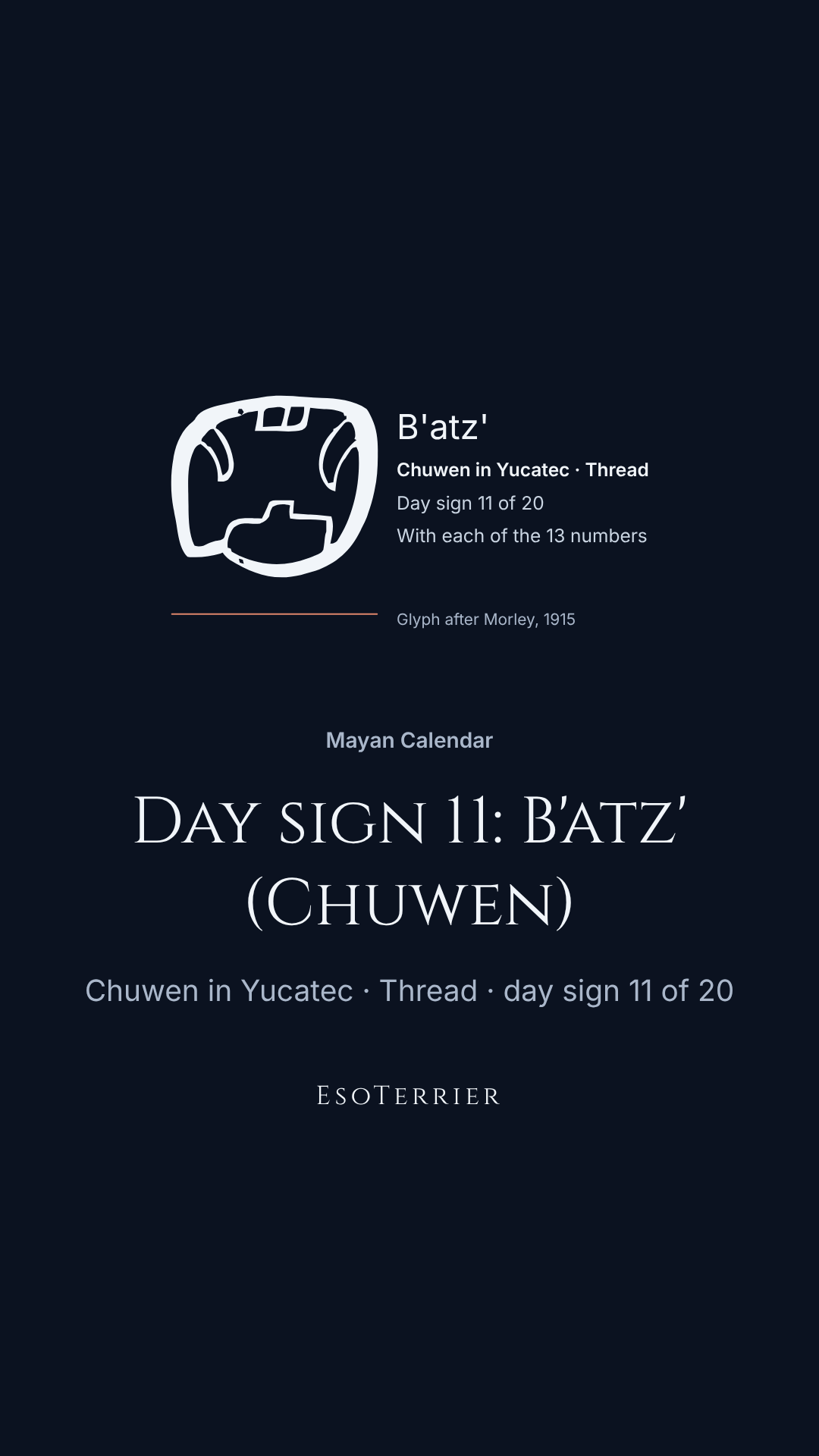
The glyph and the old readings
Thompson's Yucatec augury for the day is the craftsman, his highland one the howler monkey. B'atz' is never a year bearer.
The Central Mexican day of the same position is Ozomahtli, the monkey: the two counts share the animal.
In the count
B'atz' comes round every twentieth day, thirteen times in the 260: on days 11, 31, 51, 71, 91, 111, 131, 151, 171, 191, 211, 231 and 251, with the numbers 11, 5, 12, 6, 13, 7, 1, 8, 2, 9, 3, 10 and 4 in that order, so 11 B'atz' is its first day in the count and 4 B'atz' its last. In the nawal cross of a person born on B'atz', the day eight before (conception) falls on Aq'ab'al, the day eight after (destiny) on Kawoq, six before (the right hand) on Kan and six after (the left hand) on No'j, each with its own number.
Correspondences
Each item with how it stands: “sourced” is in the work cited, “our construction” is EsoTerrier’s own, and “disputed” means the sources disagree.
- Thompson's reading of the glyph (1950)
- uncertain sourced
- Presiding god of the day, after Thompson
- Ah Chuen sourced
- Old augury, Yucatan and the highlands, after Thompson
- craftsman (Yucatan); howler monkey (highlands); gradings differ between communities disputed
- The name, as the Zunil daykeepers explain it
- thread; the thread of time and of human destiny sourced
- Direction and colour
- west, black (ek'): read off the four-direction cycle; not attested for this day itself, and not shown on our chart unverified
- Our reading
- Time, weaving and the arts: creative and sociable, good at joining people and things together. our construction
How the schools read it
- Classic inscriptions (epigraphers)
- Reading of the glyph not known
- J. Eric S. Thompson, 1950
- The glyph as uncertain; the day's god Ah Chuen.
- Komon Tohil daykeepers, Zunil
- Thread; the thread of time and of human destiny.
- The Maya' Wuj manual
- Monkey; the beginning and the end of the thread of life; a day for art and creation.
- Momostenango (Andrés Xiloj, 2005)
- Winding up one's life and the life of one's descendants, a play on winding thread.
- The Central Mexican count (tonalpohualli)
- Ozomahtli, monkey: the day of the same position in a related but different count.
- Dreamspell (1990)
- "Blue Monkey" for the same position in its own count; not our name for the sign.
- EsoTerrier
- Time, weaving and the arts: creative and sociable, good at joining people and things together. Our words.
Claims about it
-
B'atz' is the "Blue Monkey".
falseWhat the record shows: That is a Dreamspell name from a modern count of 1990, not the Maya day.
-
The count was lost and later restored.
falseWhat the record shows: The renewal on 8 B'atz' has been kept by highland daykeepers through the colonial period to the present; the ministry announces its dates.
-
Each day is fixed as good or bad.
disputedWhat the record shows: The old gradings differ between communities; the daykeepers' great day of renewal is 8 B'atz', a pairing of number and sign, not the sign alone.