Meaning
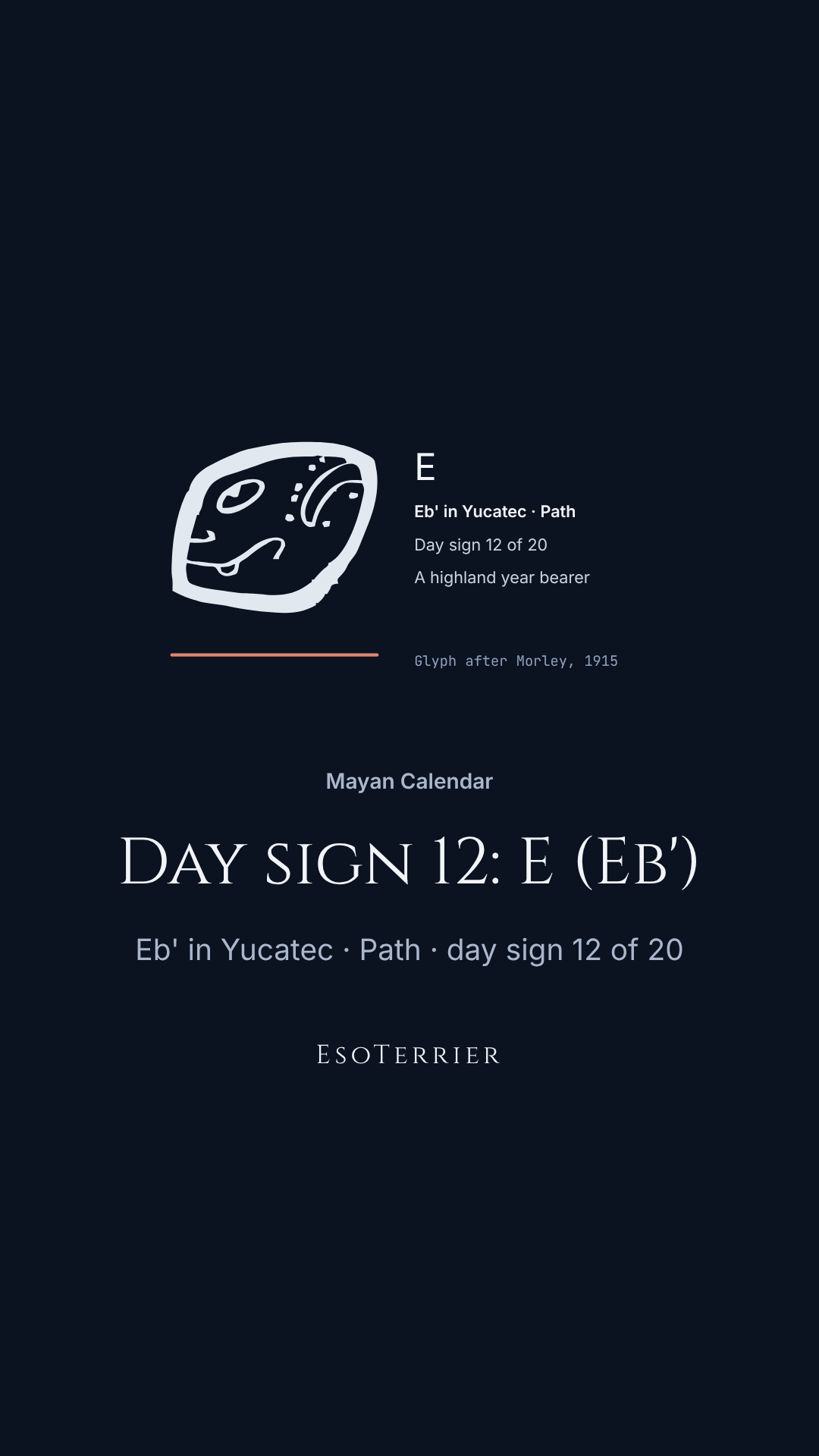
The old readings of this day are the least settled. Thompson read the glyph as destructive water and the Yucatec name Eb' as mist, drizzle and rust on plants, gave the day to a destructive rain god, and noted that the stairway meaning in the Chumayel book is late. The Classic reading is unknown.
The highland reading is clear and different: E is the road. The Komon Tohil daykeepers make it the day on which a man may ask for a woman's hand and on which the ancestors listen; the Maya' Wuj manual adds the older sense of tooth and makes it the day of journeys, negotiations and agreements.
Our reading: the road of life, travel and generosity. People born on E are described as travellers and good company, at ease with people. The words are ours.
In the highlands today
In Momostenango the prayer on 9 E, the day after 8 B'atz', is for a good road and a good work, the pair of words that means destiny, as Andrés Xiloj explained in 2005.
E is one of the four highland year bearers, with Iq', Kej and No'j; the 2022 account in Prensa Comunitaria places it in the south and makes it yellow. In the Kaqchikel of the Maya' Wuj manual the name is Ey, and some communities write B'e.
The glyph and the old readings
Eb' was also one of the Classic year bearers. Thompson records no augury for the day.
The Central Mexican day of the same position is Malinalli, grass, which has nothing to do with the road.
In the count
E comes round every twentieth day, thirteen times in the 260: on days 12, 32, 52, 72, 92, 112, 132, 152, 172, 192, 212, 232 and 252, with the numbers 12, 6, 13, 7, 1, 8, 2, 9, 3, 10, 4, 11 and 5 in that order, so 12 E is its first day in the count and 5 E its last. In the nawal cross of a person born on E, the day eight before (conception) falls on K'at, the day eight after (destiny) on Ajpu, six before (the right hand) on Kame and six after (the left hand) on Tijax, each with its own number.
Correspondences
Each item with how it stands: “sourced” is in the work cited, “our construction” is EsoTerrier’s own, and “disputed” means the sources disagree.
- Thompson's reading of the glyph (1950)
- destructive water sourced
- Presiding god of the day, after Thompson
- a destructive rain god sourced
- Old augury, Yucatan and the highlands, after Thompson
- no augury recorded; gradings differ between communities disputed
- The name, as the Zunil daykeepers explain it
- path; the day on which a man may ask for a woman's hand sourced
- Direction and colour
- south, yellow (k'an): given to this bearer in the 2022 highland account sourced
- Our reading
- The road of life and travel: generous, good company, at ease with people. our construction
How the schools read it
- Classic inscriptions (epigraphers)
- Reading of the glyph not known
- J. Eric S. Thompson, 1950
- The glyph as destructive water; the day's god a destructive rain god.
- Komon Tohil daykeepers, Zunil
- Path; the day on which a man may ask for a woman's hand.
- The Maya' Wuj manual
- Tooth; the road, destiny and the course of a life; a day to begin a negotiation or to protect a journey.
- Momostenango (Andrés Xiloj, 2005)
- A good road, a good work: a pun on b'e, road.
- The Central Mexican count (tonalpohualli)
- Malinalli, grass: the day of the same position in a related but different count.
- Dreamspell (1990)
- "Yellow Human" for the same position in its own count; not our name for the sign.
- EsoTerrier
- The road of life and travel: generous, good company, at ease with people. Our words.
Claims about it
-
E bears the same years in every source.
disputedWhat the record shows: E bears years in the highland and Classic sets, with the Classic number one higher; Landa's Yucatan used other bearers.
-
E means grass, as its Aztec counterpart does.
falseWhat the record shows: Malinalli belongs to the Central Mexican count. The K'iche' name means the road.
-
E is the "Yellow Human".
falseWhat the record shows: That is a Dreamspell name from a modern count of 1990.