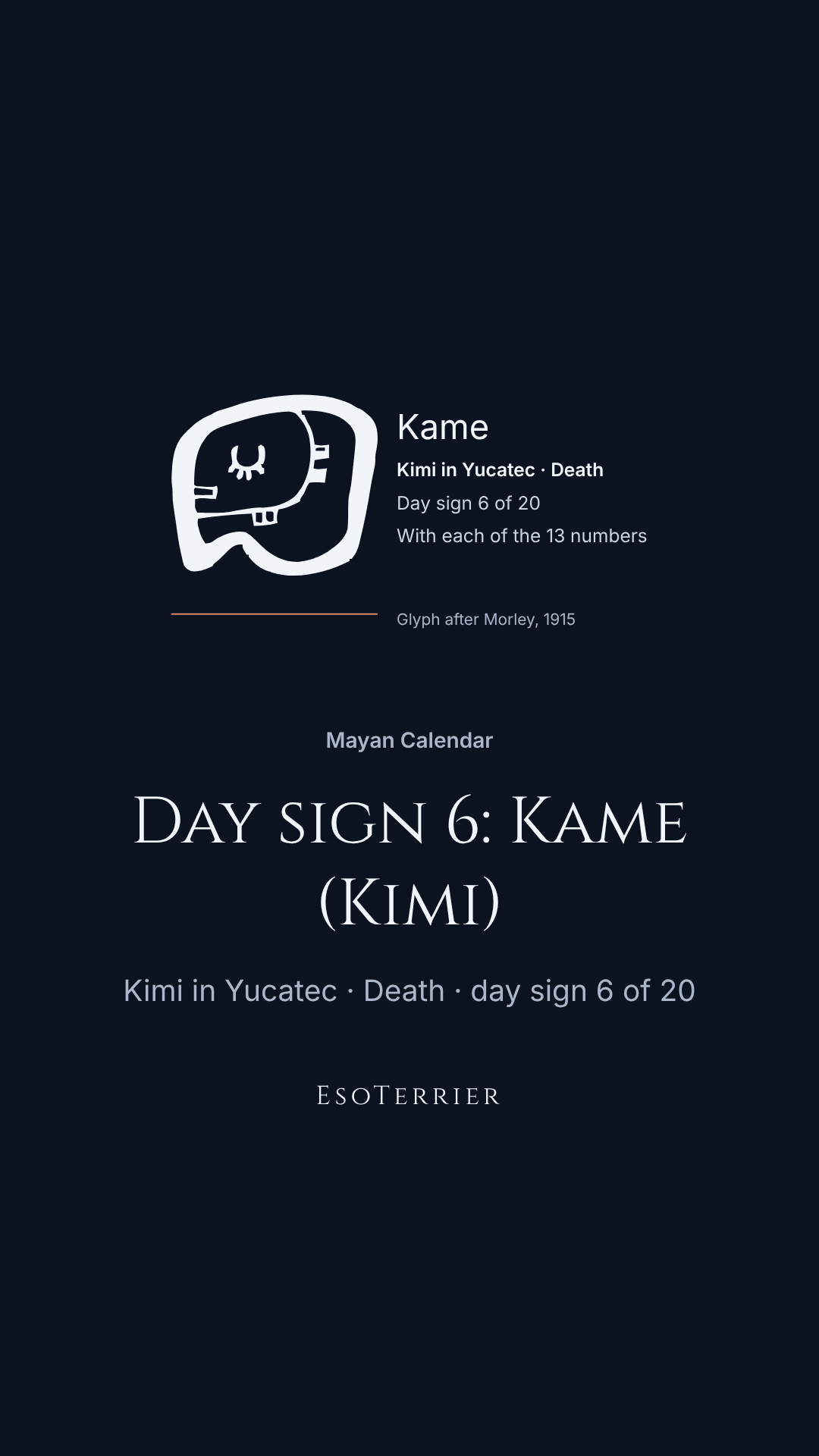
Meaning
Every tradition agrees on the word. The Classic reading is probably cham, to die; Thompson read the glyph as the death god and recorded the owl as the day's Yucatec association.
What the day means for a person is where they differ. The Komon Tohil daykeepers say that Kame holds both the good and the bad and that it is the nawal of the Sun; the Maya' Wuj manual reads death as rebirth and makes it the day for contact with the ancestors. The Momostenango daykeeper Andrés Xiloj said in 2005 that the day is not for death or disappearance but for what is good in one's life.
Our reading follows the renewing line: endings, change and the closeness of the ancestors, carried by people described as resilient and intuitive, who know loss and are not frightened by it. The words are ours.
In the highlands today
The Zunil daykeepers use Kame to ask to be free of bad choices; the Maya' Wuj manual describes it as the energy of the night that gives light to the next day.
Kame is also one of the day names in the Popol Vuh: One Death and Seven Death, Jun Kame and Wuqub' Kame, are the lords of Xibalba whom the Hero Twins defeat.
The glyph and the old readings
Thompson's own tables show the day graded well in some K'iche' towns and badly in others, which is why we read no fortune into it. In the Kaqchikel of the Maya' Wuj manual the name is Kamey.
The Central Mexican day of the same position is Miquiztli, death: here the two counts share the word.
In the count
Kame comes round every twentieth day, thirteen times in the 260: on days 6, 26, 46, 66, 86, 106, 126, 146, 166, 186, 206, 226 and 246, with the numbers 6, 13, 7, 1, 8, 2, 9, 3, 10, 4, 11, 5 and 12 in that order, so 6 Kame is its first day in the count and 12 Kame its last. In the nawal cross of a person born on Kame, the day eight before (conception) falls on Tijax, the day eight after (destiny) on I'x, six before (the right hand) on Ajpu and six after (the left hand) on E, each with its own number.
Correspondences
Each item with how it stands: “sourced” is in the work cited, “our construction” is EsoTerrier’s own, and “disputed” means the sources disagree.
- Thompson's reading of the glyph (1950)
- the death god sourced
- Presiding god of the day, after Thompson
- the death god sourced
- Old augury, Yucatan and the highlands, after Thompson
- death god (highlands); owl (Yucatan); gradings differ between communities disputed
- The name, as the Zunil daykeepers explain it
- death; the owl that announces it; the good and the bad sourced
- Direction and colour
- north, white (sak): read off the four-direction cycle; not attested for this day itself, and not shown on our chart unverified
- Our reading
- Endings, change and the ancestors: resilient and intuitive, familiar with loss and not frightened by it. our construction
How the schools read it
- Classic inscriptions (epigraphers)
- Reading of the glyph: Cham?
- J. Eric S. Thompson, 1950
- The glyph as the death god; the day's god the death god.
- Komon Tohil daykeepers, Zunil
- Death; the owl that announces it; the good and the bad.
- The Maya' Wuj manual
- Death and rebirth; the energy of the night that gives light to the next day; a day for contact with the ancestors.
- Momostenango (Andrés Xiloj, 2005)
- Not for death, nor for disappearance, but for what is good: for my life and for yours.
- The Central Mexican count (tonalpohualli)
- Miquiztli, death: the day of the same position in a related but different count.
- Dreamspell (1990)
- "White Worldbridger" for the same position in its own count; not our name for the sign.
- EsoTerrier
- Endings, change and the ancestors: resilient and intuitive, familiar with loss and not frightened by it. Our words.
Claims about it
-
Kame is an ill-fated sign, and a birth on it foretells death or misfortune.
disputedWhat the record shows: Daykeepers today read it as renewal and the ancestors. Thompson's survey shows the day graded differently from town to town.
-
Kame is the "White Worldbridger".
falseWhat the record shows: That is a Dreamspell name from a modern count of 1990, not the Maya day.
-
Each day is fixed as good or bad, and Kame is bad.
disputedWhat the record shows: The gradings of the old lists are a historical layer that differs between communities. We do not use them as readings.