Meaning
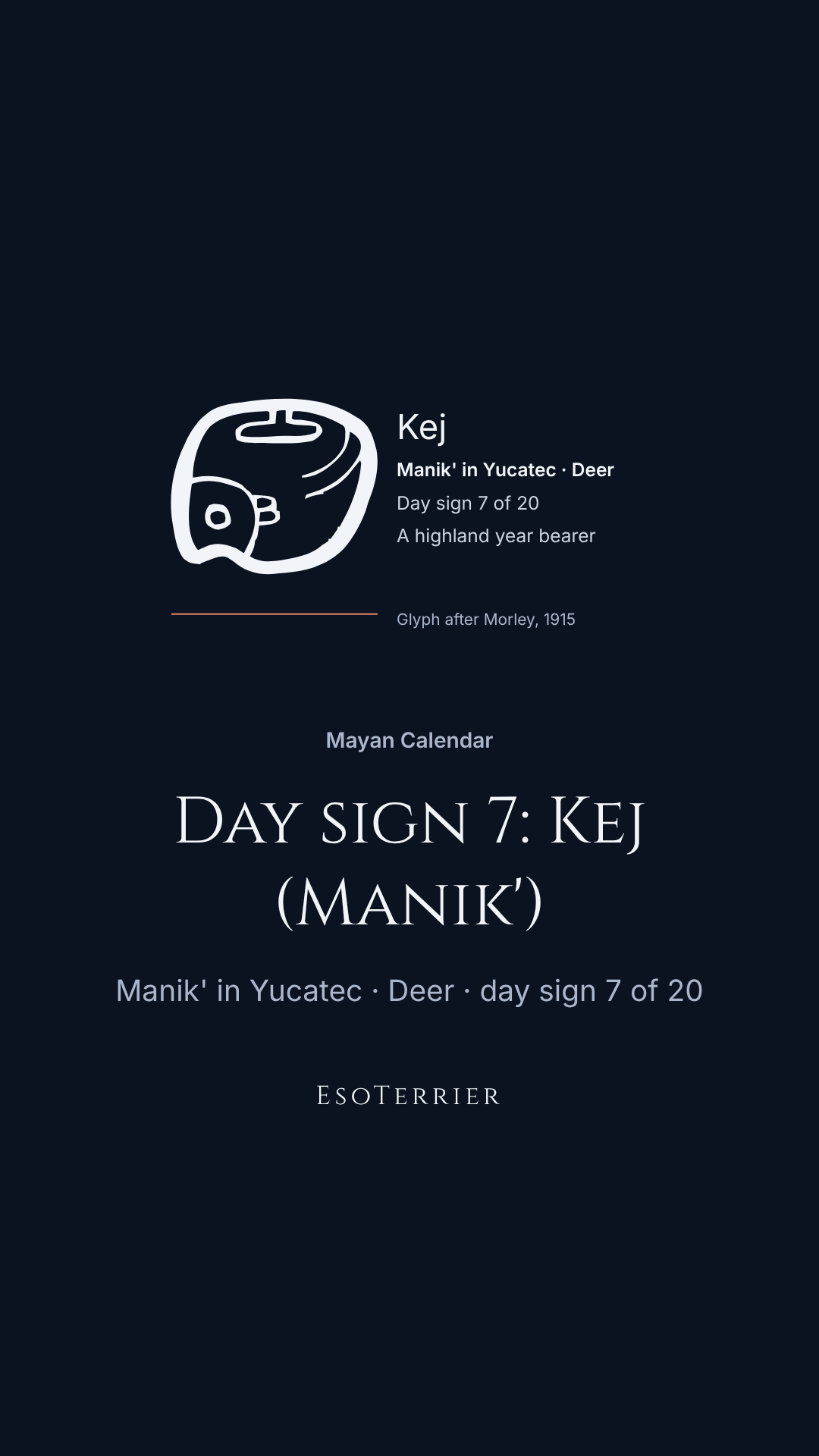
The Classic glyph is a hand, and its reading is probably chij, deer, the word the highland name Kej keeps. Thompson was unsure of the Yucatec name Manik', gave the day to an earth deity who protected deer and other game, and recorded the deer as its highland association.
The Komon Tohil daykeepers make the deer one of the four supports of the sky and the earth and the day of those who carry human destinies. Andrés Xiloj said the same in his own words in 2005: a deer that holds up the world on its four hooves, with strength. The Maya' Wuj manual adds authority and loyalty.
Our reading: strength, the four directions, protection and the carrying of responsibility for others. People born on Kej are described as strong and independent. The sentences are ours.
In the highlands today
Kej is one of the four highland year bearers. 10 Kej entered on 19 February 2022 and 1 Kej on 18 February 2026, with ceremonies that begin on the eve; the 2022 account in Prensa Comunitaria places Kej in the west, black, where the sun goes down.
The Zunil sheet records no particular petition for the day; the Maya' Wuj manual makes it a day for harmony with nature and for loyalty.
The glyph and the old readings
Manik' was also one of the Classic year bearers. Thompson's Yucatec augury for the day is uncertain; his highland one is the deer.
The Central Mexican day of the same position is Mazatl, the deer: one of the places where the two counts share an animal.
In the count
Kej comes round every twentieth day, thirteen times in the 260: on days 7, 27, 47, 67, 87, 107, 127, 147, 167, 187, 207, 227 and 247, with the numbers 7, 1, 8, 2, 9, 3, 10, 4, 11, 5, 12, 6 and 13 in that order, so 7 Kej is its first day in the count and 13 Kej its last. In the nawal cross of a person born on Kej, the day eight before (conception) falls on Kawoq, the day eight after (destiny) on Tz'ikin, six before (the right hand) on Imox and six after (the left hand) on Aj, each with its own number.
Correspondences
Each item with how it stands: “sourced” is in the work cited, “our construction” is EsoTerrier’s own, and “disputed” means the sources disagree.
- Thompson's reading of the glyph (1950)
- hand; sting of scorpions (uncertain) sourced
- Presiding god of the day, after Thompson
- an earth deity sourced
- Old augury, Yucatan and the highlands, after Thompson
- deer (highlands); whistler (Yucatan, uncertain); gradings differ between communities disputed
- The name, as the Zunil daykeepers explain it
- deer; one of the four supports of sky and earth; the four corners sourced
- Direction and colour
- west, black (ek'): given to this bearer in the 2022 highland account sourced
- Our reading
- Strength, the four directions and protection: independent, and a natural carrier of responsibility for others. our construction
How the schools read it
- Classic inscriptions (epigraphers)
- Reading of the glyph: Chij?
- J. Eric S. Thompson, 1950
- The glyph as hand; sting of scorpions (uncertain); the day's god an earth deity.
- Komon Tohil daykeepers, Zunil
- Deer; one of the four supports of sky and earth; the four corners.
- The Maya' Wuj manual
- Deer, authority; the force of the four directions needed to create the world; a day for harmony with nature and for loyalty.
- Momostenango (Andrés Xiloj, 2005)
- The four directions of the world; the deer that sustains the world on its four hooves, strength.
- The Central Mexican count (tonalpohualli)
- Mazatl, deer: the day of the same position in a related but different count.
- Dreamspell (1990)
- "Blue Hand" for the same position in its own count; not our name for the sign.
- EsoTerrier
- Strength, the four directions and protection: independent, and a natural carrier of responsibility for others. Our words.
Claims about it
-
Kej bears the same years in every calendar.
disputedWhat the record shows: Kej bears years in the highland and Classic sets; Landa's Yucatan used other bearers, and the Classic number of a year is one higher than the highland.
-
Kej is the "Blue Hand".
falseWhat the record shows: That is a Dreamspell name from a modern count of 1990. The hand belongs to the Classic glyph, not to the K'iche' day.
-
The year that 1 Kej opened is Maya year 5142.
unverifiedWhat the record shows: Sources give 5141 or 5142 for 2026; there is no agreed Maya year number, so we give none.