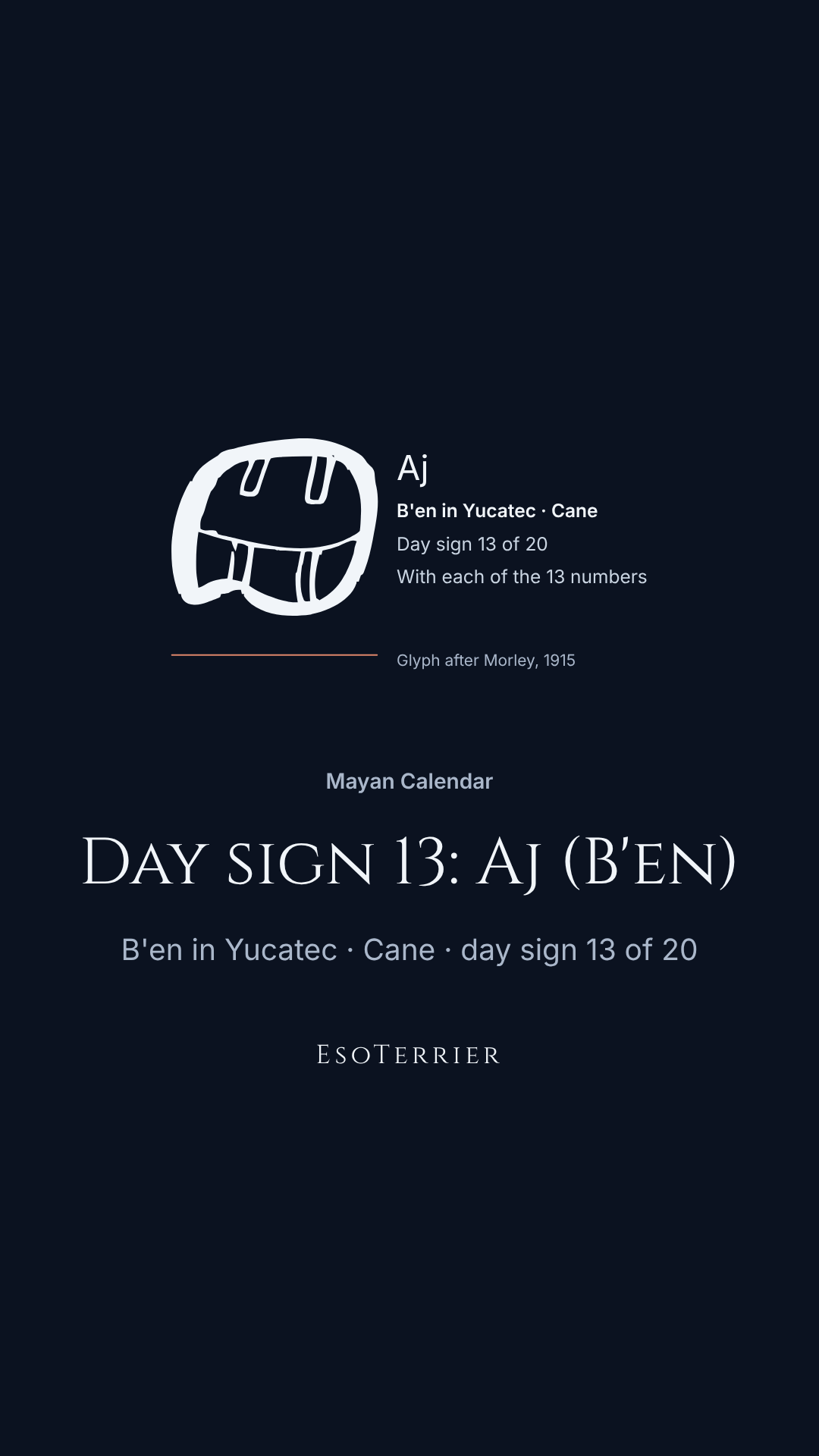
Meaning
Thompson was unsure of the glyph and of the Yucatec name B'en, but gave the day to maize, with food as its Yucatec augury and green maize as its highland one. Scholars gloss it as green maize or seed; the Classic reading is unknown.
The K'iche' name Aj is the cane, and the highland tradition reads the day through the maize plant. The Komon Tohil daykeepers derive it from the cane field and the milpa and call it a rod of virtues and a day of triumph; the Maya' Wuj manual makes it abundance and the constant sprouting of life.
Our reading: the household, steady growth and upright authority, carried by people described as calm and capable. The words are ours.
In the highlands today
Maya' Wuj makes Aj a day to give thanks for the protection of the home, its animals and its plants. Andrés Xiloj saw in it the maize stalks bent over before the harvest, as people kneel before the Earth, God and the ancestors.
Aj closes the first thirteen-day run of the count: 13 Aj is day 13 of the 260, and the next day, 1 I'x, opens the second.
The glyph and the old readings
B'en was one of the four year bearers of Late Classic Campeche; it bears no year in the highlands.
The Central Mexican day of the same position is Acatl, the reed, close to the cane of the K'iche' name but from a different count.
In the count
Aj comes round every twentieth day, thirteen times in the 260: on days 13, 33, 53, 73, 93, 113, 133, 153, 173, 193, 213, 233 and 253, with the numbers 13, 7, 1, 8, 2, 9, 3, 10, 4, 11, 5, 12 and 6 in that order, so 13 Aj is its first day in the count and 6 Aj its last. In the nawal cross of a person born on Aj, the day eight before (conception) falls on Kan, the day eight after (destiny) on Imox, six before (the right hand) on Kej and six after (the left hand) on Kawoq, each with its own number.
Correspondences
Each item with how it stands: “sourced” is in the work cited, “our construction” is EsoTerrier’s own, and “disputed” means the sources disagree.
- Thompson's reading of the glyph (1950)
- uncertain sourced
- Presiding god of the day, after Thompson
- maize sourced
- Old augury, Yucatan and the highlands, after Thompson
- food (Yucatan); green maize (highlands); gradings differ between communities disputed
- The name, as the Zunil daykeepers explain it
- cane field and milpa; maize; a rod of virtues sourced
- Direction and colour
- east, red (chak): read off the four-direction cycle; not attested for this day itself, and not shown on our chart unverified
- Our reading
- The household, steady growth and upright authority: calm and capable. our construction
How the schools read it
- Classic inscriptions (epigraphers)
- Reading of the glyph not known
- J. Eric S. Thompson, 1950
- The glyph as uncertain; the day's god maize.
- Komon Tohil daykeepers, Zunil
- Cane field and milpa; maize; a rod of virtues.
- The Maya' Wuj manual
- Cane, abundance; the constant sprouting of existence; the triumph of good over evil; a day to give thanks for the protection of the home, animals and plants.
- Momostenango (Andrés Xiloj, 2005)
- The maize stalks bent over at harvest, as we kneel before the Earth, God and the ancestors.
- The Central Mexican count (tonalpohualli)
- Acatl, reed: the day of the same position in a related but different count.
- Dreamspell (1990)
- "Red Skywalker" for the same position in its own count; not our name for the sign.
- EsoTerrier
- The household, steady growth and upright authority: calm and capable. Our words.
Claims about it
-
Aj is the "Red Skywalker".
falseWhat the record shows: That is a Dreamspell name from a modern count of 1990, not the Maya day.
-
Aj has a traditional colour, gemstone and list of jobs.
unverifiedWhat the record shows: No Maya source gives these; Western sites added them.
-
The Aztec reed is the meaning of Aj.
falseWhat the record shows: The Central Mexican count is related but different; the K'iche' name is the cane of the maize field.