Meaning
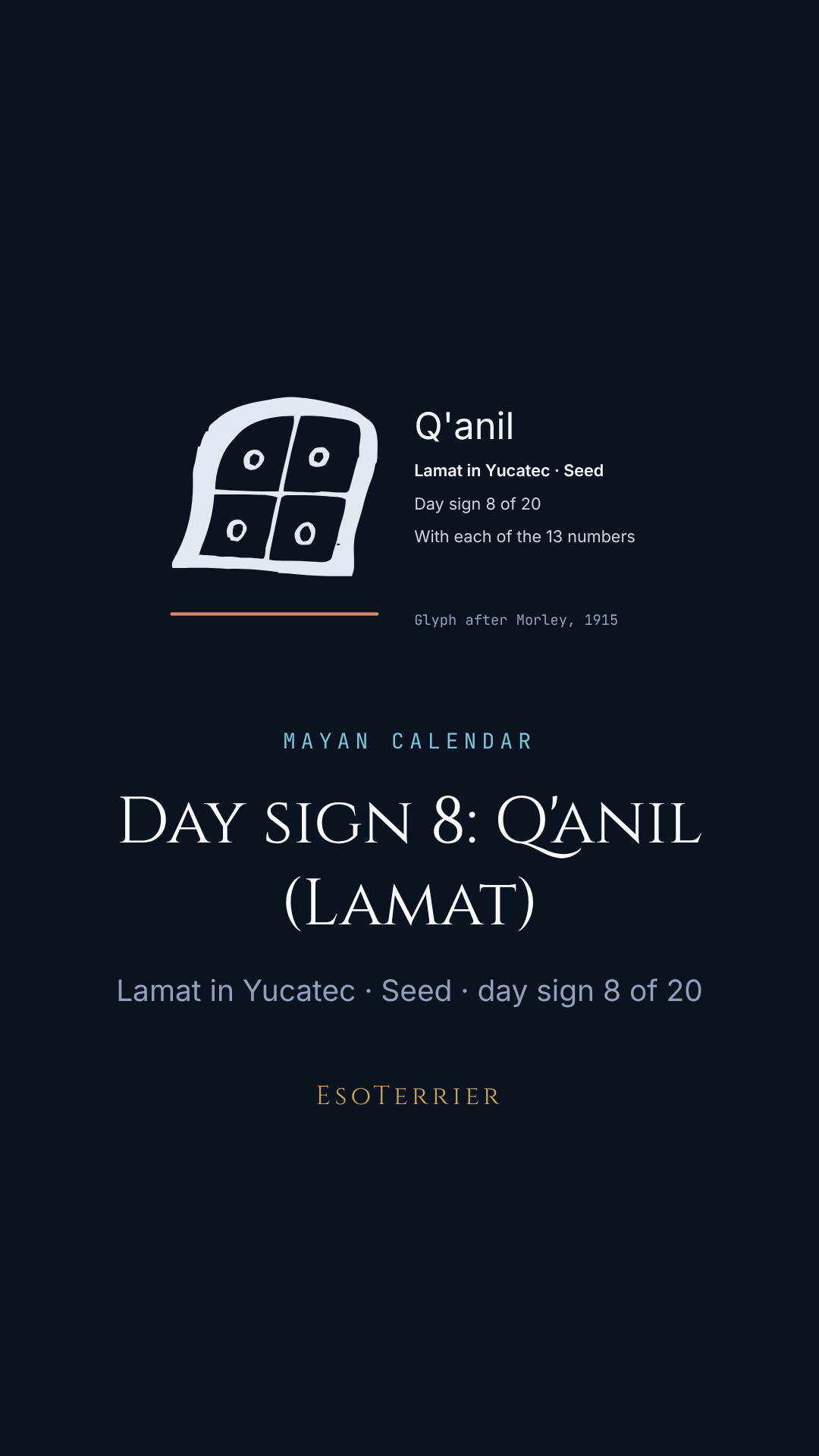
The glyph is the Venus sign, and Thompson gave the day to Lahun Chan, the Venus god, noting that no highland diviner of his time linked it with the planet. The Classic reading is probably lamaht.
The highland name Q'anil comes from q'an, yellow or ripe. The Komon Tohil daykeepers derive it from the seed and the colour yellow and make it the sign of the four seasons and of everything that lives; the Maya' Wuj manual calls it the seed of life and the four colours of maize, and a day to begin a relationship or a project.
Thompson read the shift from Venus to ripeness as a change of meaning after the conquest, so both belong on this page. Our reading: seed, fertility and patient growth, carried by people whose efforts bear fruit when they are patient and well supported. The words are ours.
In the highlands today
The Zunil sheet records no special petition for Q'anil. In Momostenango the day's reminder, as Andrés Xiloj gave it, is what brings the food and the drink.
In the Kaqchikel of the Maya' Wuj manual the name is Q'anel.
The glyph and the old readings
Lamat was one of the four year bearers of Late Classic Campeche, with Ak'b'al, B'en and Etz'nab'; it bears no year in the highlands.
The Central Mexican day of the same position is Tochtli, the rabbit, a different image in a different count.
In the count
Q'anil comes round every twentieth day, thirteen times in the 260: on days 8, 28, 48, 68, 88, 108, 128, 148, 168, 188, 208, 228 and 248, with the numbers 8, 2, 9, 3, 10, 4, 11, 5, 12, 6, 13, 7 and 1 in that order, so 8 Q'anil is its first day in the count and 1 Q'anil its last. In the nawal cross of a person born on Q'anil, the day eight before (conception) falls on Ajpu, the day eight after (destiny) on Ajmaq, six before (the right hand) on Iq' and six after (the left hand) on I'x, each with its own number.
Correspondences
Each item with how it stands: “sourced” is in the work cited, “our construction” is EsoTerrier’s own, and “disputed” means the sources disagree.
- Thompson's reading of the glyph (1950)
- Venus symbol sourced
- Presiding god of the day, after Thompson
- Lahun Chan, the Venus god sourced
- Old augury, Yucatan and the highlands, after Thompson
- Lahun Chan (Yucatan); gradings differ between communities disputed
- The name, as the Zunil daykeepers explain it
- seed and yellow; the colour of gold, cane and the sun sourced
- Direction and colour
- south, yellow (k'an): read off the four-direction cycle; not attested for this day itself, and not shown on our chart unverified
- Our reading
- Seed, fertility and patient growth: efforts that bear fruit when they are given time and support. our construction
How the schools read it
- Classic inscriptions (epigraphers)
- Reading of the glyph: Lamaht?
- J. Eric S. Thompson, 1950
- The glyph as Venus symbol; the day's god Lahun Chan, the Venus god.
- Komon Tohil daykeepers, Zunil
- Seed and yellow; the colour of gold, cane and the sun.
- The Maya' Wuj manual
- Germ, life, creativity; the seed as the principle of the world's unity; the four colours of maize; a day to begin a relationship or a project.
- Momostenango (Andrés Xiloj, 2005)
- What brings the food and the drink.
- The Central Mexican count (tonalpohualli)
- Tochtli, rabbit: the day of the same position in a related but different count.
- Dreamspell (1990)
- "Yellow Star" for the same position in its own count; not our name for the sign.
- EsoTerrier
- Seed, fertility and patient growth: efforts that bear fruit when they are given time and support. Our words.
Claims about it
-
Q'anil is the rabbit, as its Aztec counterpart is.
falseWhat the record shows: Tochtli belongs to the Central Mexican count. The Maya glyph is Venus, and the K'iche' name means yellow and ripe.
-
Q'anil is the "Yellow Star".
falseWhat the record shows: That is a Dreamspell name from a modern count that differs from the traditional one.
-
Q'anil has kept one meaning since Classic times.
disputedWhat the record shows: Thompson saw its meaning move from Venus to the ripening of maize after the conquest.