Skip to content

Mayan Calendar · Day sign 18 of 20

Tijax, the obsidian blade

Tijax is the eighteenth day sign of the 260-day count: Tijax in K'iche' and Etz'nab' in Yucatec, the flint or obsidian blade. The old readings tie it to sacrifice; the highland daykeepers turn the blade toward cutting away harm and make it the day of those who heal.

Is this your day sign?

Enter your birth date to see your free Mayan day sign. No email needed.

Not saved, and never put in a web address. Privacy policy

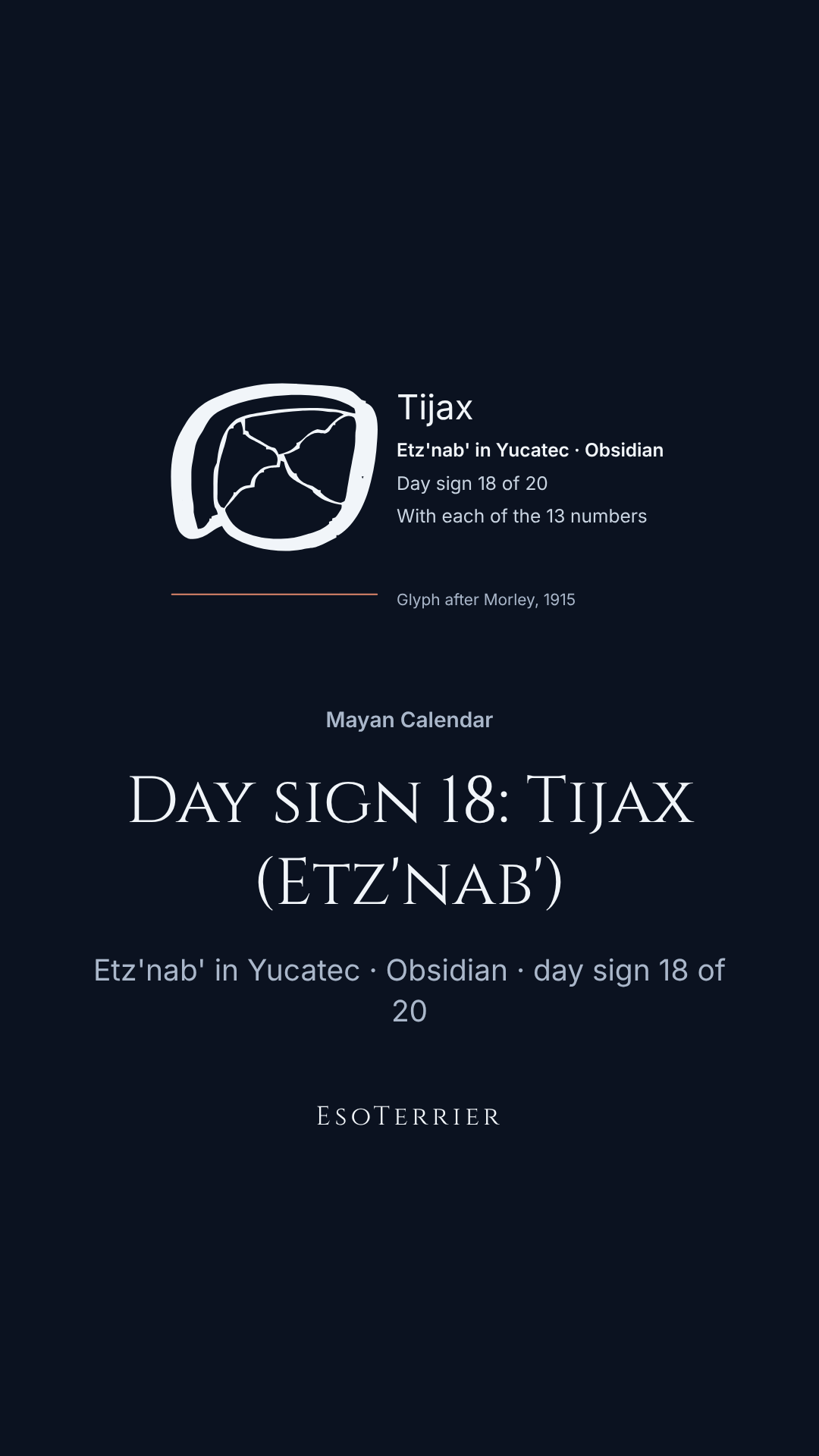
The Maya day sign Tijax as the codices write it, drawn after Sylvanus Morley's figure of 1915, beside the words Tijax, Etz'nab' in Yucatec, Obsidian, day sign 18 of 20. Tijax Etz'nab' in Yucatec · Obsidian Day sign 18 of 20 With each of the 13 numbers Glyph after Morley, 1915
Tijax (Etz'nab'), the eighteenth day sign: our tracing of the codex form in Morley's Introduction to the Study of the Maya Hieroglyphs (1915, figure 17), which is in the public domain. The day signs are not yet in Unicode.

Facts

Position
Day sign 18 of 20; days 18, 38, 58 … 258 of the 260
K'iche' name
Tijax, in the 1987 unified alphabet
Yucatec name
Etz'nab'; colonial spelling Eznab (Morley); Etznab
Our English gloss
Obsidian (ours, from the highland reading)
The Yucatec name means
flint
Classic reading of the glyph
Not known
Year bearer
Not in the highlands; in Late Classic Campeche
First day in the count
5 Tijax, day 18 of the 260
Glyph
Our tracing of Morley 1915, figure 17; not yet in Unicode

Meaning

The glyph is a pressure-flaked blade, and scholars gloss the Yucatec Etz'nab' as flint. Thompson gave the day to the god of sacrifices, with the bleeder as its Yucatec augury and tearing flesh as its highland one. The Classic reading is unknown.

The K'iche' name Tijax keeps the blade, and the highland tradition turns it to protection: the Komon Tohil daykeepers gloss it as destiny and the obsidian knife and make it the day of those who heal and of protection against wrongdoing; the Maya' Wuj manual calls it the day of intelligence and a day to cut away enmity.

Our reading: cutting through and decisiveness, with conflict as the risk of an unguarded edge. People born on Tijax are described as quick and direct. The words are ours.

In the highlands today

The Zunil daykeepers use Tijax to ask for protection against wrongdoing in the community and in one's own life. In Momostenango the day's reminder is speech, the cutting edge of the tongue, as Andrés Xiloj put it.

The blade here is the daykeepers' image for what cuts away harm.

The glyph and the old readings

Etz'nab' was one of the four year bearers of Late Classic Campeche; it bears no year in the highlands. Morley's figure of 1915 spells it Eznab.

The Central Mexican day of the same position is Tecpatl, the flint knife: the same object in a different count.

In the count

Tijax comes round every twentieth day, thirteen times in the 260: on days 18, 38, 58, 78, 98, 118, 138, 158, 178, 198, 218, 238 and 258, with the numbers 5, 12, 6, 13, 7, 1, 8, 2, 9, 3, 10, 4 and 11 in that order, so 5 Tijax is its first day in the count and 11 Tijax its last. In the nawal cross of a person born on Tijax, the day eight before (conception) falls on Tz'i', the day eight after (destiny) on Kame, six before (the right hand) on E and six after (the left hand) on K'at, each with its own number.

Correspondences

Each item with how it stands: “sourced” is in the work cited, “our construction” is EsoTerrier’s own, and “disputed” means the sources disagree.

Thompson's reading of the glyph (1950)
knife blade (uncertain) sourced
Presiding god of the day, after Thompson
the god of sacrifices sourced
Old augury, Yucatan and the highlands, after Thompson
bleeder (Yucatan); tearing flesh (highlands); gradings differ between communities disputed
The name, as the Zunil daykeepers explain it
destiny, obsidian knife, sudden temptation sourced
Direction and colour
north, white (sak): read off the four-direction cycle; not attested for this day itself, and not shown on our chart unverified
Our reading
Cutting through and decisiveness: quick and direct, with conflict as the risk of an unguarded edge. our construction

How the schools read it

Classic inscriptions (epigraphers)
Reading of the glyph not known
J. Eric S. Thompson, 1950
The glyph as knife blade (uncertain); the day's god the god of sacrifices.
Komon Tohil daykeepers, Zunil
Destiny, obsidian knife, sudden temptation.
The Maya' Wuj manual
Flint; the energy that opens the doors to the rain; the day of intelligence and of those who heal; a day to cut away enmity.
Momostenango (Andrés Xiloj, 2005)
Speaking, talking, our speech.
The Central Mexican count (tonalpohualli)
Tecpatl, flint knife: the day of the same position in a related but different count.
Dreamspell (1990)
"White Mirror" for the same position in its own count; not our name for the sign.
EsoTerrier
Cutting through and decisiveness: quick and direct, with conflict as the risk of an unguarded edge. Our words.

Claims about it

  • Tijax is the "White Mirror".

    false

    What the record shows: That is a Dreamspell name from a modern count of 1990, not the Maya day.

  • Tijax is a day of bad fortune.

    disputed

    What the record shows: The old gradings differ between communities, and the daykeepers today use it to ask for protection. We read no fortune into it.

  • Tijax has its own colour, gemstone and guardian animal.

    unverified

    What the record shows: No Maya source gives these; Western sites added them.
Elsewhere on EsoTerrier

Sources

Primary texts (6)
  1. Komon Tohil (K'iche' daykeepers, Zunil); Smithsonian NMAI, The Meaning of the Days in the Maya Sacred Calendar. maya.nmai.si.edu, 2012. Consulted for facts; never copied. maya.nmai.si.edu/sites/default/files/resources/The%20Meaning%20of%20the%20Days%20in%20the%20Maya%20Sacred%20Calendar.pdf
  2. Editorial Maya' Wuj, Usolik rokisaxik ri Cholq'ij, ri Ab' / Manual de los calendarios mayas Cholq'ij y Ab' (manual for the 2025 to 2026 wall calendar). Editorial Maya' Wuj, Guatemala, 2025. Consulted for facts; never copied. mayawuj.com.gt/wp-content/uploads/2025/04/Instructivo-rueda-calendarica-de-pared-2025-2026.pdf
  3. Mayatecum, ¿Cuál es el verdadero día del año nuevo maya solar?. mayatecum.com, 2024. Facts only. mayatecum.com/cual-es-el-verdadero-dia-del-anyo-nuevo-maya-solar
  4. Sylvanus Griswold Morley, An Introduction to the Study of the Maya Hieroglyphs. Bureau of American Ethnology, Washington, 1915. Public domain (a US government publication); our day-sign glyphs are traced from its figure 17. gutenberg.org/files/43491/43491-h/43491-h.htm
  5. J. Eric S. Thompson, Maya Hieroglyphic Writing: Introduction. Carnegie Institution of Washington, Publication 589, 1950 (reprinted 1960 and 1971). Facts and short attributed phrases only. mesoweb.com/publications/Thompson/Thompson1950.html
  6. Andres Xiloj; translation and notes by Allen J. Christenson; Night Fire Films, Breaking the Maya Code: interview with Andres Xiloj, K'iche' daykeeper of Momostenango (12 February 2005), transcript. Night Fire Films, 2005. Facts only; paraphrased, not quoted. nightfirefilms.org/breakingthemayacode/interviews/XilojTRANSCRIPT.pdf
Studies and other sources (8)
  1. "Maya calendar", Wikipedia (orientation only). en.wikipedia.org/wiki/Maya_calendar
  2. "Tzolk'in", Wikipedia (orientation only). en.wikipedia.org/wiki/Tzolk%CA%BCin
  3. "Dreamspell", Wikipedia (orientation only). en.wikipedia.org/wiki/Dreamspell
  4. Academia de Lenguas Mayas de Guatemala, Academia de Lenguas Mayas de Guatemala: history, and Government Accord 1046-87 (unified alphabets). almg.org.gt, 2026. Facts only. almg.org.gt/historia
  5. Script Encoding Initiative, UC Berkeley, Script Encoding Initiative: 'From Stone to Screen' (30 December 2025) and 'SEI in 2026' (24 February 2026). sei.berkeley.edu, 2026. Facts only. sei.berkeley.edu/2025/12/30/from-stone-to-screen
  6. Harri Kettunen and Christophe Helmke, Introduction to Maya Hieroglyphs, 20th edition. Wayeb (European Association of Mayanists), 2025. Facts only. wayeb.org/wp-content/uploads/2025/11/Kettunen_Helmke_2025_WH_English_20th_ed.pdf
  7. "Tonalpohualli", Wikipedia (orientation only). en.wikipedia.org/wiki/T%C5%8Dnalp%C5%8Dhualli
  8. Nicholas A. Hopkins and J. Kathryn Josserand, Directions and Partitions in Maya World View. FAMSI (Foundation for the Advancement of Mesoamerican Studies), 2011. Facts only. famsi.org/research/hopkins/DirectionalPartitions.pdf
Our own research (2)
  1. EsoTerrier Mayan calendar research, 2026-10-11 (main report, validation report, visual survey, notes) (2026).
  2. EsoTerrier engine, Mayan reference and calculation (2026). Its texts are our own, written from the sources above.

Your Mayan Calendar reading, $4.99. Includes this system's raw data. Written for you by AI. Read a sample. Charts and the written text are free in every account.

By EsoTerrier. Written with AI assistance from our research and checked against its sources; last revised 20 October 2026. How we write these pages.

First published ; last revised . Corrections: support@esoterrier.com.