Skip to content

Mayan Calendar · Day sign 4 of 20

K'at, the net that holds the maize

K'at is the fourth day sign of the 260-day count: K'at in K'iche', the net, and K'an in Yucatec, ripe or yellow. The two names read the same day through different words, and Landa made K'an the first of the four colonial year bearers of Yucatan.

Is this your day sign?

Enter your birth date to see your free Mayan day sign. No email needed.

Not saved, and never put in a web address. Privacy policy

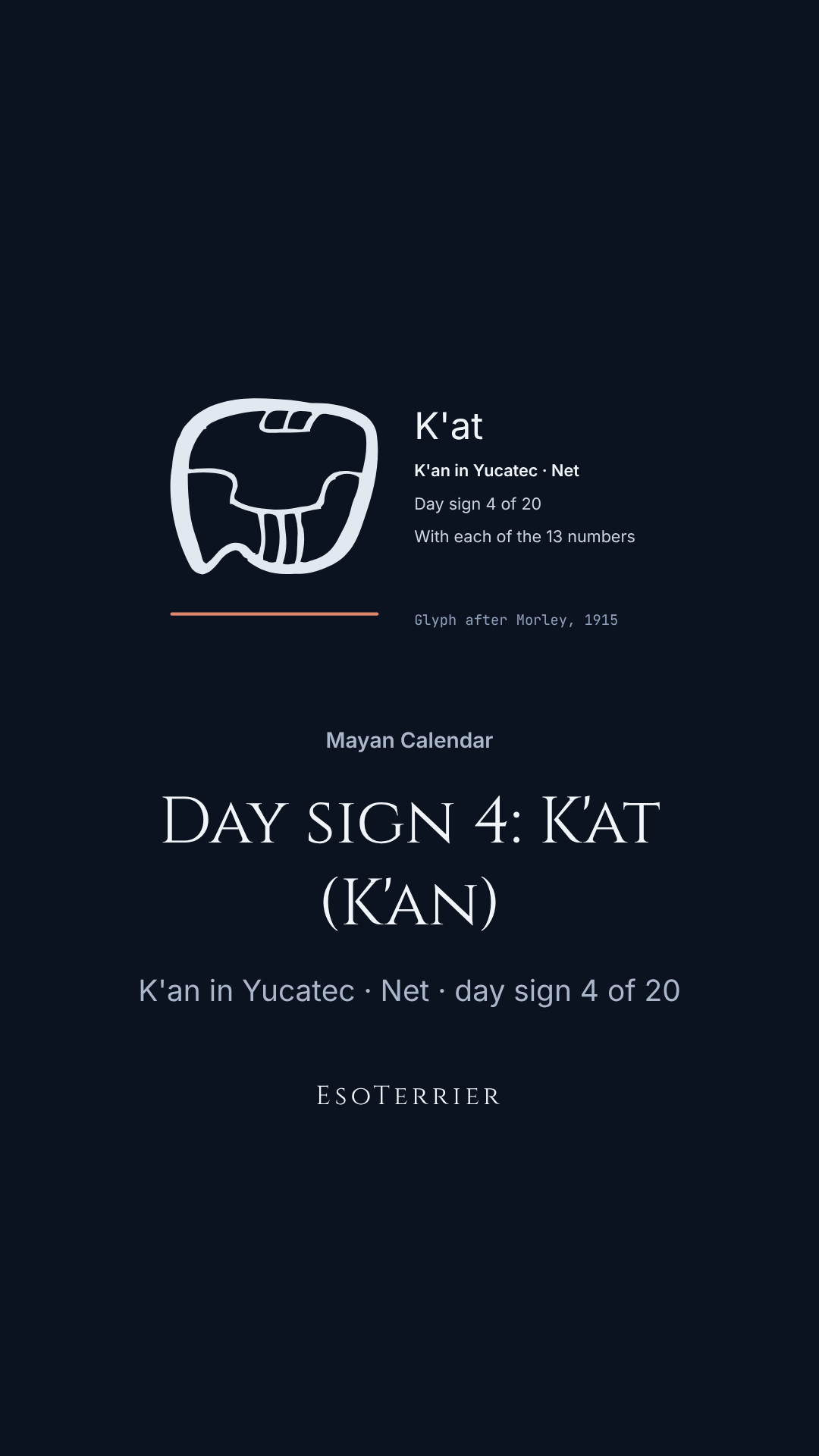
The Maya day sign K'at as the codices write it, drawn after Sylvanus Morley's figure of 1915, beside the words K'at, K'an in Yucatec, Net, day sign 4 of 20. K'at K'an in Yucatec · Net Day sign 4 of 20 With each of the 13 numbers Glyph after Morley, 1915
K'at (K'an), the fourth day sign: our tracing of the codex form in Morley's Introduction to the Study of the Maya Hieroglyphs (1915, figure 17), which is in the public domain. The day signs are not yet in Unicode.

Facts

Position
Day sign 4 of 20; days 4, 24, 44 … 244 of the 260
K'iche' name
K'at, in the 1987 unified alphabet
Yucatec name
K'an; colonial spelling Kan
Our English gloss
Net (ours, from the highland reading)
The Yucatec name means
net, sacrifice
Classic reading of the glyph
Ohl? (a question mark: not secure)
Year bearer
Not in the highlands; in Postclassic Yucatan under Landa (about 1566)
First day in the count
4 K'at, day 4 of the 260
Glyph
Our tracing of Morley 1915, figure 17; not yet in Unicode

Meaning

This day is read through two different words. In Yucatec k'an is ripe or yellow; Thompson read the glyph as maize and gave the day to the maize god. In K'iche' the name is K'at, the net.

The Komon Tohil daykeepers explain K'at as the net that holds the maize cobs and as tangling and untangling; the Maya' Wuj manual adds fire and the weaving of life and calls it the best day for undoing knots.

Our reading follows the highland net: gathering, keeping and getting caught up, and the work of untying the knots of worry and obligation that collectors and organisers tend to gather. The words are ours.

In the highlands today

In Zunil K'at is a day to ask for a child to be born; Maya' Wuj also makes it a day for abundance. In Momostenango, Andrés Xiloj said, the net is the one in which the ears of maize are gathered.

The pairing of net and maize runs through both names: the Yucatec word names the ripe grain, the K'iche' word the net that carries it.

The glyph and the old readings

The Classic reading is uncertain (Ohl? in the handbook). In Landa's Yucatan K'an was the first of the four dominical days that could open a year, assigned to the south; it is not a bearer in the highland count.

The Central Mexican day of the same position is Cuetzpalin, the lizard, an image that has nothing to do with the net or the maize.

In the count

K'at comes round every twentieth day, thirteen times in the 260: on days 4, 24, 44, 64, 84, 104, 124, 144, 164, 184, 204, 224 and 244, with the numbers 4, 11, 5, 12, 6, 13, 7, 1, 8, 2, 9, 3 and 10 in that order, so 4 K'at is its first day in the count and 10 K'at its last. In the nawal cross of a person born on K'at, the day eight before (conception) falls on Ajmaq, the day eight after (destiny) on E, six before (the right hand) on Tijax and six after (the left hand) on Tz'i', each with its own number.

Correspondences

Each item with how it stands: “sourced” is in the work cited, “our construction” is EsoTerrier’s own, and “disputed” means the sources disagree.

Thompson's reading of the glyph (1950)
maize sourced
Presiding god of the day, after Thompson
the maize god sourced
Old augury, Yucatan and the highlands, after Thompson
ripe (highlands); maize (Yucatan); gradings differ between communities disputed
The name, as the Zunil daykeepers explain it
net; tangle and disentangle; the net that protects the maize cobs sourced
Direction and colour
south, yellow (k'an): Landa gives this colonial bearer its direction sourced
Our reading
Gathering and keeping, and the knots that come with it: an organiser whose task is to untie worry and obligation. our construction

How the schools read it

Classic inscriptions (epigraphers)
Reading of the glyph: Ohl?
J. Eric S. Thompson, 1950
The glyph as maize; the day's god the maize god.
Komon Tohil daykeepers, Zunil
Net; tangle and disentangle; the net that protects the maize cobs.
The Maya' Wuj manual
Net, fire; the weaving of life; the best day for undoing tangles and for abundance.
Momostenango (Andrés Xiloj, 2005)
The net in which ears of maize are gathered.
The Central Mexican count (tonalpohualli)
Cuetzpalin, lizard: the day of the same position in a related but different count.
Dreamspell (1990)
"Yellow Seed" for the same position in its own count; not our name for the sign.
EsoTerrier
Gathering and keeping, and the knots that come with it: an organiser whose task is to untie worry and obligation. Our words.

Claims about it

  • K'at is the lizard, as its Aztec counterpart is.

    false

    What the record shows: Cuetzpalin is the Central Mexican day. The Maya names mean the net (K'iche') and ripe maize (Yucatec).

  • K'at bears years in every Maya calendar.

    disputed

    What the record shows: It was a year bearer in Landa's Yucatan only; the highland bearers are Iq', Kej, E and No'j.

  • K'at is the "Yellow Seed".

    false

    What the record shows: That is a Dreamspell name, from a modern count that differs from the traditional one.
Elsewhere on EsoTerrier

Sources

Primary texts (8)
  1. Komon Tohil (K'iche' daykeepers, Zunil); Smithsonian NMAI, The Meaning of the Days in the Maya Sacred Calendar. maya.nmai.si.edu, 2012. Consulted for facts; never copied. maya.nmai.si.edu/sites/default/files/resources/The%20Meaning%20of%20the%20Days%20in%20the%20Maya%20Sacred%20Calendar.pdf
  2. Editorial Maya' Wuj, Usolik rokisaxik ri Cholq'ij, ri Ab' / Manual de los calendarios mayas Cholq'ij y Ab' (manual for the 2025 to 2026 wall calendar). Editorial Maya' Wuj, Guatemala, 2025. Consulted for facts; never copied. mayawuj.com.gt/wp-content/uploads/2025/04/Instructivo-rueda-calendarica-de-pared-2025-2026.pdf
  3. Mayatecum, ¿Cuál es el verdadero día del año nuevo maya solar?. mayatecum.com, 2024. Facts only. mayatecum.com/cual-es-el-verdadero-dia-del-anyo-nuevo-maya-solar
  4. Diego de Landa; tr. William Gates, Yucatan Before and After the Conquest (Landa's Relación de las cosas de Yucatán, translated with notes). The Maya Society, Baltimore, 1937. Public domain. search.worldcat.org/title/1518208
  5. Sylvanus Griswold Morley, An Introduction to the Study of the Maya Hieroglyphs. Bureau of American Ethnology, Washington, 1915. Public domain (a US government publication); our day-sign glyphs are traced from its figure 17. gutenberg.org/files/43491/43491-h/43491-h.htm
  6. J. Eric S. Thompson, Maya Hieroglyphic Writing: Introduction. Carnegie Institution of Washington, Publication 589, 1950 (reprinted 1960 and 1971). Facts and short attributed phrases only. mesoweb.com/publications/Thompson/Thompson1950.html
  7. Diego de Landa, Relacion de las cosas de Yucatan (c. 1566), Spanish text. Biblioteca Antologica (transcription of the public-domain text), c. 1566 (transcription 2019). Public domain. biblioteca-antologica.org/es/wp-content/uploads/2019/08/LANDA-Relaci%C3%B3n-de-las-cosas-del-Yucat%C3%A1n.pdf
  8. Andres Xiloj; translation and notes by Allen J. Christenson; Night Fire Films, Breaking the Maya Code: interview with Andres Xiloj, K'iche' daykeeper of Momostenango (12 February 2005), transcript. Night Fire Films, 2005. Facts only; paraphrased, not quoted. nightfirefilms.org/breakingthemayacode/interviews/XilojTRANSCRIPT.pdf
Studies and other sources (8)
  1. "Maya calendar", Wikipedia (orientation only). en.wikipedia.org/wiki/Maya_calendar
  2. "Tzolk'in", Wikipedia (orientation only). en.wikipedia.org/wiki/Tzolk%CA%BCin
  3. "Dreamspell", Wikipedia (orientation only). en.wikipedia.org/wiki/Dreamspell
  4. Academia de Lenguas Mayas de Guatemala, Academia de Lenguas Mayas de Guatemala: history, and Government Accord 1046-87 (unified alphabets). almg.org.gt, 2026. Facts only. almg.org.gt/historia
  5. Script Encoding Initiative, UC Berkeley, Script Encoding Initiative: 'From Stone to Screen' (30 December 2025) and 'SEI in 2026' (24 February 2026). sei.berkeley.edu, 2026. Facts only. sei.berkeley.edu/2025/12/30/from-stone-to-screen
  6. Harri Kettunen and Christophe Helmke, Introduction to Maya Hieroglyphs, 20th edition. Wayeb (European Association of Mayanists), 2025. Facts only. wayeb.org/wp-content/uploads/2025/11/Kettunen_Helmke_2025_WH_English_20th_ed.pdf
  7. "Tonalpohualli", Wikipedia (orientation only). en.wikipedia.org/wiki/T%C5%8Dnalp%C5%8Dhualli
  8. Nicholas A. Hopkins and J. Kathryn Josserand, Directions and Partitions in Maya World View. FAMSI (Foundation for the Advancement of Mesoamerican Studies), 2011. Facts only. famsi.org/research/hopkins/DirectionalPartitions.pdf
Our own research (2)
  1. EsoTerrier Mayan calendar research, 2026-10-11 (main report, validation report, visual survey, notes) (2026).
  2. EsoTerrier engine, Mayan reference and calculation (2026). Its texts are our own, written from the sources above.

Your Mayan Calendar reading, $4.99. Includes this system's raw data. Written for you by AI. Read a sample. Charts and the written text are free in every account.

By EsoTerrier. Written with AI assistance from our research and checked against its sources; last revised 20 October 2026. How we write these pages.

First published ; last revised . Corrections: support@esoterrier.com.