Meaning
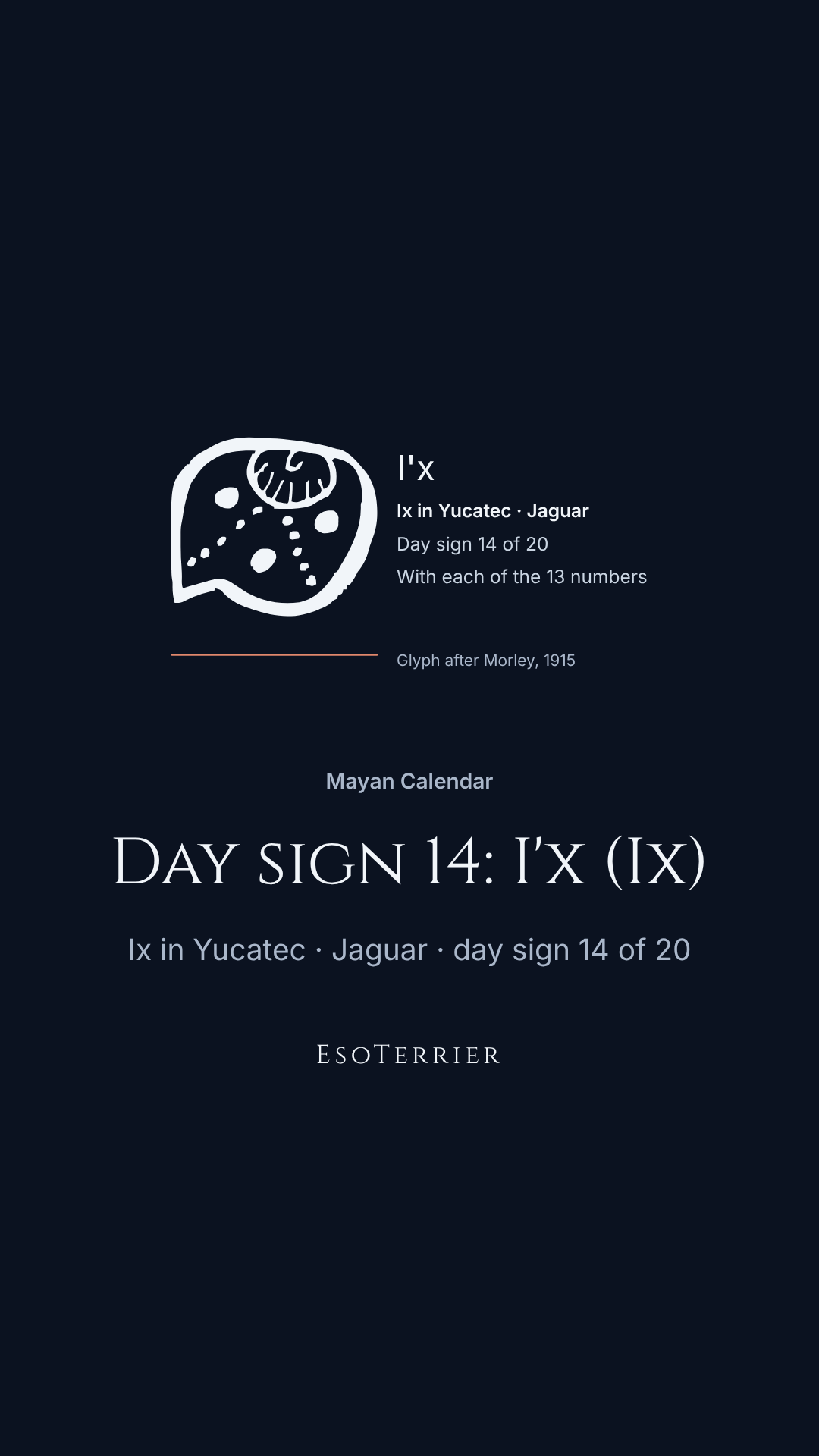
The Classic reading is probably hix, a jaguar word, and the glyph shows jaguar skin or a jaguar's ear; Thompson gave the day to the jaguar in every column of his table.
The K'iche' name is I'x, in Kaqchikel B'alam. The Komon Tohil daykeepers connect it with vitality, the Maya altar and wisdom and call it the sacred name of divinity on the Earth; the Maya' Wuj manual makes it vitality and revelation and a day to honour the creative work of women.
Our reading: the power of the earth, the mountains and the night, carried by people described as strong and vital, with an instinct for hidden and sacred places. We do not give the day a gender or call it shamanic. The words are ours.
In the highlands today
The Zunil sheet records no particular petition for I'x, and names it the nawal of domestic animals; Maya' Wuj makes it a day to rethink one's life. In Momostenango the day's reminder is a play on k'ix, shame.
I'x opens the second thirteen-day run of the count: 1 I'x is day 14 of the 260.
The glyph and the old readings
Landa made Ix the third of the four days that could open a year in Yucatan, assigned to the north. It bears no year in the highland count.
The Central Mexican day of the same position is Ocelotl, the jaguar: the two counts share the animal.
In the count
I'x comes round every twentieth day, thirteen times in the 260: on days 14, 34, 54, 74, 94, 114, 134, 154, 174, 194, 214, 234 and 254, with the numbers 1, 8, 2, 9, 3, 10, 4, 11, 5, 12, 6, 13 and 7 in that order, so 1 I'x is its first day in the count and 7 I'x its last. In the nawal cross of a person born on I'x, the day eight before (conception) falls on Kame, the day eight after (destiny) on Iq', six before (the right hand) on Q'anil and six after (the left hand) on Ajpu, each with its own number.
Correspondences
Each item with how it stands: “sourced” is in the work cited, “our construction” is EsoTerrier’s own, and “disputed” means the sources disagree.
- Thompson's reading of the glyph (1950)
- jaguar skin or ear sourced
- Presiding god of the day, after Thompson
- the jaguar sourced
- Old augury, Yucatan and the highlands, after Thompson
- jaguar; gradings differ between communities disputed
- The name, as the Zunil daykeepers explain it
- tiger (jaguar); vitality, the Maya altar and wisdom; the nawal of domestic animals sourced
- Direction and colour
- north, white (sak): Landa gives this colonial bearer its direction sourced
- Our reading
- The power of the earth, the mountains and the night: strong and vital, drawn to hidden and sacred places. our construction
How the schools read it
- Classic inscriptions (epigraphers)
- Reading of the glyph: Hix?
- J. Eric S. Thompson, 1950
- The glyph as jaguar skin or ear; the day's god the jaguar.
- Komon Tohil daykeepers, Zunil
- Tiger (jaguar); vitality, the Maya altar and wisdom; the nawal of domestic animals.
- The Maya' Wuj manual
- Jaguar, vitality; divine revelations; a day to give thanks for the creative work of women and to rethink one's life.
- Momostenango (Andrés Xiloj, 2005)
- A sound play on k'ix, shame.
- The Central Mexican count (tonalpohualli)
- Ocelotl, jaguar: the day of the same position in a related but different count.
- Dreamspell (1990)
- "White Wizard" for the same position in its own count; not our name for the sign.
- EsoTerrier
- The power of the earth, the mountains and the night: strong and vital, drawn to hidden and sacred places. Our words.
Claims about it
-
I'x is the "White Wizard".
falseWhat the record shows: That is a Dreamspell name from a modern count of 1990, which gives most dates a different sign.
-
I'x gives each person a guardian animal, a set of matching signs and a list of suitable jobs.
unverifiedWhat the record shows: The jaguar is the day's own meaning; guardian animals, matches and job lists were added by Western sites.
-
Each day sign has an agreed direction and colour.
disputedWhat the record shows: Only the year-bearer days are attested; Landa gives Ix the north as a colonial bearer.