Skip to content

Mayan Calendar · Number 1 of 13

One, the number that opens every run of thirteen

Number 1 is the first of the thirteen numbers of the 260-day count, written as a single dot. Every thirteen-day run begins with it, 1 Imox is the first day of the 260, and in the highland reading reported from Momostenango it belongs to the gentle low numbers.

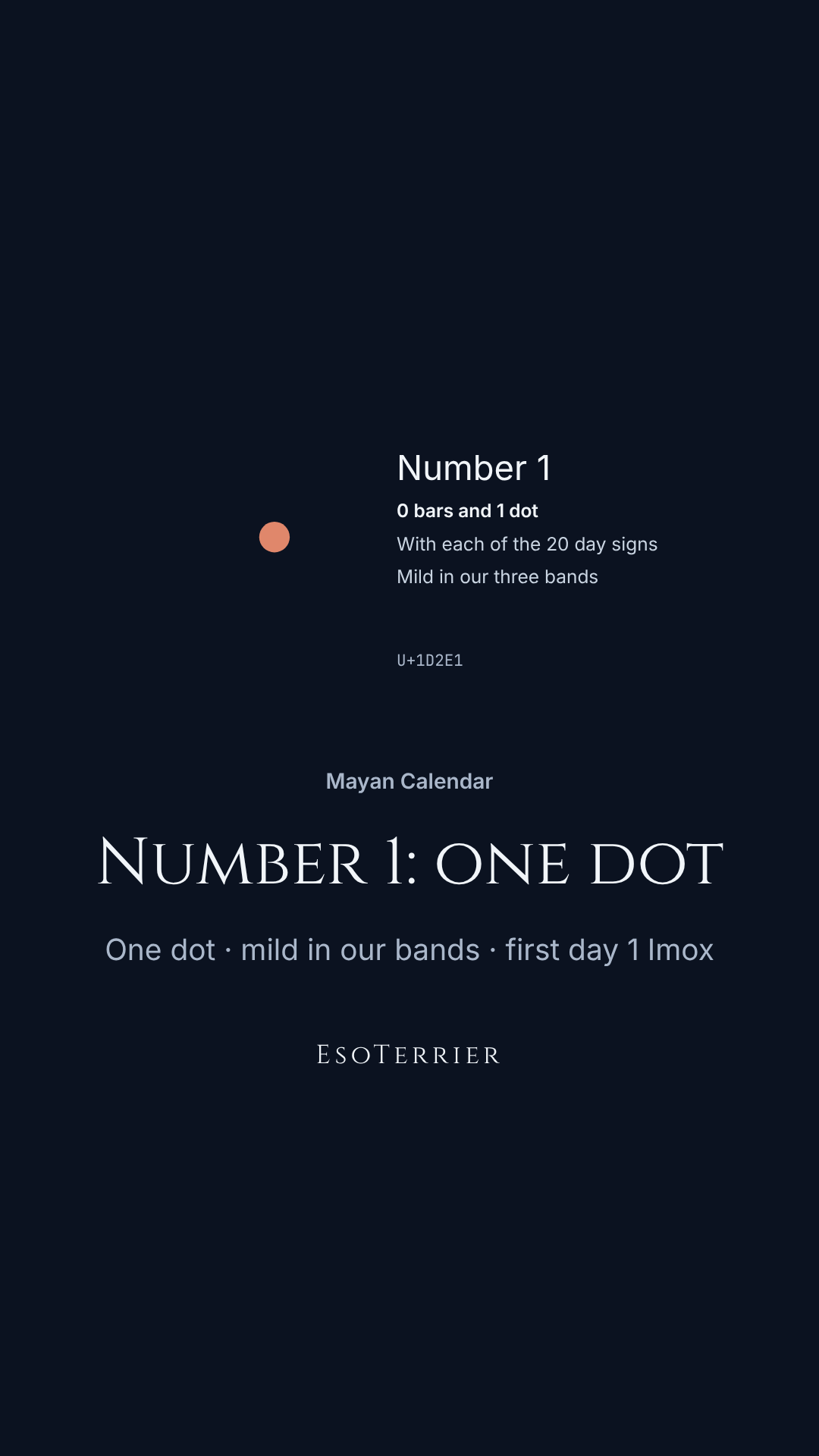
The Maya number 1 drawn as one dot, beside the words Number 1, one dot, mild in our three bands, and its Unicode code point U+1D2E1. Number 1 0 bars and 1 dot With each of the 20 day signs Mild in our three bands U+1D2E1
The number 1 as the Maya scribes wrote it, one dot, drawn by us; a bar is five and a dot is one.

Facts

Written
One dot
Unicode
U+1D2E1, MAYAN NUMERAL ONE (Unicode 11.0, 2018)
Strength in our three bands
mild (1 to 3 mild, 4 to 9 middle, 10 to 13 strong; our grouping)
First day in the count
1 Imox, day 1 of the 260
Days with this number
Twenty in every 260: days 1, 14, 27 … 248
Head variant (Classic, after Thompson)
the youthful earth and moon goddess
Highland year bearers with this number, 2018 to 2038
1 Kej from 18 February 2026

Meaning

Every day of the count carries a number beside its sign, and a daykeeper reads the pair together. One opens each thirteen-day run: after 13 comes 1 again, with the next sign. In the highland ethnography, as others report Barbara Tedlock's work at Momostenango and Ruth Bunzel's at Chichicastenango, the low numbers are gentle and the high ones strong.

We place 1 in our mild band, with 2 and 3; the bands and their edges are EsoTerrier's grouping of that reported principle, not a published scheme. Our keyword for it, "beginning, seed", and our sentence, that one is a mild, unformed force, the first step of whatever is starting, are ours, offered as a reading aid and not as what the tradition teaches.

Days and ceremonies

1 Imox is day 1 of the 260, the day the count's tables begin with. 1 Kej opened the highland year on 18 February 2026, the bearer whose number then rises by one each year.

Barbara Tedlock described in her 2005 interview how daykeepers take people to the shrines especially on days numbered one, for prayers and ceremonies there.

The numeral

The scribes wrote one as a single dot. In the Classic inscriptions a number could also be written as the head of a god, and Thompson identified the head for 1 as the youthful earth and moon goddess, the same god he gave to the day Kab'an: a Classic writing fact, which says nothing about how a daykeeper reads the number today.

In the count

The number 1 falls on twenty days of the 260: days 1, 14, 27, 40, 53, 66, 79, 92, 105, 118, 131, 144, 157, 170, 183, 196, 209, 222, 235 and 248, with the signs Imox, I'x, Kej, Ajpu, Aj, Kame, Kawoq, E, Kan, Tijax, B'atz', K'at, No'j, Tz'i', Aq'ab'al, Ajmaq, Toj, Iq', Tz'ikin and Q'anil in that order. A sign comes back every twenty days and a number every thirteen, so the same pairing, such as 1 Imox, returns only after 260 days. Each year the highland year bearer's number rises by one, because 365 days are 28 runs of thirteen and one day more.

Correspondences

Each item with how it stands: “sourced” is in the work cited, “our construction” is EsoTerrier’s own, and “disputed” means the sources disagree.

Strength, in the highland reports
The number gives the day its force: low numbers gentle, high numbers strong (Tedlock at Momostenango and Bunzel at Chichicastenango, as reported) sourced
Our band
mild; the bands and their edges are EsoTerrier's grouping, not a published scheme our construction
Our keyword and sentence
"beginning, seed"; One opens every thirteen-day run: a mild, unformed force, the first step of whatever is starting. our construction
Head variant of the numeral, after Thompson
the youthful earth and moon goddess, the god he gave to the day Kab'an sourced
A fixed character for the number
None established; which numbers are good differs from town to town disputed

How the schools read it

Highland ethnography, as reported
The number is the strength of the day, gentle in the low numbers and strong in the high.
Thompson's survey of highland towns
Which numbers count as good or bad differs from town to town.
Classic scribes
Wrote 1 as one dot, or as a god's head: the youthful earth and moon goddess, in Thompson's identification.
Dreamspell (1990)
Gives each number a name of its own in a different modern count; not used here.
EsoTerrier
Mild in our bands; keyword "beginning, seed". Our words, a reading aid.

Claims about it

  • The number 1 has a fixed traditional character.

    unverified

    What the record shows: The highland reports give the numbers strength, low gentle and high strong; fixed characters per number are modern, and our own keyword is labelled as ours.

  • One is one of thirteen cosmic "tones" with a Maya name.

    false

    What the record shows: The tone names are Dreamspell's, from 1990. The Maya count has numbers 1 to 13.
Elsewhere on EsoTerrier

Sources

Primary texts (3)
  1. Mayatecum, ¿Cuál es el verdadero día del año nuevo maya solar?. mayatecum.com, 2024. Facts only. mayatecum.com/cual-es-el-verdadero-dia-del-anyo-nuevo-maya-solar
  2. Atitlan Vida, The 13 numbers of the Tzolk'in. atitlanvida.com, 2025. Facts only. atitlanvida.com/culture/tzolkin/the-13-numbers
  3. J. Eric S. Thompson, Maya Hieroglyphic Writing: Introduction. Carnegie Institution of Washington, Publication 589, 1950 (reprinted 1960 and 1971). Facts and short attributed phrases only. mesoweb.com/publications/Thompson/Thompson1950.html
Studies and other sources (8)
  1. "Maya calendar", Wikipedia (orientation only). en.wikipedia.org/wiki/Maya_calendar
  2. "Dreamspell", Wikipedia (orientation only). en.wikipedia.org/wiki/Dreamspell
  3. Barbara Tedlock, Time and the Highland Maya. University of New Mexico Press, 1982. Not read by us: no lawful copy was reachable. Known through Barbara and Dennis Tedlock's 2005 interview (S99) and the works that cite it; facts only. search.worldcat.org/title/8033915
  4. Unicode Consortium; Google Noto, Mayan Numerals (Unicode block U+1D2E0 to U+1D2FF) and Noto Sans Mayan Numerals. unicode.org; github.com/notofonts, 2018. github.com/notofonts/mayan-numerals
  5. Soy Migrante, Año Nuevo Maya 5141 inicia con la fuerza del venado (18 February 2026). soymigrante.com, 2026. Facts only. soymigrante.com/revista/ano-nuevo-5141-del-calendario-maya-haab-comienza-con-la-fuerza-del-venado-conoce-mas
  6. Harri Kettunen and Christophe Helmke, Introduction to Maya Hieroglyphs, 20th edition. Wayeb (European Association of Mayanists), 2025. Facts only. wayeb.org/wp-content/uploads/2025/11/Kettunen_Helmke_2025_WH_English_20th_ed.pdf
  7. Barbara Tedlock and Dennis Tedlock; Night Fire Films, Breaking the Maya Code: interview with Barbara and Dennis Tedlock (11 to 12 February 2005, Momostenango), transcript. Night Fire Films, 2005. Facts only. nightfirefilms.org/breakingthemayacode/interviews/TedlocksTRANSCRIPT.pdf
  8. Ruth Leah Bunzel, Chichicastenango: A Guatemalan Village. J. J. Augustin, Locust Valley NY (Publications of the American Ethnological Society 22), 1952. Public domain; its passage on the numbers is known to us second hand. catalog.hathitrust.org/Record/004939427
Our own research (2)
  1. EsoTerrier Mayan calendar research, 2026-10-11 (main report, validation report, visual survey, notes) (2026).
  2. EsoTerrier engine, Mayan reference and calculation (2026). Its texts are our own, written from the sources above.

Your Mayan Calendar reading, $4.99. Includes this system's raw data. Written for you by AI. Read a sample. Charts and the written text are free in every account.

By EsoTerrier. Written with AI assistance from our research and checked against its sources; last revised 20 October 2026. How we write these pages.

First published ; last revised . Corrections: support@esoterrier.com.