Meaning
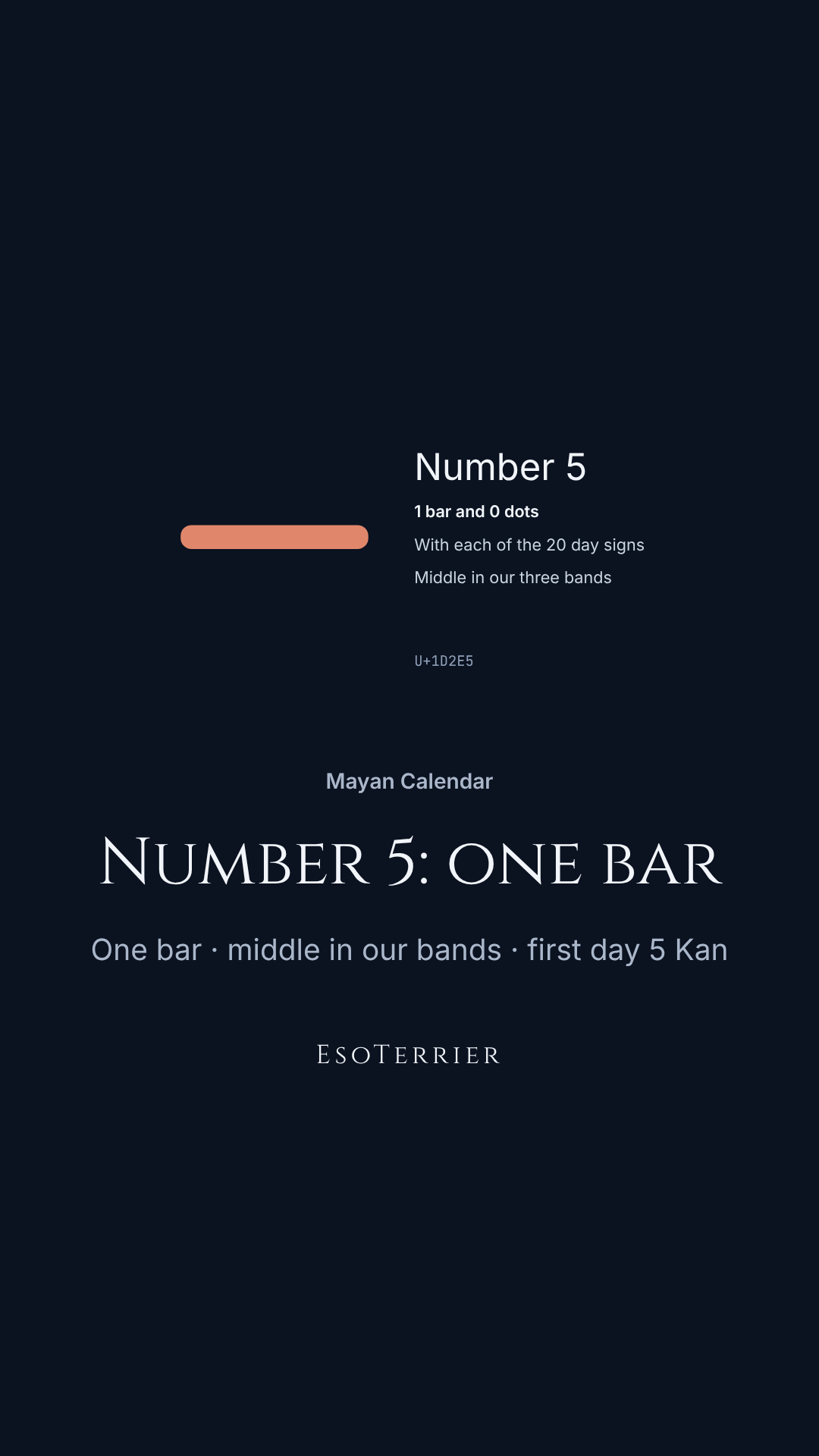
Five is where the written number changes: one bar stands for five, and the dots begin again above it. In the count it is a middle number, neither gentle nor strong in the highland scale as reported; our middle band, 4 to 9, is our own grouping of that scale.
Our sentence for five calls it the count of one hand and the number of practical effort, with the keyword "work, the hand": EsoTerrier's aid, not a meaning the daykeepers give.
Days and ceremonies
Its first day is 5 Kan, day 5 of the 260. Among the highland year bearers, 5 Kej bears the year that opens in February 2030.
The numeral
The bar-and-dot system counts in twenties, with a bar for five, a dot for one and a shell for zero; Unicode encoded the numerals in 2018. Thompson identified the Classic head for 5 as an aged god, perhaps the earth god Mam, with a shell on his back, the god he gave to the day Imix.
Five dots are never written: at five the dots give way to a bar, and at ten to a second bar.
In the count
The number 5 falls on twenty days of the 260: days 5, 18, 31, 44, 57, 70, 83, 96, 109, 122, 135, 148, 161, 174, 187, 200, 213, 226, 239 and 252, with the signs Kan, Tijax, B'atz', K'at, No'j, Tz'i', Aq'ab'al, Ajmaq, Toj, Iq', Tz'ikin, Q'anil, Imox, I'x, Kej, Ajpu, Aj, Kame, Kawoq and E in that order. A sign comes back every twenty days and a number every thirteen, so the same pairing, such as 5 Kan, returns only after 260 days. Each year the highland year bearer's number rises by one, because 365 days are 28 runs of thirteen and one day more.
Correspondences
Each item with how it stands: “sourced” is in the work cited, “our construction” is EsoTerrier’s own, and “disputed” means the sources disagree.
- Strength, in the highland reports
- The number gives the day its force: low numbers gentle, high numbers strong (Tedlock at Momostenango and Bunzel at Chichicastenango, as reported) sourced
- Our band
- middle; the bands and their edges are EsoTerrier's grouping, not a published scheme our construction
- Our keyword and sentence
- "work, the hand"; Five, the count of one hand and the first bar in Maya numerals, is the number of practical effort. our construction
- Head variant of the numeral, after Thompson
- the aged god N, perhaps Mam, the earth god, with a shell on his back, the god he gave to the day Imix sourced
- A fixed character for the number
- None established; which numbers are good differs from town to town disputed
How the schools read it
- Highland ethnography, as reported
- The number is the strength of the day, gentle in the low numbers and strong in the high.
- Thompson's survey of highland towns
- Which numbers count as good or bad differs from town to town.
- Classic scribes
- Wrote 5 as one bar, or as a god's head: the aged god N, perhaps Mam, the earth god, with a shell on his back, in Thompson's identification.
- Dreamspell (1990)
- Gives each number a name of its own in a different modern count; not used here.
- EsoTerrier
- Middle in our bands; keyword "work, the hand". Our words, a reading aid.
Claims about it
-
The number 5 has a fixed traditional character.
unverifiedWhat the record shows: The highland reports give the numbers strength, low gentle and high strong; fixed characters per number are modern, and our own keyword is labelled as ours.
-
Five is one of thirteen cosmic "tones" with a Maya name.
falseWhat the record shows: The tone names are Dreamspell's, from 1990. The Maya count has numbers 1 to 13.