Meaning
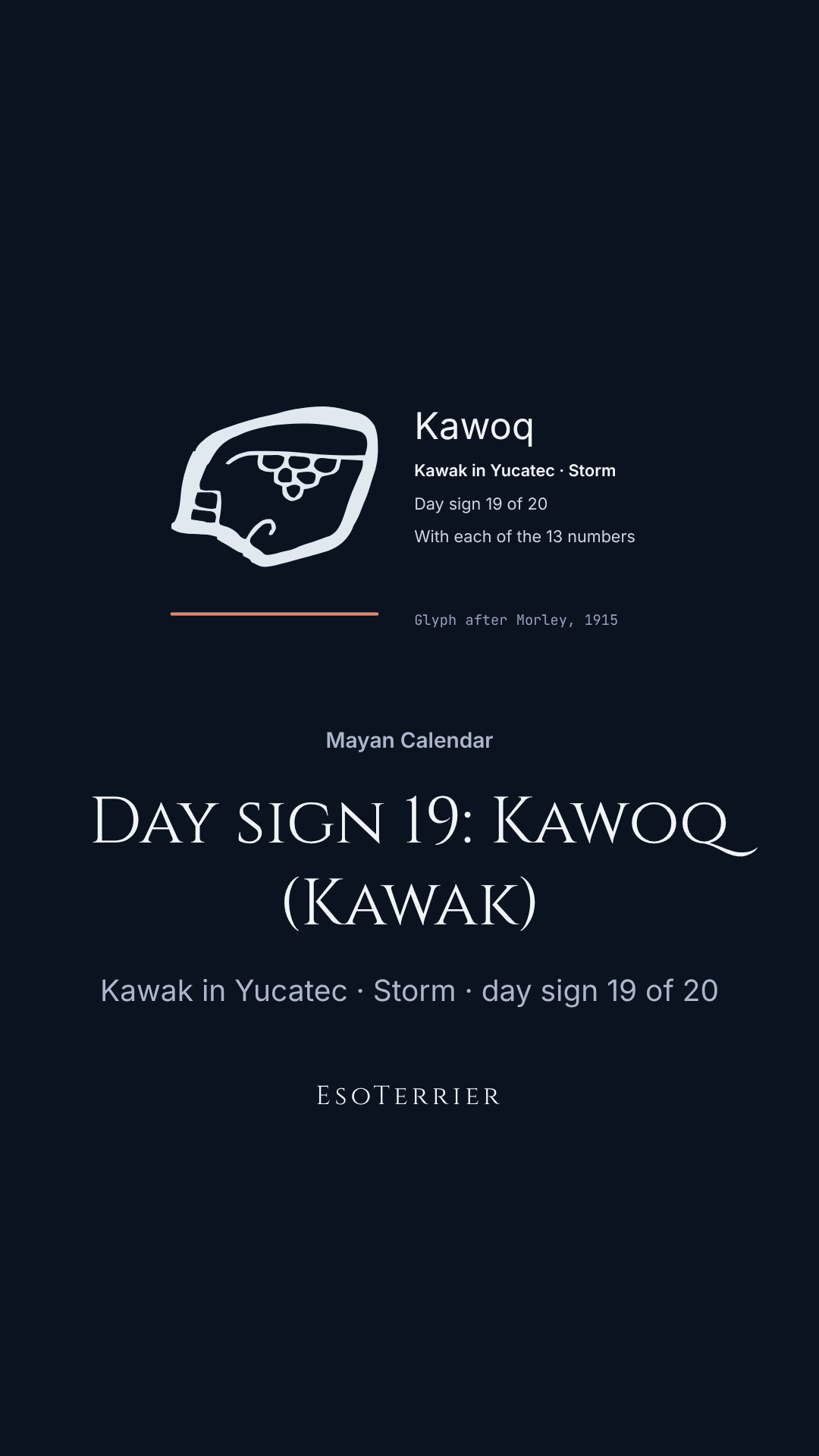
The Yucatec and the highland names both come from words for thunder, lightning and storm. Thompson gave the day to the celestial dragons, the Itzamnas who send the rain, and noted that the parts of this day's glyph also form the glyph for the year. The Classic reading is unknown.
The highland reading adds the human side. The Komon Tohil daykeepers derive the name from thunder, ants and woman and use the day to ask for the success of projects and for a clear mind; the Maya' Wuj manual makes it the day on which the grandparents overcame every obstacle and a day to work at family difficulties.
Our reading: the storm and the rain that renew the land, and the community and the family, carried by people described as perceptive and fair. The words are ours.
In the highlands today
In Momostenango, Andrés Xiloj said in 2005, the day is for bringing mouth and face together to ask for goodness, not to curse a neighbour.
Some sheets list the gift of foresight among those born on Kawoq; we do not repeat it as a promise. Some communities write the name Kawuq.
The glyph and the old readings
Landa made Kawak the fourth of the four days that could open a year in Yucatan, assigned to the west; the colonial spelling is Cauac. It bears no year in the highland count.
The Central Mexican day of the same position is Quiyahuitl, rain: the counts share the weather, not the gods.
In the count
Kawoq comes round every twentieth day, thirteen times in the 260: on days 19, 39, 59, 79, 99, 119, 139, 159, 179, 199, 219, 239 and 259, with the numbers 6, 13, 7, 1, 8, 2, 9, 3, 10, 4, 11, 5 and 12 in that order, so 6 Kawoq is its first day in the count and 12 Kawoq its last. In the nawal cross of a person born on Kawoq, the day eight before (conception) falls on B'atz', the day eight after (destiny) on Kej, six before (the right hand) on Aj and six after (the left hand) on Kan, each with its own number.
Correspondences
Each item with how it stands: “sourced” is in the work cited, “our construction” is EsoTerrier’s own, and “disputed” means the sources disagree.
- Thompson's reading of the glyph (1950)
- rain sourced
- Presiding god of the day, after Thompson
- the celestial dragon, Itzamna sourced
- Old augury, Yucatan and the highlands, after Thompson
- quetzal (Yucatan); storm (highlands); gradings differ between communities disputed
- The name, as the Zunil daykeepers explain it
- thunder, ants and woman sourced
- Direction and colour
- west, black (ek'): Landa gives this colonial bearer its direction sourced
- Our reading
- The storm and the renewing rain, the community and the family: perceptive and fair. our construction
How the schools read it
- Classic inscriptions (epigraphers)
- Reading of the glyph not known
- J. Eric S. Thompson, 1950
- The glyph as rain; the day's god the celestial dragon, Itzamna.
- Komon Tohil daykeepers, Zunil
- Thunder, ants and woman.
- The Maya' Wuj manual
- Tempest; the day on which the grandparents overcame every obstacle; a day to work at family difficulties.
- Momostenango (Andrés Xiloj, 2005)
- Bringing mouth and face together to ask for goodness, not to curse a neighbour.
- The Central Mexican count (tonalpohualli)
- Quiyahuitl, rain: the day of the same position in a related but different count.
- Dreamspell (1990)
- "Blue Storm" for the same position in its own count; not our name for the sign.
- EsoTerrier
- The storm and the renewing rain, the community and the family: perceptive and fair. Our words.
Claims about it
-
Kawoq is the "Blue Storm".
falseWhat the record shows: That is a Dreamspell name from a modern count of 1990, which gives most dates a different sign.
-
Kawoq is a year bearer.
disputedWhat the record shows: Kawak was one of Landa's four in colonial Yucatan; the highland bearers are Iq', Kej, E and No'j.
-
The colonial spellings, Cauac and Ahau, are the correct names.
disputedWhat the record shows: They are sixteenth-century Spanish spellings. Today's Guatemalan alphabets, official since 1987, write Kawoq and Kawak.