How it works
The chart takes four moments of the Chinese calendar at the birth: the year, the month, the day and the double hour (時辰, two clock hours). Each is named by a pair drawn from ten Heavenly Stems (天干, 甲 to 癸) and twelve Earthly Branches (地支, 子 to 亥), which run side by side through a cycle of sixty. Four pairs make eight characters, and the eight characters give the chart its name.
The year and the month. The year of the chart does not begin on 1 January, nor at the lunar new year, but at 立春, the Beginning of Spring, around 4 February. Each month begins at one of the twelve 節 solar terms, roughly a month apart, so a birth in late January belongs to the previous year and the twelfth month. The month's stem follows from the year's by a rule the 三命通會 gives as a verse, the "five tigers" (五虎遁). We find each term at the moment the Sun reaches its longitude and compare it with the birth in its own time zone; on seventy test births the year and month agreed with an independent library every time, across eight zones, daylight saving and both hemispheres.
The day. The day pillar is a running count of sixty that, by the eclipses recorded in the Spring and Autumn Annals, has not broken since 722 BCE. We count it from 1 October 1949, a 甲子 day. Our first engine anchored the count on the wrong day, so every day branch it cast was four places out; it was rebuilt in October 2026.
The hour. The day is divided into twelve double hours named by the branches, the first, 子, running from 23:00 to 00:59. Whether a birth between 23:00 and midnight belongs to the next day is a matter of school. By default we open the new day at 23:00, as most fate-calculation tools do, and offer midnight as the alternative; a chart born in the 子 hour always says which it used, and shows the other when they differ. The hour's stem follows from the day's by a second verse, the "five rats" (五鼠遁).
True solar time. The old charts were read from the Sun. Standard time came to China in 1914 and a single zone for the whole country in 1949, and the clock has run apart from the Sun ever since. When the birth place is known we turn the clock time into the Sun's time, four minutes per degree of longitude from the zone's meridian plus the equation of time, and print both. Clock time stays a setting, because established schools read it.
The Day Master and the Ten Gods. The stem of the day is the Day Master (日主), the chart's point of reference: in the words of the 淵海子平, "take the day stem as master" (取日干為主). Every other stem, visible or hidden, is named by how its phase and polarity stand to the day master's. A stem of the same phase is a Friend (比肩) or Rob Wealth (劫財); one the day master produces is the Eating God (食神) or Hurting Officer (傷官); one it overcomes is Indirect (偏財) or Direct Wealth (正財); one that overcomes it is Seven Killings (七殺) or the Direct Officer (正官); one that produces it is Indirect (偏印) or Direct Resource (正印). The first name of each pair is for a stem of the day master's own polarity, the second for the other. These are the Ten Gods (十神). They are names of relations, and the day stem itself is never one of them.
The phases turn in two classical sequences. In the producing order Wood feeds Fire, Fire makes Earth, Earth bears Metal, Metal carries Water and Water feeds Wood; in the overcoming order Wood breaks Earth, Earth dams Water, Water quenches Fire, Fire melts Metal and Metal cuts Wood. The classics work from these two (相生 and 相剋), and so do we.
Hidden stems. Each branch holds one to three stems (藏干): 寅, for instance, holds 甲, 丙 and 戊. We print the set of the 淵海子平's verse, the one nearly every tool now uses, with the main, middle and residual qi marked; the Ming day-share tables of the 三命通會 divide some branches differently, so the roles are a convention.
Luck and the years. From the month pillar the chart steps forward or backward through the sixty in ten-year luck pillars (大運), the direction set by the year's polarity and the chart gender. The age at which they start is counted from the birth to the nearest 節 term, at three days to a year, the commonest of several conventions. Each year adds its own pillar (流年). They are the tradition's reading of the periods of a life, and have their own page, Luck Pillars.
What else the chart shows, and what it does not. Beside the pillars we give the Na Yin name of each pair, the twelve stages of the day master on each branch (as phases of its qi), the two void branches, the clashes and combinations between the pillars, and a count of the eight characters by phase, with the hidden stems counted apart. The tradition goes on to weigh the day master's strength and look for a useful god (用神); EsoTerrier computes neither and shows no strength bar, by the owner's decision of October 2026. The classics also read rank, wealth, kin and lifespan from a chart; we report that they did and make no such reading ourselves.
Origins and history
The calendar is ancient; reading a fate from it is medieval; the day-master method is Song; the manuals that teach it are Ming.
| When | Who | What happened |
|---|---|---|
| From about 1250 BCE | Shang diviners | The stems and branches date nearly every oracle-bone inscription by the sixty-day count; the ten stems also name the dead kin whose sacrifices fall on their days. A calendar, not a fate. |
| 722 BCE onward | Court annalists | Eclipses in the Spring and Autumn Annals show the day count running unbroken from here to the present. |
| 104 BCE | The 太初 calendar reform | All twenty-four solar terms enter the official calendar; the twelve 節 among them later bound the months of the chart. |
| 6th century | 魏寧, at the Northern Qi court | Kept by the emperor because he was "good at reckoning fate" (善推祿命); he is tested with the emperor's own year and month of birth. |
| 627 to 649 | 呂才 (606 to 665) | Ordered to correct the divination books, he says the fate books "have long circulated" and tests them on the birth years and months of past rulers, finding them wrong each time. |
| Died 813 | Li Xuzhong 李虛中 | Han Yu's epitaph: from a person's year, month and day of birth Li judged lifespan, rank and fortune. Three pillars; whether the hour is meant is unresolved. |
| Late Northern Song | 林開; the 珞琭子 | 林開's book adds the hour, and the month of conception, to the "three lives" of year, month and day; the anonymous 珞琭子 poem circulates and gathers commentaries. |
| 1135 to 1146 (one dating) | The commentator "Xu Ziping" 徐子平 | A commentary on the 珞琭子 under this name; the Qing catalogue says the method reads fortune "solely from the eight characters of year, month, day and hour". Whether the man lived is questioned. |
| 1253 to 1258 | 徐大升 | Two books, 淵海 and 淵源, of the day-master teaching. |
| Ming | 楊淙, compiler | Merges them, with additions, into the 淵海子平 now in circulation: the hidden-stem verse, the Ten God chapters, and "in the Song arose the Ziping teaching". |
| 1523 to 1603 | Wan Minying 萬民英 | The 三命通會 in twelve juan: the older year-based methods set beside the Ziping method; the verses for the month and hour stems; the rules for the luck pillars. |
| 1638 | Zhang Nan 張楠 | The 神峰通考 in print: the reading by 病藥, a fault in the chart and its cure. |
| 1645 | The 時憲 calendar | The solar terms move from the mean Sun to the true Sun, every fifteen degrees of its path: the definition every modern chart uses. |
| 17th century | 陳之遴, compiler | The 滴天髓輯要, published under the name of Liu Bowen (劉基); one edition study places the text in the mid-Ming or later. |
| 18th century | Shen Xiaozhan 沈孝瞻 | The 子平真詮: the useful god taken from the month's command and the pattern (格局) method. |
| Qing | 余春台, editor | The 窮通寶鑑, from the 欄江網 manuscript: the reading by season, stem by stem and month by month. |
| After 1820 | 任鐵樵 (born 1773) | The 滴天髓闡微: the verse, its older commentary (原注) and his own, with case charts, his own among them. |
| Joseon; 1818 to 1830 | Korea; 桜田虎門 in Sendai | In Korea the method, called Saju (사주), becomes an examination subject; in Japan the 淵海子平 is translated as the 推命書. |
| 1886 to 1948 | 徐樂吾 and his circle | Commentaries on the 滴天髓, the 子平真詮 and the 窮通寶鑑 that shape twentieth-century practice. |
| 1914; 1949 | Republic and People's Republic | Standard time, then one zone for the country: the clock parts from the Sun, and the question of true solar time is born. |
| 1946 to 2023 | Chao Wei-pang; Richard J. Smith; Stéphanie Homola | The first scholarly English account (1946), a history of divination in late imperial China (1991), and a study of fate calculation in Taipei, Beijing and Kaifeng (2023). |
| 1978 to 2010 | 梁湘潤 in Taipei; Derek Walters, Raymond Lo, Lillian Too; Joey Yap | The Taipei publishing line behind much Taiwanese practice; the first English books (from 1987); a Malaysian book series on the Ten Gods whose English names most tools now use. |
| 2015 | Jung and Yang, Seoul | The one published empirical test of the chart against personality inventories. |
| 2026 | EsoTerrier | The engine rebuilt and checked on seventy births: the day count, the 23:00 day, true solar time, the luck start and the Ten Gods for every stem. |
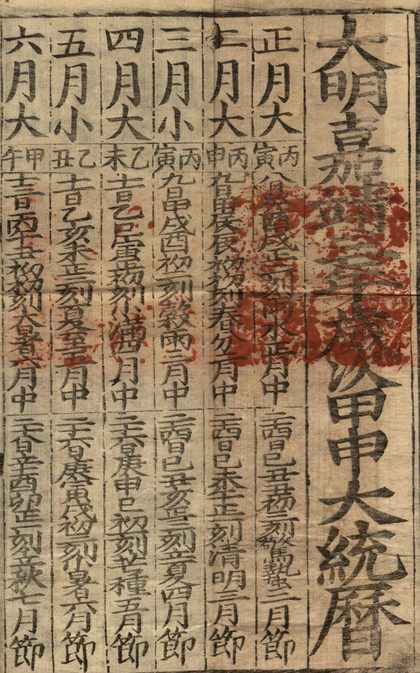
A chart is read off a calendar like this one. The year's pair names the year pillar; a month pillar runs from one 節 term to the next, so a birth a day before 驚蟄 still belongs to the first month; and the day pillar is the day's place in the sixty-day count, the same count the almanac gives for the first day of each month. Only the hour is not in the almanac: it is read from the clock, or from the Sun.
The tradition tells its history as a line of masters: Li Xuzhong reading the day, Xu Ziping making it the master, the Ming books handing the method down. The documents tell it as a slower growth. Fate reckoning from the year and month was a court art before Li; the hour appears in Song books with no single inventor; the man called Xu Ziping is a name on a commentary; and the books we read were compiled in the Ming and Qing from older material. The calendar under it, the sixty-day count and the solar terms, is very old and still runs.
The ten day masters
The day master is one of the ten Heavenly Stems, so there are ten. Each has its own page: its phase and polarity, the branches it is rooted in, the stems it combines and clashes with, the classical verse and images the texts give it, and the image our chart uses, labelled as ours.
Variants and what we leave out
Two tools can give the same birth different charts, and the reason is nearly always one of these choices. We name each, and say which one we take.
- Schools of reading. Within the Ziping line the classics ground the useful god differently: by supporting or restraining the day master (the 滴天髓's commentators), by the pattern of the month's command (子平真詮), by the season (窮通寶鑑), or by a fault and its cure (病藥, 神峰通考). The older methods that the 三命通會 compares read from the year pillar instead. The Blind school (盲派) says it reads by images and rules rather than strength and pattern. Japan's schools and Korea's Saju cast the same chart with their own conventions.
- The 子 hour. Three schools: the new day at 23:00; midnight, with a birth after 23:00 taking the next day's hour stem; and midnight with the same day's hour stem. We offer the first two and default to the first. 任鐵樵's "night 子 hour" (夜子時) concerns which hidden stem rules, not a change of day.
- True solar time. On by default and switchable. Some calculators apply it, many schools ignore it, and some masters choose the hour from a person's life instead. The correction moves the hour pillar for births near the turn of a double hour, and the day for births near 23:00.
- Hidden stems. The modern list against the Ming day-share tables, tables that add or drop a stem in 亥 and 午, and two orders for 丑. We print the common set with roles.
- The blade of the yin stems. The 三命通會 reports an older rule that gave every stem a blade (羊刃) and says that the Ziping method gives one to the yang stems only; our pages follow the Ziping rule and note the older one.
- Counting the phases. The eight characters as printed, all stems and hidden stems unweighted, or weighted schemes with seasonal multipliers. We headline the first and show the hidden stems separately; there is no one correct count.
- The stages of the yin stems. Every tool runs the yin stems backward through the twelve stages, as the 三命通會 does; the 滴天髓's commentators question it, and 任鐵樵 rejects it. We print the backward rule and say it is disputed.
- Order and script. Chinese tools write hour to year, right to left, with nominal ages; English tools write year to hour with real ages. We write year to hour, in Traditional characters with tone-marked pinyin, and give real ages.
- Left out. The day master's strength, the useful god and the names of patterns (never computed); the symbolic stars beyond the common eight (a later pass); the Life and Conception palaces; monthly pillars and the minor cycle; transformations; and every modern author's archetype set and interpretation texts.
Myths and disputed claims
What is said about BaZi, who says it, and what the record shows. The label is ours; several of these claims were ours too, until October 2026.
-
BaZi is a science: a biological code of time, a law of nature, a rigorous tool for profiling personality.
falseWho says it: Our own pages before October 2026, and much English marketing copy.
What the record shows: It is a fate-calculation tradition built on the yin-yang and five-phase doctrine, as the scholarship describes it. No mechanism is proposed and no study supports the wording.
-
The Shang used the stems and branches to read destinies.
falseWho says it: Our own pages before October 2026.
What the record shows: On the oracle bones the cycle counts days and the stems name the dead kin whose sacrifices fall on them. Fate reckoning from a birth date is first recorded in the sixth century AD.
-
The twelve Earthly Branches come from Jupiter's twelve-year orbit.
disputedWho says it: Many popular books, and our old page.
What the record shows: The branches are attested first as a day count. They came to stand for the Jupiter cycle later; the sources say they represent it, not that they came from it.
-
Li Xuzhong (died 813) founded fate calculation.
disputedWho says it: The Qing imperial catalogue, which calls him the ancestor of the art, and most English pages.
What the record shows: Fate reckoning from the birth year and month was practised at the Northern Qi court in the sixth century and attacked as long established in the early Tang. Li is the first reader of the day we know of.
-
Li Xuzhong set out the four pillars.
disputedWho says it: English Wikipedia.
What the record shows: His epitaph names the year, month and day: three pillars. The Ming 淵海子平 says he used the hour too, and the 三命通會 credits him with the day master; the Qing editors and the Ming writer 謝肇淛 say he did not.
-
The hour pillar was Xu Ziping's addition, and with it the eight-character chart began.
disputedWho says it: Wikipedia, most English teaching sites, and our old page.
What the record shows: The hour is in late Northern Song books, among them 林開's, recorded in a Song catalogue. Who first added it is not recorded, and nothing ties it to Xu Ziping.
-
Xu Ziping was a historical Northern Song diviner.
disputedWho says it: The tradition.
What the record shows: No record of the man survives. The Qing editors wrote that nothing of his life can be traced; one modern dating puts the commentary under his name at 1135 to 1146, and a modern researcher doubts that he lived.
-
The 淵海子平 is a Song text.
disputedWho says it: English Wikipedia and our old page.
What the record shows: The book in circulation is a Ming compilation by 楊淙 of two Song works by 徐大升, with additions. Its own chapter dates the day-master method to the Song.
-
BaZi has run unchanged as a calculating system for a thousand years.
disputedWho says it: Our old page writer's notes.
What the record shows: The day-master method is attested from the Song, the hour from late Northern Song books, and the manuals we read are Ming and Qing. About nine hundred years for the method is defensible; the rest is not.
-
A chart is wrong unless it uses true solar time.
disputedWho says it: Several English calculators, and our old page.
What the record shows: Before standard time the clock was the Sun, and most calculators now correct to it; but established schools read clock time, as the calculators themselves say. It is a choice of school.
-
The Chinese day begins at 23:00, so a birth after 23:00 belongs to the next day.
disputedWho says it: The prevailing fate-calculation school and most tools.
What the record shows: The calendar starts the day at midnight; the double hours, and folk custom, start at 23:00. Three schools exist, and we found no classical text that moves the day pillar at 23:00.
-
The day master's strength and the useful god can be computed by a formula.
disputedWho says it: Calculators with strength bars and useful-god cards.
What the record shows: The classics ground the useful god in at least four different ways, and a Republican commentator misread one of them. We compute neither.
-
The chart foretells the course of a life: its length, its fortune, its marriages.
unverifiedWho says it: The classical texts and many practitioners.
What the record shows: The tradition does make such readings; our pages and readings do not.
-
The four pillars have been shown to describe personality.
disputedWho says it: Practitioners citing one Korean study.
What the record shows: That study, of 148 people, found no effect on its main measures and weak correlations on others, and asked for larger samples. Nothing has replicated it.
-
Direct Wealth is the wife and Direct Officer the husband.
disputedWho says it: The 淵海子平's table of kin, and modern teaching.
What the record shows: The table is in the 淵海子平; within the tradition 任鐵樵 rejected parts of it. We give it as the tradition's reading and apply it to no one.
-
The one-word images of the day masters (tall tree, the sun, the ocean) are their traditional meaning.
disputedWho says it: Most English BaZi sites, and our own chart's titles.
What the record shows: The classics give other images: the 滴天髓's verses, the 三命通會's sky images (thunder, wind, the sun, the stars), the 窮通寶鑑's seasons. The popular images are a modern simplification; ours are labelled as ours.
-
EsoTerrier's engine casts every chart without error.
falseWho says it: Our own page before October 2026.
What the record shows: Until 10 October 2026 every day branch it cast was four places out and most luck starts were wrong. The rebuilt engine agrees with three reference libraries; the sentence is gone.
Stories and lore
These are told as the tradition and its texts tell them.
The censor who could not be wrong. Han Yu, the great Tang prose writer, buried his friend Li Xuzhong with an epitaph that is the first account of this art to name the day. Learned in everything and deepest in the books of the five phases, Li would take a person's year, month and day of birth with their stems and branches, weigh how they produced and overcame one another, and so tell lifespan, rank and fortune, "and in a hundred would not miss one or two" (百不失一二). The later books retell it with growing credit: the 淵海子平 adds the hour, the 三命通會 makes Li the first to take the day stem as master, and the Ming writer 謝肇淛 says Li never used the hour at all. The epitaph ends with Li dying after taking an elixir of mercury, which 謝肇淛 called proof that he did not know fate.
The skeptic at Taizong's court. Ordered to correct the divination books, 呂才 cast the fates of the duke of Lu, the First Emperor, Emperor Wu of Han and other rulers from their birth years and months, and showed the books contradicting the histories each time: a duke whom the books made sickly and short and the Odes praise as tall and handsome, an emperor promised a long old age who died before fifty.
The recluse of Mount Hua. The Qing catalogue quotes a Ming writer, 劉玉: Xu Ziping, given name 居易, lived in retreat on Mount Hua with the Daoist 麻衣, Chen Tuan and Lü Dongbin. The catalogue's editors add that they do not know where the story comes from. The same mountain and the same company appear in Zi Wei Dou Shu's account of its own origin. A lineage legend.
Root, sprout, flower, fruit. The 淵海子平 gives the chart its oldest image: take the day stem as master, the year as the root, the month as the sprout, the day as the flower and the hour as the fruit (以年為根,以月為苗,以日為花,以時為果).
The stems as a landscape. The 滴天髓 gives each stem a nature in verse; the 三命通會 gives each a sky image (thunder, wind, the sun, the stars, rosy cloud, cloud, the moon, frost, autumn dew, spring rain) and a pair of images in heaven and on earth. The modern images, a tall tree for 甲 or the ocean for 壬, descend from them in part, though the commentary to the 滴天髓 says plainly that 辛 is "not jewels".
The minister's book. The 滴天髓 was published under the name of Liu Bowen, the strategist of the first Ming emperor, by 陳之遴, a Ming official who became a Qing grand secretary and died in exile in 1666. The prestige of the name is why the attribution has lasted.
The commentator's own chart. 任鐵樵 printed his own birth chart, of 1773, and read it against himself: a family estate lost, a life of telling fortunes to fill his mouth, and the remark that the fortune-teller he once paid had only flattered him.
A dangerous examination. In Joseon Korea the method was an examination subject; a successful candidate might advise the court on the princes' charts, a post the Korean account calls very dangerous.
The blind diviners. The Blind school says its art came from Guiguzi and passed from blind master to blind pupil as a livelihood, until twentieth-century teachers brought sighted students to it. The story is the school's own and has no references.
Evidence and criticism
What the scholarship says. Chao Wei-pang in 1946 described fate calculation as an outgrowth of the yin-yang and five-phase doctrine, quite different from astrology; Richard J. Smith placed it among the divination arts of late imperial China; Stéphanie Homola studied it as a living practice in Taipei, Beijing and Kaifeng, where BaZi and Zi Wei Dou Shu are the two commonest methods and clients use them to think about study, work, marriage and politics. None of them judges whether it is true.
The oldest criticism is Chinese. 呂才 in the seventh century tested the fate books against the recorded lives of rulers and found them wrong each time. 謝肇淛 in the seventeenth wrote that every village fortune-teller could work the eight characters "but they do not come true", and asked how a creator could fix a life by eight characters. The editors of the imperial catalogue in 1782, who kept the fate books as useful to practitioners, said of the diviners' origin stories that not one in a hundred was true.
The one empirical test. Jung and Yang (2015) cast the charts of 148 Korean adults and compared them with two personality inventories. They found no link with the overall count of yin and yang and no differences by the yin or yang day stem or by the five phases; they found weak correlations with the phases (r 0.18 to 0.29) and with the "six gods" (r 0.18 to 0.25), called the effects relatively small and asked for larger samples. It is one small study, not replicated.
The test the chart invites. Everyone born in the same double hour, in the same place, with the same chart gender, has the same chart. Dean and Kelly followed 2,101 Londoners born on average under five minutes apart and found them no more alike than chance on 110 measures. That study was of Western astrology; BaZi has not been tested this way, and it could be.
Why people consult it. A study of Korean adults found their trust in acupuncture and the four pillars shaped by family culture, the social system and their idea of science. It studies the people who consult the chart, not the chart.
The texts disagree with each other. On the ground of the useful god, on whether yin stems have a blade, on the hidden stems and their shares, on the kin each Ten God stands for, on who first read from the day stem, and on the stages of the yin stems; modern practice adds the 子 hour, true solar time, how to count the phases and nominal against real ages. The texts themselves are mixed: the book under Li Xuzhong's name is partly Song work, the 滴天髓's attribution is doubted, the 三命通會 holds charts of late-Ming people added by later printers, and the 子平真詮 has no lawful transcription we could find.
Our own validation shows that the engine applies the conventions it names: it agrees with three reference libraries on seventy births and with two calculators where their settings match.
The state's view. Fate calculation was condemned as superstition in twentieth-century mainland campaigns; the practice carried on in Taiwan, Hong Kong and Southeast Asia and has returned to the mainland.
Terms
- BaZi 八字
- "Eight characters": the stem and branch of the year, month, day and double hour of birth. Also the Four Pillars of Destiny (四柱命理) and, for the day-master method, the Ziping method (子平法).
- Pillar
- One column of the chart, a Heavenly Stem above an Earthly Branch. Written here from year to hour, left to right; Chinese tools write hour to year.
- Heavenly Stems 天干
- The ten signs 甲 乙 丙 丁 戊 己 庚 辛 壬 癸, five yang and five yin, two to each of the five phases. In the Shang they named the ten days of the week.
- Earthly Branches 地支
- The twelve signs 子 to 亥, each with an animal, a phase and a double hour. Later associated with the twelve-year cycle of Jupiter; first attested as a day count.
- The sixty pairs 干支
- Stems and branches paired in turn, 甲子, 乙丑 and on to 癸亥, a cycle of sixty that names years, months, days and hours.
- Day Master 日主
- The stem of the day pillar, the reference point of the chart. It is not itself one of the Ten Gods.
- Ten Gods 十神
- The names of every other stem by its relation to the day master: Friend 比肩, Rob Wealth 劫財, Eating God 食神, Hurting Officer 傷官, Indirect Wealth 偏財, Direct Wealth 正財, Seven Killings 七殺, Direct Officer 正官, Indirect Resource 偏印, Direct Resource 正印. Each names a relation.
- Solar terms 節氣
- Twenty-four points of the Sun's yearly path, fifteen degrees apart. The twelve 節 terms open the months of the chart; 立春 opens its year.
- The 子 hour
- The double hour from 23:00 to 00:59. Schools differ on whether a birth after 23:00 takes the next day's pillar.
- True solar time
- The clock time turned into the Sun's time at the birth place: four minutes per degree of longitude from the zone's meridian, plus the equation of time.
- Luck pillars 大運
- Ten-year pillars stepping forward or back from the month pillar; with the annual pillars 流年, the tradition's reading of the periods of a life.
- Na Yin 納音
- A name and phase given to each of the sixty pairs in a fixed table, such as 海中金, Gold in the Sea, for 甲子 and 乙丑.
- The twelve stages 十二長生
- The phase of a stem's qi in each branch, from 長生 (birth) to 養 (nurture). Metaphors of growth and decline.
- Void 空亡
- The two branches a ten-day run of the cycle leaves without a stem, read from the day pillar.
- Useful god 用神
- The element or stem the tradition says a chart most needs. The classics ground it in different ways; EsoTerrier does not compute it.