How it works
A Nine Star Ki chart is calendar arithmetic. Every solar year, every solar month and every day has one of the nine stars, and a person's chart is the three that were current at birth, read with the palace that follows from the first two. The tradition reads the year star as the core character, the month star as the inner nature and the day star as the day-to-day tendency, in that order of weight.
The year star (本命星). The stars count down by one each solar year, and the solar year opens at 立春 (risshun), when the Sun reaches 315°, about 4 February. The day before it, 節分, still belongs to the old year, so a person born in January has the star of the year before. The star is eleven minus the digit sum of the year, reduced to one figure: 1984, the first year of a sixty-year cycle, is 七赤, Seven Red Metal, which the almanacs use as an anchor. With a birth time we take the exact moment of 立春 from an ephemeris; without one, the whole local day of the term goes to the new year, as the Japanese almanacs print it.
The month star (月命星). The months are the twelve solar months that open at the 節 terms, 寅 from 立春 to 丑 from 小寒, never the calendar or lunar months. The stars count down by one each month. The first month's star depends on the year: 八白 in years of 一白, 四緑 and 七赤, 二黒 in years of 二黒, 五黄 and 八白, and 五黄 in years of 三碧, 六白 and 九紫.
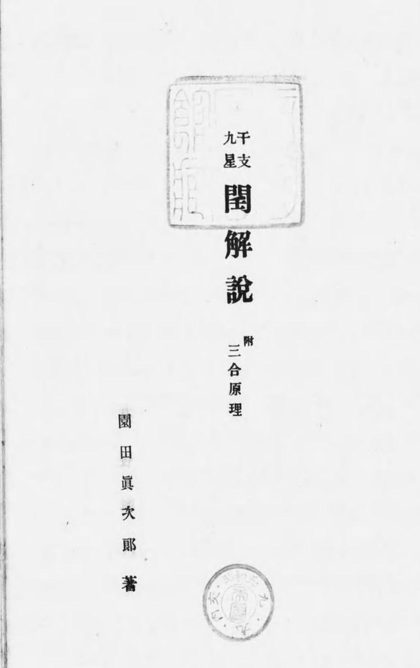
The day star (日命星). EsoTerrier follows the Japanese day chart, as the almanacs print it. From the 甲子 day (the first of the sixty-day cycle) nearest the winter solstice the stars count up from 一白, the ascending run called 陽遁; from the 甲子 nearest the summer solstice they count down from 九紫, the descending run, 陰遁. Because sixty-day cycles do not fit the solar year exactly, the switch days drift, and every eleven or twelve years two of them fall 240 days apart. The almanacs then run the old direction for thirty more days and start the new run on the 甲午, the thirty-first day of the cycle, so that one star (三碧 in summer, 七赤 in winter) falls on two days running. This leap rule is set out by Sonoda himself, in 園田真次郎, 干支九星閏解説 (大正館, 1930), NDL Digital Collection, and the schools still differ over it; our chart marks a birth inside such a window. The day runs from midnight to midnight in the place of birth, as Sonoda states.
The inclination (傾斜宮). Put the month star in the centre of the square and see where the year star lands: that palace is the inclination, read as the slant the year star takes. When the year and month stars are the same, the year star lands in the centre itself, 中宮傾斜. Some schools then substitute another palace from a table, and their tables disagree; we report the centre as it is, with no table and no gender.
The boards (方位盤). The square is drawn as a Japanese direction board, South on top, with the home stars 4 9 2, 3 5 7, 8 1 6. A natal board has the year star in the centre; the year, month and day boards of any date have that period's star in the centre, and the other eight follow in the order of the square. On each board the person's house is the palace their year star stands in (同会), and the tradition gives each of the nine houses its own reading as a phase of a nine-year rhythm: the low phase in the north, the starting phase in the east, the harvest phase in the west and so on. When the year star stands in the centre the person is said to be blocked in all eight directions, 八方塞がり.
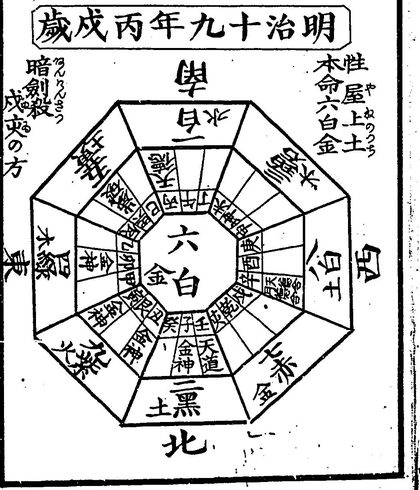
The directions. Each board carries the directions the tradition names. The killing directions (殺) are those practitioners avoid moving toward: 五黄殺 where 五黄 stands, 暗剣殺 opposite it, 歳破, 月破 and 日破 opposite the branch of the year, month or day, and the person's own 本命殺 (where their year star stands) and 本命的殺 (opposite it). A direction counts as auspicious when the star standing there supports the year star by the five phases: it generates it (生気), shares its phase (比和) or is generated by it (退気). 五黄 is never auspicious, a killing direction overrides, and the direction that also supports the month star is called the best (最大吉方). These are the tradition's readings. We show them with their names and say what practitioners do about them; we do not say what a direction will do to anyone, and we do not advise a journey, a move or a date.
What you enter, and what we leave out. The birth date and the place of birth, for its time zone; the time is optional; no gender, because no star in 九星気学 depends on it. We checked the year and month stars against two open libraries on 118 of 118 test dates, and the Japanese day chart against almanac tables for six years and the leap of 2020, when 19 and 20 June were both 三碧.
Origins and history
The nine stars are old; the system is from 1924. The table follows them from a Han ritual text to a Tokyo diviner's pamphlet.
| When | Who | What happened |
|---|---|---|
| 1st century BCE | The Da Dai Liji, the 明堂 chapter | The oldest surviving text that spells out the arrangement: the nine rooms of the Bright Hall, numbered 二九四, 七五三, 六一八. A gloss says the rooms follow "the turtle pattern". |
| Han | The Yijing's Great Commentary and its commentators | "河出圖,洛出書": the River gave forth the Chart and the Luo the Writing, and the sages took them as models. The sentence names no numbers; commentators joined the square to it later. |
| About 200 | The Qian zuo du, with Zheng Xuan's commentary | The spirit Taiyi moves through the nine palaces, and every side and corner adds up to fifteen; Zheng Xuan names the trigram of each palace, the Later Heaven order still used. |
| About 190 and the 6th century | 徐岳's 數術記遺, with 甄鸞's commentary | The verse that fixes the square: 2 and 4 the shoulders, 6 and 8 the feet, 3 left, 7 right, 9 the head, 1 the foot, 5 the centre. Cammann dates the first explicit square to about 570. |
| Sui dynasty (581 to 618) | 蕭吉's 五行大義 | Records the names of the seven stars of the Northern Dipper, 貪狼 and the rest; Chinese feng shui later pairs them with the nine numbers. |
| Tang dynasty, and 602 in Japan | Qimen Dunjia; the Baekje monk 観勒 | The divination whose ascending and descending runs the day chart borrows; its texts reach Japan in 602. |
| Song dynasty | 劉牧, 蔡元定 and 朱熹 | The square is drawn as a diagram and given the name of the Luo Writing, which stuck. |
| Heian period (794 to 1185) | The court and its diviners | 方違え: before a journey or building work, a taboo direction is avoided by a detour. The habit of reading directions that 気学 inherits. |
| 1840 to 1851 | 松浦琴鶴, an Osaka diviner | Books on house reading and the nine stars; the Japanese accounts name his line as the one Sonoda simplified. |
| 9 December 1872 | The Meiji government | The calendar reform edict adopts the solar calendar and calls the notes of the old almanacs mostly "wild and groundless" (妄誕無稽); the official calendar drops them. |
| 1873 to 1945 | Unlicensed almanac printers | The notes return in the お化け暦, the "ghost almanacs", now with the nine stars, which no earlier almanac had printed. |
| 1924, by the Japanese accounts | 園田真次郎 (1876 to 1961), of Kiryū in Gunma | Puts the nine-star direction lore together as 気学. No document of that year survives; one article gives 1909 instead. |
| 1928 and 1930 | Sonoda, as 荻野地角 and under his own name | His handbook of directions sets out the year, month, day and hour boards and the killing directions under the names still used; his pamphlet of 1930 explains the leap of the day chart. |
| 1945 | The occupation's Shinto Directive | Ends the shrine monopoly on the calendar; almanacs with notes may be printed openly, and today's almanacs descend from them. |
| 1986 and 1991 | Takashi Yoshikawa; Michio Kushi with Edward Esko | The first English books of the line, in New York and Massachusetts; the name "Nine Star Ki" comes from them. |
| 1992 to 1999 | Bob Sachs, Jon Sandifer, Rex Lassalle, 9starki.com | The Western books and sites: "1 Water" names, a "third number" and a day count of their own. |
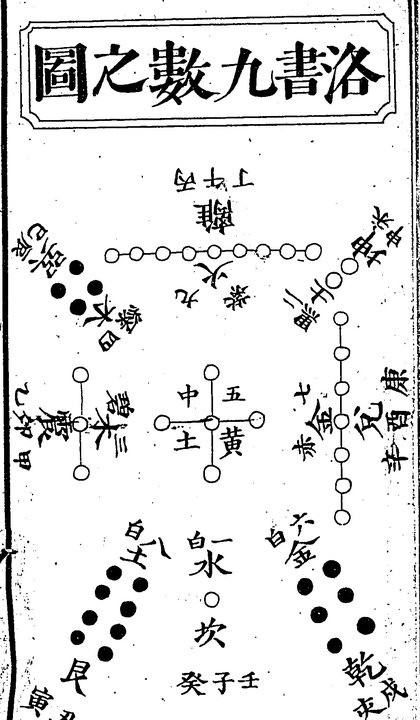
The square itself is a piece of Chinese cosmology with about two thousand years of written history, not four thousand: the Han ritual texts make it the floor plan of the hall where the king moved with the seasons, and the Han apocrypha lay the eight trigrams on its outer cells. Its pairing with colours, phases and directions, and the way a period's star moves round it, came to Japan with Chinese calendar lore and lived on in direction divination.
What is Japanese and modern is the system as a reading of a person. The nine-star boards did not appear in official Japanese almanacs; they entered the unlicensed ones after 1872. Sonoda, a diviner from Kiryū who wrote as 荻野地角, organised that lore in the 1920s, published the boards and killing directions by 1928, called his teaching 『氣學』 by 1936, and ran a hall whose yearly almanac gave month-by-month readings for each star. The Western line kept his year and month stars and added a day count and a "third number" of its own.
The nine stars
Each star is a number of the square with a colour and a phase; eight of them carry a trigram and a direction, and the fifth holds the centre. The names are Japanese: 碧 in the third star means jade, a blue-green, and 緑 in the fourth means green, so we write Three Jade Wood and Four Green Wood.
- 1 One White Water, 一白水星 (ippaku suisei): Water, 坎 Kan, north.
- 2 Two Black Earth, 二黒土星 (jikoku dosei): Earth, 坤 Kon, south-west.
- 3 Three Jade Wood, 三碧木星 (sanpeki mokusei): Wood, 震 Shin, east.
- 4 Four Green Wood, 四緑木星 (shiroku mokusei): Wood, 巽 Son, south-east.
- 5 Five Yellow Earth, 五黄土星 (goō dosei): Earth, no trigram, the centre.
- 6 Six White Metal, 六白金星 (roppaku kinsei): Metal, 乾 Ken, north-west.
- 7 Seven Red Metal, 七赤金星 (shichiseki kinsei): Metal, 兌 Da, west.
- 8 Eight White Earth, 八白土星 (happaku dosei): Earth, 艮 Gon, north-east.
- 9 Nine Purple Fire, 九紫火星 (kyūshi kasei): Fire, 離 Ri, south.
Each star has its own page: its place on the boards, the trigram's classical correspondences, how the Japanese and Western schools read it, and what is claimed about it.
Variants and what we leave out
Several conventions go by the same name. We describe them so you can recognise them, and say what we do instead.
- The term day. Chinese calculators take the date of each solar term in Beijing time, which can differ from the Japanese date by a day. We take the whole local day of the birth place, as today's Japanese almanacs do. Sonoda's own almanac for 1934 started each month on the day after its term day, so in his practice a birth on that day went to the old period.
- The day chart without the leap. Some open libraries switch runs on the nearest 甲子 and apply no leap, so they differ from the almanacs inside the leap windows (2019 to 2020 was the latest; 2032 is the next); one Japanese blog lists three competing leap methods. We follow the printed rule, which is also Sonoda's, and mark births inside a window.
- The Western day count. The Kushi line repeats the 1 Water day nearest the winter solstice and the 9 Fire day nearest the summer solstice, without the sixty-day cycle; another Western site changes the run at the moment of the solstice. Their count agrees with the Japanese day chart on about 38 percent of days between 1950 and 2030. Left out for now; it may become a labelled option.
- The Western "third number". Kushi and Lassalle take the number in the house of the year number when the month number is in the centre, which comes to the home star of our inclination palace; Sachs takes the mirror image; when the two stars are equal the Western number is 5. We show the Japanese palace instead.
- Substitution tables for the centre case. Several Japanese sites give a table that moves a 中宮傾斜 to another palace (by gender for 五黄), another site gives a different table, and a third reads the centre as it is. We report the centre, and this is the only place where gender enters 気学 at all.
- The Kua number (命卦). Eight Mansions feng shui gives each person a trigram number by one formula for men and another for women. Its value for a man coincides with the year star except for 5. A different quantity, which we never put in the year star's place.
- The hour star, and the schools' extras. An hour board exists but needs a birth time and is left for later; so are the extra killing directions some schools add, such as 定位対冲, 土用殺 and 小児殺.
- Chinese flying stars. Xuan Kong feng shui flies the nine numbers over the 24 mountains of a building for twenty-year periods, years and months, with readings of its own about a building's sectors. We give each star's Chinese Dipper name as another name only, and never apply those readings to a person.
- The Western names. The Kushi line writes "1 Water, 2 Soil, 3 Tree" and so on, and another Western author uses "Earth" and "Tree". We use the literal colour names with Wood and Earth; "Tree" and "Soil" are the same stars.
- Compatibility. Japanese apps and the Western books compare two people's stars. We offer no comparison, and would never give a score.
- The practice. Japanese schools teach 方位取り (travelling in an auspicious direction), fetching water from a shrine in that direction, and house reading. We show the directions and their traditional names; we do not advise anyone to travel or move.
Myths and disputed claims
What is said about Nine Star Ki, who says it, and what the record shows. The label is ours.
-
The Lo Shu square goes back to the seventh century BCE, or to the reign of Emperor Yu about 2000 BCE.
falseWho says it: Many Nine Star Ki and feng shui sites, and EsoTerrier's own page before October 2026.
What the record shows: The oldest surviving text that spells out the arrangement is the Da Dai Liji, compiled in the first century BCE. Cammann dates the first clear references to a magic square to about 80 CE and the first drawn square to about 570 CE.
-
Yu the Great saw the nine numbers on the shell of a turtle that rose from the Luo River.
told as loreWho says it: Han and later commentators; every Nine Star Ki book.
What the record shows: The Great Commentary on the Yijing says only that the Luo gave forth the Writing. The turtle story is the commentators', and we tell it as a legend.
-
Nine Star Ki is an ancient system.
disputedWho says it: Western book subtitles, apps, and our own page before October 2026.
What the record shows: The numbers, the square and the flying order are old Chinese material. The year, month and day boards belong to Japanese almanacs after 1872, and the system was put together in 1924.
-
Sonoda founded the system in 1909.
disputedWho says it: The Japanese Wikipedia article on 九星気学, unsourced.
What the record shows: The better-sourced accounts give 1924. No document of either year survives in the National Diet Library; his earliest dated book is the handbook of 1928.
-
Sonoda built the system out of Flying Star feng shui, the Kua number and the eight trigrams.
unverifiedWho says it: The English Wikipedia article.
What the record shows: The Japanese accounts say he simplified the Edo-period direction divination of the 松浦琴鶴 line, which already used the nine stars. The family likeness to the Chinese schools is real; a direct borrowing is not documented.
-
本命 (honmei) means "true feelings", and the day star has no proper Japanese name.
falseWho says it: Our own page before October 2026, and the file it was written from.
What the record shows: 本命 means one's own birth fate, as in 本命年. The day star is 日命星 (nichimeisei) in Japanese calculators and simply the day's 九星 in the almanacs.
-
The day star simply steps down by one every day without a break.
falseWho says it: Our own engine and page before 10 October 2026.
What the record shows: The Japanese day chart counts up from the 甲子 day nearest the winter solstice and down from the one nearest the summer solstice, with a leap. Our old count matched the almanac on about one day in twenty.
-
Women count their year star the other way, or use another formula.
falseWho says it: Some Western calculators and feng shui pages.
What the record shows: No Japanese source and no Kushi-line source changes the year star by gender. The gendered formula is the Kua number of Eight Mansions feng shui, a different quantity.
-
Each star rules parts of the body and shows what a person must guard against.
unverifiedWho says it: The Western books and some practitioner pages.
What the record shows: The body parts are the Shuogua's symbols for the eight trigrams, carried over to the stars, and we give them as the tradition's.
-
The fifteen of the square stands for the fifteen days of a solar term.
unverifiedWho says it: Popular feng shui pages and our own page before October 2026.
What the record shows: A solar term lasts about 15.2 days. No classical text makes the square's total a count of days.
-
The nine stars are celestial bodies, and the system computes their positions at birth.
falseWho says it: Our own page before October 2026.
What the record shows: The stars are the nine numbers of the square. The only astronomy in the method is the Sun's longitude, which fixes the terms and the solstices.
-
Two people's compatibility can be scored as a percentage from their stars.
unverifiedWho says it: Compatibility calculators, and our own page before October 2026.
What the record shows: The five-phase relation between two year stars is a traditional reading; the percentages are a website's invention. We give no compatibility score.
-
The Lo Shu is the source of the I Ching and the bedrock of Chinese science.
disputedWho says it: Our own page before October 2026, after Wikipedia.
What the record shows: Han texts lay the trigrams on the nine palaces by about 200; the name "Luo Writing" is Song, long after the Yijing's core text. Historians treat the square as a cosmological emblem, not as the classic's source.
-
Moving toward a killing direction harms a person; an auspicious direction brings good fortune.
unverifiedWho says it: The tradition: the almanacs, Sonoda's own almanacs, practitioner sites and the Western books.
What the record shows: These are the tradition's readings. We name each direction and say that practitioners avoid or favour it.
Stories and lore
These are told as the tradition tells them.
The turtle of the Luo. The Yijing's Great Commentary says only that the Luo gave forth the Writing. The full story, that Yu the Great, taming the flood, saw a divine turtle rise from the Luo River with the nine numbers in dots on its shell, is the commentators', and every Japanese and Western book of the nine stars retells it.
The Bright Hall. The Han ritual text makes the square the plan of the Mingtang, the hall in which the king moved from room to room with the seasons; Cammann reads the square of three as an image of the centre, with the sovereign at the number 5.
The Dipper gods. The Chinese names of the stars, Greedy Wolf, Great Gate, Wealth Preserved, Civil Song, Pure Chastity, Martial Song, Army Breaker and two helpers, are the Daoist names of the seven stars of the Northern Dipper and two hidden companions, recorded in the Sui dynasty. Chinese feng shui attached them to the nine numbers; Japanese 気学 rarely uses them.
The Yellow Emperor's gift. Qimen Dunjia, whose rising and falling runs the day chart borrows, is said to have been given by Heaven to the Yellow Emperor in his war with Chi You. Its own nine stars are a different set, 天蓬, 天芮 and the rest.
Heian detours. For centuries the Japanese court divined the direction of every journey. When the way lay through a taboo direction, one set out another way, slept a night elsewhere and arrived from a safe side. The deities who made a direction taboo moved on their own timetables, one of them five days at a time, another three years.
The founder's lecture. In the preface of his 1930 pamphlet, Sonoda writes that the older books on the two runs were not thorough and that none explained the principle behind them, and that his hall now sets it out for its advanced course.
The 1684 mistake. A Japanese calendar writer tells how, for sixty years, Japanese diviners took 1684 for the first year of the last of the three sixty-year cycles and read everyone born in it accordingly, until Chinese almanacs showed it had opened the first.
The name on the almanacs. 高島嘉右衛門 (Takashima Kaemon, 1832 to 1914), a railway and gas promoter called the sage of divination, wrote a famous book on the I Ching in 1886. He never wrote the almanacs that carry his name; the many bodies that use it have no link to him.
The clinic in New York. Takashi Yoshikawa taught "ki-ology" and macrobiotics in New York from the 1960s; his publisher says his clients included John Lennon and Yoko Ono. Michio Kushi built the Kushi Institute in Becket, Massachusetts, which closed in 2016.
Our own coincidence. EsoTerrier's old engine got the day star right on about one day in twenty, and our test person's birthday happened to be one of them, which is why the error passed its first check.
Evidence and criticism
No study. We know of no controlled test of the stars against character or events. The calculation is calendar arithmetic; the readings are the tradition's.
The calendar historians. The Meiji edict of 1872 called the almanacs' notes "wild and groundless" and took them out of the official calendar. The nine stars never stood in an official Japanese almanac; a standard dictionary of calendar notes places them in divination, not in calendar science. Cammann and Swetz give the square about two thousand years of documented history.
The tradition's own uncertainty. Sonoda wrote in 1930 that the earlier books on the two runs were inadequate, and his own almanac of 1934 drew the month boundaries a day later than today's do. The Japanese writers who print the day chart call its leap vague and school-dependent, and the centre case of the inclination has at least three answers.
Two lineages, one name. The Western books share the Japanese year and month stars but count the day differently and add a third number that, as Wikipedia notes, adds little. The two lines agree on the day star about 38 percent of the time.
The trade around it. Japanese consumer-affairs offices warn about cheap divination offers that lead to expensive prayers and goods, and since 2008 such a prayer has a cooling-off period. Most nine-star advice in Japan is sold through almanacs and "fortune-opening" schemes.
Our own audit. We checked the rebuilt engine against two open libraries and seven web calculators. The one convention the sources split over, the leap window, affects about two percent of days.
Scholarship. No academic history of 九星気学 as such was found. Watanabe's history of feng shui in Japan (2005) is the starting point for the Japanese side.
Terms
- 九星気学 (kyūsei kigaku), 気学
- The Japanese name of the system; "Nine Star Ki" is the English name of the Western line. We write the Japanese as one word, not in separated syllables.
- Star (星)
- One of the nine numbers of the Lo Shu with its colour and phase. "Star" is a counting name, as in the nine stars of Qimen Dunjia; nothing in the sky is meant.
- 本命星 (honmeisei), the year star
- The star of the solar year of birth, which opens at 立春. 本命 means one's own birth fate, as in 本命年, not "true feelings".
- 月命星 (getsumeisei), the month star
- The star of the solar month of birth, counted in 節 months from 立春.
- 日命星 (nichimeisei), the day star
- The star of the day of birth by the Japanese day chart; the almanacs simply print the day's 九星.
- 傾斜宮 (keishakyū), the inclination palace
- The palace the year star stands in when the month star is put in the centre. When the two are the same star it is the centre, 中宮傾斜.
- Palace (宮)
- One of the nine cells of the square, named after its trigram: 坎宮 Kan (north), 坤宮 Kon, 震宮 Shin, 巽宮 Son, 中宮 Chū (centre), 乾宮 Ken, 兌宮 Da, 艮宮 Gon, 離宮 Ri (south). The fixed arrangement is the 後天定位盤.
- 同会 (dōkai) and 八方塞がり
- 同会 is the palace the person's year star stands in on a given board, read as their house for that period; when it stands in the centre the tradition calls the person blocked in all eight directions, 八方塞がり.
- 陽遁 (yōton) and 陰遁 (inton)
- The ascending and descending runs of the day chart: up from 一白 after the winter solstice, down from 九紫 after the summer solstice. The names come from Qimen Dunjia.
- 立春 and the 節 terms
- 立春 (risshun), when the Sun reaches 315°, opens the year; the twelve 節 (setsu) open the months. Months are named by branch and term, never by calendar month. The terms are written in their Japanese form: the third is 啓蟄 (keichitsu), which Chinese almanacs write 驚蟄.
- Killing directions (殺)
- The directions practitioners avoid on a board: 五黄殺 where 五黄 stands, 暗剣殺 opposite it, 歳破, 月破 and 日破 opposite the period's branch, and the person's 本命殺 and 本命的殺.
- Auspicious directions (吉方位)
- In the tradition's reading, the directions where a star stands that supports the year star by the five phases: it generates it (生気), shares its phase (比和) or is generated by it (退気).
- Kua number (命卦)
- A number from Eight Mansions feng shui, worked out by one formula for men and another for women. A different quantity from the year star, never a Nine Star Ki number.