Meaning
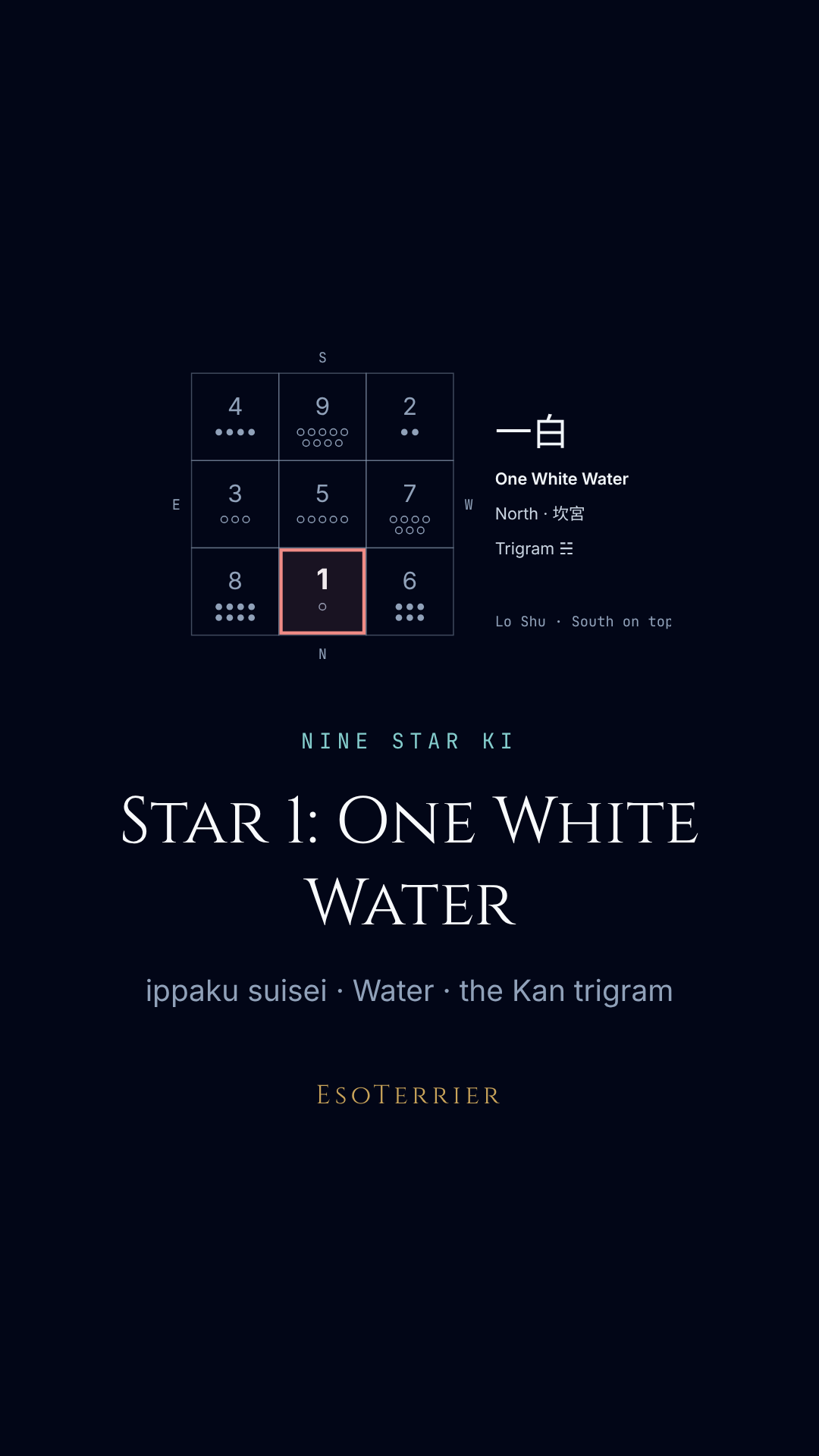
One White Water stands at the foot of the square, in the north, the place the Shuogua gives to the 坎 trigram. The Shuogua's circuit of the year ends there: "勞乎坎", it says, the labours of the year come to 坎, the trigram of water where all things return to rest. Its family role is the middle son, and by its place in the circuit its season is winter.
Japanese practitioners read a person whose year star is 一白 as flexible and adaptable, someone who gets on with almost anyone and is reserved about their own feelings, with a nervous streak under the calm; some add that the type finds its way late, by steady effort rather than a quick start. Our own text puts it as water in the dark: perceptive and emotionally intelligent, a deep listener who keeps much in reserve, with inconsistency, secrecy and withdrawal as the shadow side. The Kushi line in the West calls the same number 1 Water and gives it winter, midnight and a season of rest, study and reflection, a modern reading of the same circuit rather than a Japanese one.
The tradition reads the year star as the core character; the same star as a month star is read as the inner nature, and as a day star as the day-to-day tendency.
On the boards
一白 is the star of the solar years 1990, 1999, 2008, 2017 and 2026, each counted from 立春, about 4 February; a person born in January of one of those years has the previous year's star. In a 一白 year the first solar month, from 立春, has the star 八白, and the months count down from there, so a 一白 person born in the 酉 month, from 白露 in early September to 寒露 in early October, has 一白 as their month star too: the centre case of the inclination, 中宮傾斜.
For every other month star the inclination is a palace of its own. With the month star in the centre, a 一白 year star lands in 巽宮 (month star 2), 震宮 (3), 坤宮 (4), 坎宮 (5), 離宮 (6), 艮宮 (7), 兌宮 (8) or 乾宮 (9). The synthetic person we test with, born in June 1990, has month star 4 and so the inclination 坤宮.
On the boards of any year, month or day, the palace where 一白 stands is the 一白 person's house for that period. Its home palace, 坎宮, is the first house of the nine-step rhythm, which the tradition reads as the low phase, a time for rest, hidden work and planning; in 2026, when 一白 itself is in the centre, the house of every 一白 person is the centre, the position the tradition calls blocked in all eight directions.
The tradition counts a direction auspicious for a 一白 person where a star stands that supports Water: 六白 or 七赤, whose Metal generates Water (生気), or 三碧 or 四緑, the Wood that Water generates (退気). No other Water star exists, so there is no 比和. These are the tradition's readings, which we show with their names; we do not advise a journey or a move.
The trigram's classical correspondences
The Shuogua, one of the commentaries of the Yijing, gives each trigram a family member, a part of the body and an image of nature. For 坎 it gives:
- Family member: the middle son (中男).
- Part of the body: the ears (坎為耳).
- Image: water (坎為水); Legge's translation lists ditches and channels, what is hidden, and the moon among its further images.
- Polarity of the trigram: yang, as one of the three sons.
These are symbols of the trigram in a classical text, given here as such. They are not statements about anyone's body, and the star's own yin or yang is not stated in any source we found.
Names
The Japanese name reads ippaku suisei: 一 one, 白 white, 水 water, 星 star. The Traditional Chinese form is the same; Chinese feng shui also calls it 一白貪狼星, after 貪狼, the first star of the Northern Dipper, whose name the Sui-dynasty 五行大義 records. The trigram is read Kan in Japanese and Kǎn in Chinese; its pairing with the number 1 goes back to Zheng Xuan's Han commentary on the Qian zuo du, which starts the spirit Taiyi's round of the nine palaces at 坎. The doubled trigram is hexagram 29 of the I Ching.
Correspondences
Each item with how it stands: “sourced” is in the work cited, “our construction” is EsoTerrier’s own, and “disputed” means the sources disagree.
- Season in the Later Heaven circuit
- Winter, by its place in the north: the Shuogua's trigram where all things return to rest sourced
- The Kushi line's season and hour
- Winter and midnight; a modern Western reading of the same circuit sourced
- Character taught in Japan
- Flexible and adaptable, with a nervous streak; often finds its way late, by steady effort sourced
- Chinese Dipper name
- 貪狼, the first star of the Northern Dipper; a name only here sourced
- Our one-line image
- Water in the dark our construction
- Our reading of its house
- The low phase, read as a time for rest, hidden work and planning our construction
- Yin or yang of the star itself
- No source gives one; only the trigram's polarity (yang) is classical, and our old engine's "yin" was dropped disputed
How the schools read it
- Japanese 気学
- Flexible and adaptable, able to get on with anyone, reserved about their own feelings.
- The Kushi line
- "1 Water": winter and midnight, a season of rest, study and reflection.
- Chinese feng shui (Xuan Kong)
- Names the number 一白貪狼星 and reads it for the sectors of a building over time; those readings are not about people and are not shown here.
- Eight Mansions feng shui
- A Kua number of 1 is the 坎 life trigram, from a formula that differs for men and women: a different number from the year star.
- EsoTerrier
- Water in the dark: perceptive, a deep listener who keeps much in reserve, with inconsistency and withdrawal as the shadow side.
Claims about it
-
One White Water is a star in the sky that shapes people born under it.
falseWhat the record shows: It is the number 1 of the Lo Shu with its colour and phase. "Star" is a counting name; nothing astronomical is computed beyond the Sun's longitude for the calendar.
-
一白 is a yin star.
unverifiedWhat the record shows: Our old engine said so, and other lists say the opposite. No Japanese source gives the star a polarity; the Shuogua makes its trigram, 坎, a yang one.
-
The star rules parts of the body and shows what its people must guard against.
unverifiedWhat the record shows: The Shuogua gives the 坎 trigram a body part as a symbol, and the Western books turned that into lists for the stars. We show the symbol only in the trigram's own block.
-
Midnight is the traditional hour of 1 Water in Japanese kigaku.
unverifiedWhat the record shows: The hour comes from the Kushi line's macrobiotic reading, not from a Japanese source. Winter follows from the north's place in the Shuogua's circuit.