Meaning
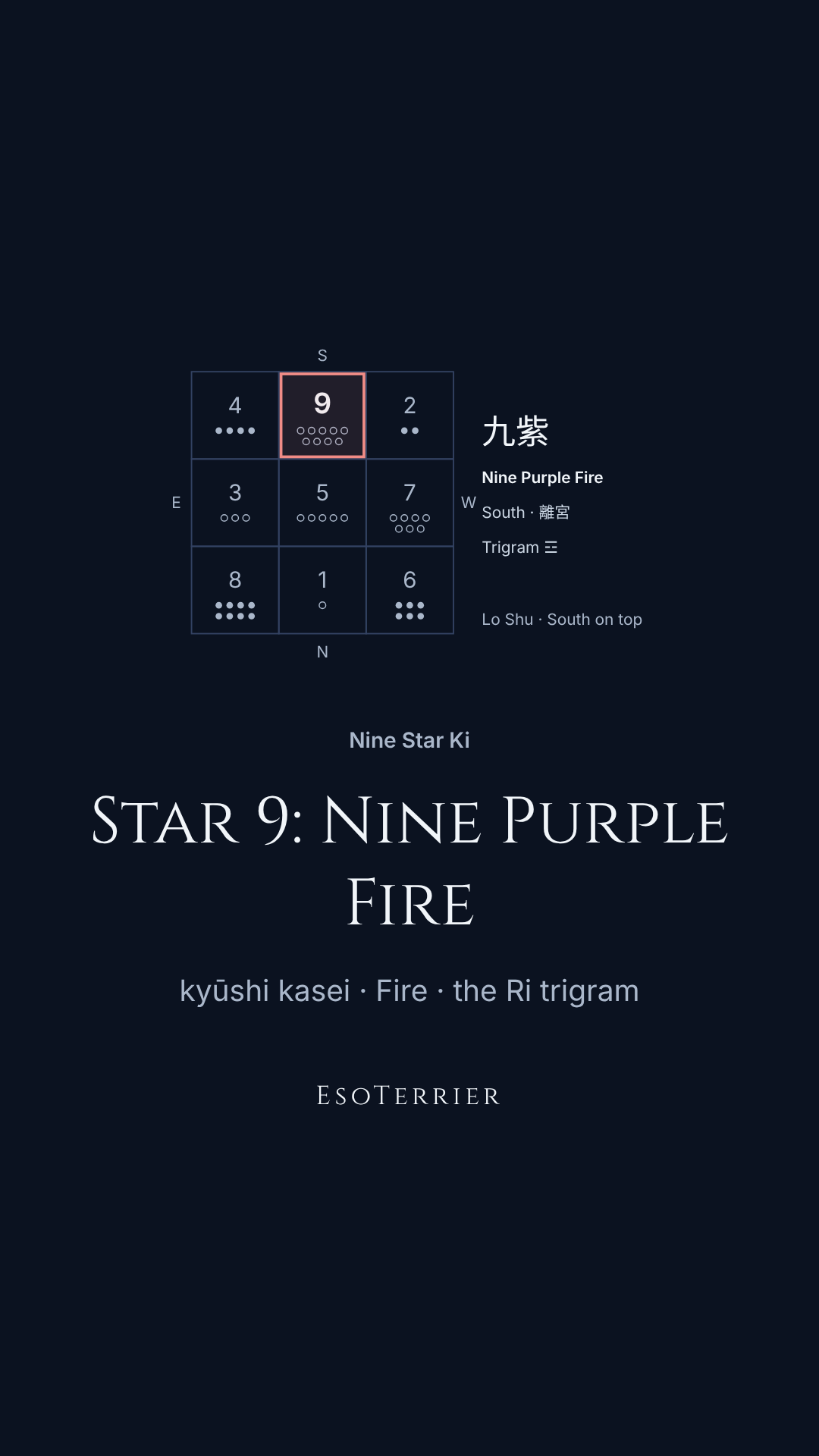
Nine Purple Fire stands at the top of the square, in the south, the place of the 離 trigram, fire and the sun. The Shuogua makes it the trigram of brightness: "相見乎離", in 離 all things see one another, and it adds that the sage faces south when he gives audience, turning toward the light to govern. Its season is summer, and its family role is the middle daughter.
Japanese practitioners read a person whose year star is 九紫 as sensitive and perceptive, with an aesthetic sense and a gift for seeing through things, and say the type does best in a specialised field. Our own text calls it fire at noon: bright, perceptive and passionate, an illuminator who sees clearly and shows others, drawn to beauty and recognition, with impulse, exposure and volatility as the shadow side. The Kushi line calls the number 9 Fire and gives it summer, noon and the themes of activity and brightness.
North and south face each other across the square: 九紫 at the top and 一白 at the foot, fire and water, the two stars with no other star of their phase.
On the boards
九紫 is the star of the solar years 1982, 1991, 2000, 2009 and 2018, each from 立春. In a 九紫 year the first solar month has the star 五黄, so a 九紫 person born in the 未 month, from 小暑 in early July to 立秋 in early August, has 九紫 as their month star too, and the inclination falls on the centre.
With any other month star in the centre, a 九紫 year star lands in 巽宮 (month star 1), 震宮 (2), 坤宮 (3), 坎宮 (4), 離宮 (5), 艮宮 (6), 兌宮 (7) or 乾宮 (8).
The south palace is the ninth and last house of the nine-step rhythm, which the tradition reads as the bright phase, a time of visibility, clarity and partings. The tradition counts a direction auspicious for a 九紫 person where 三碧 or 四緑 stands, the Wood that generates Fire (生気), or where 二黒 or 八白 stands, the Earth that Fire generates (退気); there is no other Fire star, and 五黄 is never counted. We show these as the tradition's readings and advise no journey.
九紫 also marks the turn of the day chart. From the 甲子 day nearest the summer solstice, the Japanese day chart counts down from 九紫, the descending run called 陰遁, until the 甲子 nearest the winter solstice starts the count up again from 一白.
The trigram's classical correspondences
The Shuogua's lists for 離:
- Family member: the middle daughter (中女).
- Part of the body: the eyes (離為目).
- Image: fire (離為火); Legge's translation adds the sun, lightning, a coat of mail and the tortoise among its images.
- Polarity of the trigram: yin, as one of the three daughters.
These are the trigram's symbols in a classical text, nothing more. They are not statements about anyone's body, and no source we found gives the star itself a yin or yang.
Names
The Japanese name reads kyūshi kasei: 九 nine, 紫 purple, 火 fire, 星 star. The Traditional Chinese form is the same; Chinese feng shui also calls it 九紫右弼星, after 右弼, the right-hand helper that later lists add to the seven stars of the Northern Dipper. The trigram is read Ri in Japanese and Lí in Chinese; Zheng Xuan's commentary ends the spirit Taiyi's round of the palaces at 離. Its doubled form is hexagram 30 of the I Ching.
Correspondences
Each item with how it stands: “sourced” is in the work cited, “our construction” is EsoTerrier’s own, and “disputed” means the sources disagree.
- Season in the Later Heaven circuit
- Summer: the south, the trigram of brightness, where the Shuogua says all things see one another sourced
- The Kushi line's season and hour
- Summer and noon, under the name 9 Fire; a modern Western reading sourced
- Character taught in Japan
- Sensitive, with an aesthetic sense; at its best in a specialised field sourced
- Place in the day chart
- The star the descending run (陰遁) starts from after the summer solstice sourced
- Chinese Dipper name
- 右弼, the right-hand helper of the Northern Dipper; a name only here sourced
- Our one-line image
- Fire at noon our construction
- Our reading of its house
- The bright phase, read as a time of visibility, clarity and partings our construction
How the schools read it
- Japanese 気学
- Sensitive and aesthetic, perceptive and quick to see through things; does best in a field of its own.
- The Kushi line
- "9 Fire": summer and noon, activity and brightness.
- Chinese feng shui (Xuan Kong)
- Names the number 九紫右弼星 and reads it for the sectors of a building over time; that reading is not a trait of people and is not shown here.
- Eight Mansions feng shui
- A Kua number of 9 is the 離 life trigram, from a formula that differs for men and women: a different number from the year star.
- EsoTerrier
- Fire at noon: bright, perceptive and passionate, an illuminator drawn to beauty and recognition, with impulse, exposure and volatility as the shadow side.
Claims about it
-
九紫 is a yang star.
unverifiedWhat the record shows: Our old engine said so. No Japanese source gives the star a polarity, and the Shuogua makes its trigram, 離, a yin one, as the middle daughter.
-
The Chinese flying-star reading of 九紫 describes the people born under it.
disputedWhat the record shows: In Xuan Kong that reading belongs to the number in a sector of a building for a period. We show only the Chinese name.
-
Nine Purple Fire rules a part of the body.
unverifiedWhat the record shows: The Shuogua gives the 離 trigram a part of the body as a symbol. We give it only in the trigram's block.
-
Nine Purple Fire is a star in the sky.
falseWhat the record shows: It is the number 9 of the Lo Shu with its colour and phase; "star" is a counting name.